Most advice on how to ask for the job is lazy. It gives you a polished closing line and pretends the line is the win.
It isn't.
A closing line without a case behind it is just a stranger asking for a favor. That's why so many smart professionals freeze at the end of interviews. They waited to be judged instead of leading the conversation. Then they try to fix that in the last thirty seconds.
The better approach is simpler. Build belief first. Ask second. If your interview has been a clear story about the problems you solve, the ask won't feel pushy. It'll feel obvious.
Stop Waiting to Be Picked
The biggest mistake isn't being too aggressive. It's being too passive.
A lot of experienced professionals walk into interviews with a school mindset. Answer the question. Be polite. Don't interrupt. Hope the panel connects the dots. That's a bad strategy if you want to get hired for work that matters.
There's also a real psychological block here. A HiringThing roundup notes that fear of overt asking stops many candidates from asking at all, and only 12% of job seekers know how to structure an informational interview to uncover hiring needs without directly asking (HiringThing job application statistics). That's the gap. People aren't short on ambition. They're short on method.
Stop thinking, “How do I ask without sounding desperate?”
Start thinking, “Have I made it easy for them to see me doing this job?”
If you're serious about moving up, this same shift applies beyond interviews. Clear self-advocacy matters in promotions too. If you're also thinking about advancing your executive career, the core idea is the same. Don't wait for people to infer your value. State it cleanly.
One more hard truth. Mid-to-senior professionals often undersell themselves before the interview even starts. If your application reads like a list of duties, you've already made the conversation harder. That's why it helps to study examples of job applications that stand out. The interview close starts on the page.
What bad advice gets wrong
Most popular advice says something like:
- Just be enthusiastic: “I'm very excited about this role.”
- Ask directly: “So, do I have the job?”
- End politely: “I hope to hear from you soon.”
None of those lines is the problem. The problem is using them without earning them.
A weak interview plus a strong closing line is still a weak interview. The ask only works when it feels like the natural result of the conversation.
Build Your Case Before You Ask
Your interview is not a personality test. It's a live argument for why hiring you solves a problem.

That means every answer should do one thing. Connect a concrete piece of your past to a concrete need in their future.
SHRM-backed guidance cited in the verified data is blunt on this point. Candidates who embed a concise STAR anecdote with a result tied to the job's top KPI achieve a 78% offer acceptance rate in technical roles, versus 32% for those who do not (SHRM). The lesson isn't “memorize STAR.” The lesson is “show business impact, not activity.”
Turn answers into proof
If they say, “We need someone who can steady a messy cross-functional process,” don't answer with vague confidence.
Say something like:
“That's familiar. In my last role, product, ops, and finance were working from different assumptions. I pulled the workflow into one review cadence, tightened handoffs, and gave leaders one source of truth. The result was faster decisions and fewer avoidable escalations. That's why this role makes sense to me.”
That works because it does three things fast:
- Matches their pain point
- Shows your action
- Ends with a result they can picture
If English interviews add extra friction for you, it helps to practice how you phrase impact, not just your grammar. This guide on how to succeed in English job interviews is useful for tightening that part.
Use your resume like source material
Your resume shouldn't be a separate artifact from the interview. It should be your evidence file.
That's where a lot of candidates fail. They know what they did, but they can't say it cleanly. If that sounds familiar, read this on how to talk about your work. It's the same muscle you need in the room.
Practical rule: If an interviewer describes a challenge, answer with, “That sounds similar to a situation where I...” and then give a short STAR story.
A simple before-and-after example
| Weak answer | Strong answer |
|---|---|
| “I'm good at stakeholder management.” | “In my last role, I inherited a project with conflicting stakeholder priorities. I reset ownership, created a shared review process, and got decisions moving again. That's the kind of operating problem I'd expect to help solve here.” |
| “I've led teams before.” | “I've led teams through change when expectations were unclear. My job was to create focus, remove ambiguity, and keep delivery steady. From what you described, that seems relevant here.” |
| “I'm interested in this opportunity.” | “The role lines up with work I've already done well, especially where teams need clearer execution and stronger cross-functional alignment.” |
That's how you earn the close. You stop sounding like an applicant and start sounding like a useful hire.
The Direct Ask Scripts and When to Use Them
Once the conversation has done its job, the close should be direct.
Not dramatic. Not cheesy. Not needy.
Use a Structured Close. The verified data says candidates who use a Structured Close, meaning they validate value alignment before asking, secure job offers 2.5 times more frequently than people who rely on generic pleas. It also notes the common Ambiguous Close has a less than 10% success rate in competitive markets.
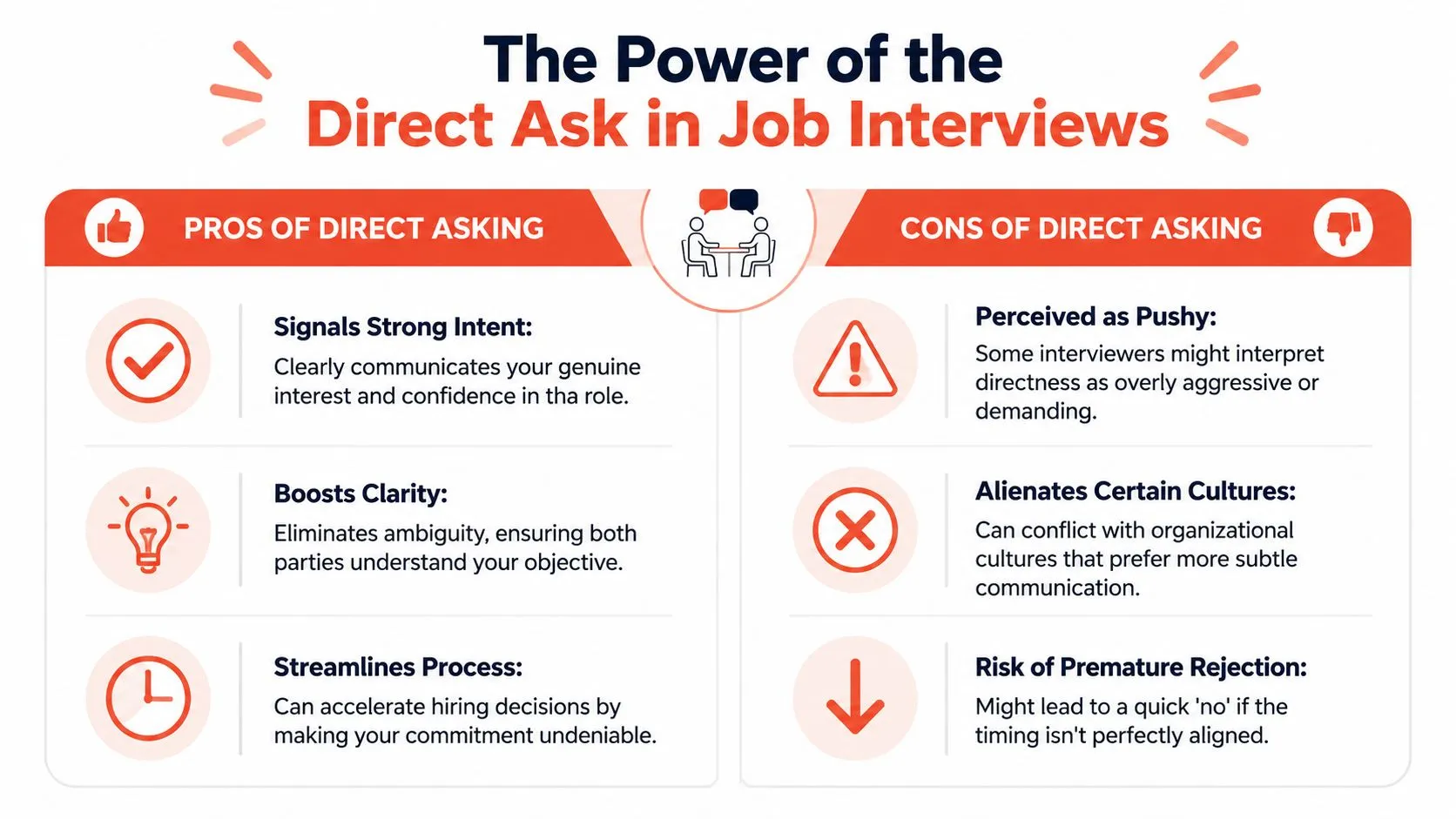
The pattern is simple:
- State the alignment
- Check that they see it too
- Ask for the next step
The weak close versus the strong close
| Weak | Strong |
|---|---|
| “I hope you consider me.” | “From what we discussed, my background in fixing cross-functional execution issues lines up with what this team needs.” |
| “I'm very interested.” | “It sounds like the role needs someone who can bring structure, judgment, and momentum quickly.” |
| “Let me know if you need anything else.” | “If you see that fit as well, I'd like to move forward to the next step.” |
The weak version asks them to do all the interpretation. The strong version does the synthesis for them.
A quick visual example helps here.
Scripts by career level
Senior leader script
Senior people shouldn't sound tentative. You're not asking for permission to exist.
Try this:
“Based on what you've shared, this role needs someone who can bring clarity, align stakeholders, and drive execution without a lot of hand-holding. That matches the work I've done repeatedly. Does that line up with what you're looking for? If so, I'd like to move ahead in the process and discuss how I can help your team deliver on those priorities.”
Mid-level professional script
This is the sweet spot for a collaborative close.
“The problems you described are close to the work I've handled before, especially around improving process, communication, and accountability. Does that feel aligned from your side? If it does, I'd love to move to the next step and continue the conversation about joining the team.”
Earlier-stage professional script
You can be energetic without sounding lightweight.
“I'm excited because the role connects directly to the kind of work I've already started doing well. I can see where I'd contribute quickly, especially on the priorities we discussed. If you agree there's a fit, I'd love the chance to move forward.”
When to use each version
- Use the senior script when the interviewer is evaluating judgment, ownership, and leadership range.
- Use the mid-level script when the role depends on collaboration and reliable execution.
- Use the earlier-stage script when potential matters, but you still need to sound grounded.
- Do not use any script if you haven't built a case yet. Ask better questions first, then close.
Your ask should sound like a conclusion, not a wish.
The transition line that keeps it smooth
The struggle isn't with the ask itself; rather, it's with the transition into it.
Use one of these:
- After discussing challenges: “What you described lines up closely with work I've done before.”
- After your final question: “Hearing that, I'm even clearer on where I could help.”
- At the end: “Before we wrap, I want to be direct about my interest.”
That's enough. You don't need theater.
Your Follow-Up Is Another Chance to Close
Your interview does not end when the call ends.
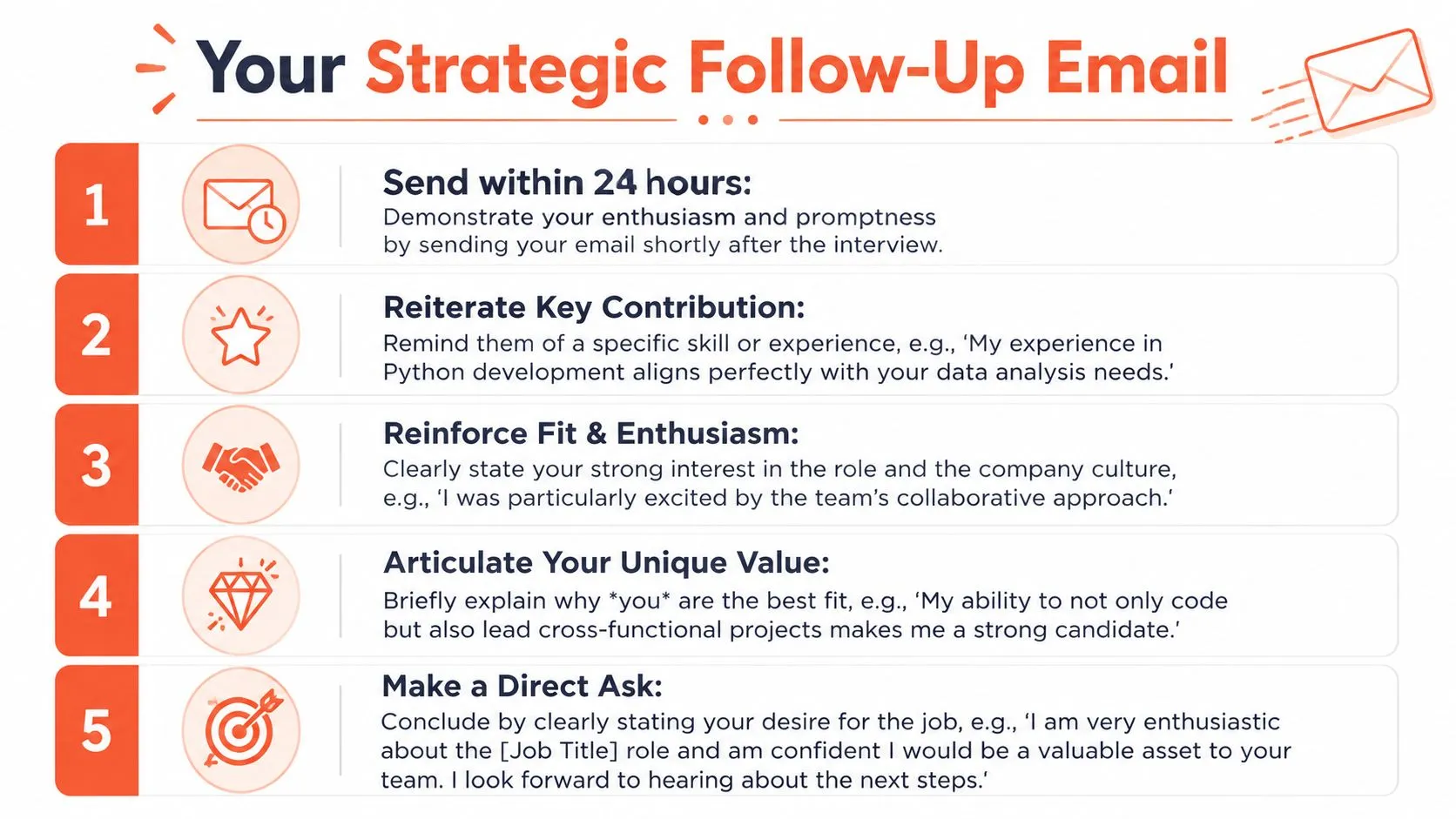
The follow-up is where a lot of candidates waste a real advantage. They send a courtesy note, call it professionalism, and miss the point. A good follow-up does one job. It reminds the hiring team why saying yes to you is the logical decision.
“Thanks for your time” is fine for manners. It does nothing to close.
Use the email to continue the case you already built in the interview. Bring back one concrete problem they mentioned. Tie it to relevant work you've done. Then state your interest plainly. That is what makes the message useful.
What to include
Keep it tight. Three parts are enough.
- Name one specific point from the interview: A challenge, priority, or metric they care about.
- Connect your experience to that point: Show how you've handled something similar, with a clear result.
- Close with intent: Say you want the role and would like to continue in the process.
If you want extra examples of writing effective follow up emails, study the structure, not the wording. Copying someone else's phrasing is lazy. You need your own facts.
The same rule applies across your whole application. This guide to writing a strong job application email makes the point well. Generic messages get ignored because they ask the reader to do the work.
A follow-up template that works
Subject: Thank you and next steps
Hi [Name],
Thanks again for the conversation today. I appreciated hearing more about your focus on [specific challenge or priority].
That stood out because it connects directly to work I've done before. In my last role, I [briefly describe relevant action] and helped [brief result]. I can see a clear way to bring that same kind of contribution to this role.
I'm very interested in the opportunity and would welcome the chance to continue in the process.
Best,
[Your Name]
A strong follow-up is not paperwork. It is your written closing argument.
What to cut
Do not send any of this:
- A generic thank-you: It is polite and forgettable.
- A long recap of your career: They already interviewed you.
- A hard sell: Pressure reads as poor judgment.
One more rule. Send the note while the conversation is still fresh, but do not rush so hard that you send fluff. Specificity beats speed if you have to choose.
How to Handle Their Response or Silence
This part tests your posture.

You asked clearly. You followed up well. Now they say, “We're speaking with a few more candidates,” or worse, they say nothing.
Don't spiral. Stay useful and stay professional.
The BLS data matters here. Job seekers who secure at least one interview have a 37% probability of receiving a job offer (U.S. Bureau of Labor Statistics). The interview gives you a real chance. But that chance still needs follow-through.
If they say they're interviewing others
That's normal. It isn't a coded rejection.
Reply like this:
“That makes sense. I appreciate the update. After our conversation, I'm confident I can help with the priorities we discussed, so I'd be glad to stay in the process. Please let me know if anything else would be helpful from my side.”
That answer does two things. It respects the process, and it demonstrates your value.
If they go silent
Silence is annoying. It is not a strategy cue for panic.
Use a simple sequence:
- Wait reasonably: Give them time to run their process.
- Send one concise follow-up: Reference the interview and restate interest.
- If there's still no response: Move on while keeping the door open.
Try this:
“Hi [Name], I wanted to follow up on our conversation and reiterate my interest in the role. I enjoyed our discussion about [specific topic], and I remain confident I could contribute in that area. If there's an update on timing or next steps, I'd appreciate it.”
Mistakes that wreck your leverage
- Over-messaging: Repeated nudges make you look rattled.
- Reading delay as rejection: Hiring processes are often messy.
- Accepting weak terms from fear: Interest is good. desperation is expensive.
- Dropping the thread entirely: If you want the job, act like it.
Reality check: A slow process is frustrating. It isn't proof that you should abandon your standards.
If they reject you, ask one useful question. “What was missing relative to the role?” Then stop. Don't argue. Don't beg for reconsideration. Take the data and leave with your reputation intact.
The Ask Is the End of Your Story
Asking for the job isn't a trick line. It's the last sentence of a well-told story.
If the ask feels awkward, the story was probably weak. If the story is clear, the ask feels earned. You showed the problem, proved the match, checked alignment, and made the next step easy.
That's the answer to how to ask for the job. Don't search for magic words. Build a case so strong that asking becomes the obvious next move.
StoryCV is a Digital Resume Writer built for people who've done strong work but struggle to say it clearly. It uses editorial judgment at software speed to turn your experience into a sharp, believable career story, so your applications sound like you on your best day, not like a template filled with keywords.