Most letter of interest advice deserves to be ignored. It tells you to sound eager, compliment the company, and package your background in polite business prose. That approach fails because it treats the letter like a softer cover letter instead of what it really is: cold outreach to a busy decision-maker.
A strong letter of interest works as an unsolicited business pitch. Your job is not to announce that you exist. Your job is to show that you spotted a meaningful bottleneck and can help fix it. The company is not asking for you, so generic enthusiasm has no value.
That changes how you write from the first line. You lead with relevance, not admiration. You write to the business problem, not your personal goals. You make the reader feel understood before you ask for any conversation.
Keep it tight. A short letter wins because busy people skim cold outreach fast, judge it even faster, and reply only when the message feels specific enough to be useful. The same logic that helps communicators improve PR email open rates applies here. Specificity gets attention. Flattery gets deleted.
Why Your Letter of Interest Gets Ignored
Ignored letters usually fail before the second sentence.
The problem is not formatting. It is posture. The writer shows up like an applicant asking for a chance, instead of a useful outsider who noticed a business issue worth discussing. Busy operators can smell that difference fast.
Three habits cause the delete.
First, the letter centers your desire. Lines like “I've admired your company for years” or “I'd be honored to contribute” announce need, not value. They create work for the reader because now they have to figure out why you matter.
Second, the letter copies cover-letter logic. It drags in polished filler, broad claims, and career-summary paragraphs built for an open role. In cold outreach, that reads like camouflage. If you want practical ways to stand out in job applications, use them in the right place. A letter of interest is a different tool.
Third, the letter repeats the resume. That is dead weight. Titles, responsibilities, and stock strengths belong in the document attached below your message, not in the pitch itself.
What a bad letter tells the reader
A weak letter of interest signals three things:
- You studied the brand, not the business: You can repeat slogans, but you did not spot friction, risk, or missed opportunity.
- You are asking for attention: The message is built around your goals, your background, and your interest.
- You sent a template: Swap the company name and the letter still works. That is exactly why it gets ignored.
Specificity changes the reaction. A generic note feels like inbox tax. A sharp note earns a second look because it gives the reader a reason to care now.
That is why standard customization advice falls short. Using the right name matters. Clean formatting matters. Subject lines matter too, and the same principles that help communicators improve PR email open rates apply here. But those are delivery mechanics. They do not fix weak positioning.
The frame that gets replies
Treat the letter as a short business pitch. You are not introducing yourself to the company. You are presenting a point of view about something the company may need to fix, improve, or handle better.
That shift changes what the reader sees. Instead of another stranger asking for consideration, they see someone who understands pressure, priorities, and tradeoffs. Instead of vague enthusiasm, they get relevance. Instead of a personal summary, they get a useful observation tied to outcomes.
Your goal is simple.
Make the reader think, “This person gets what is happening here.”
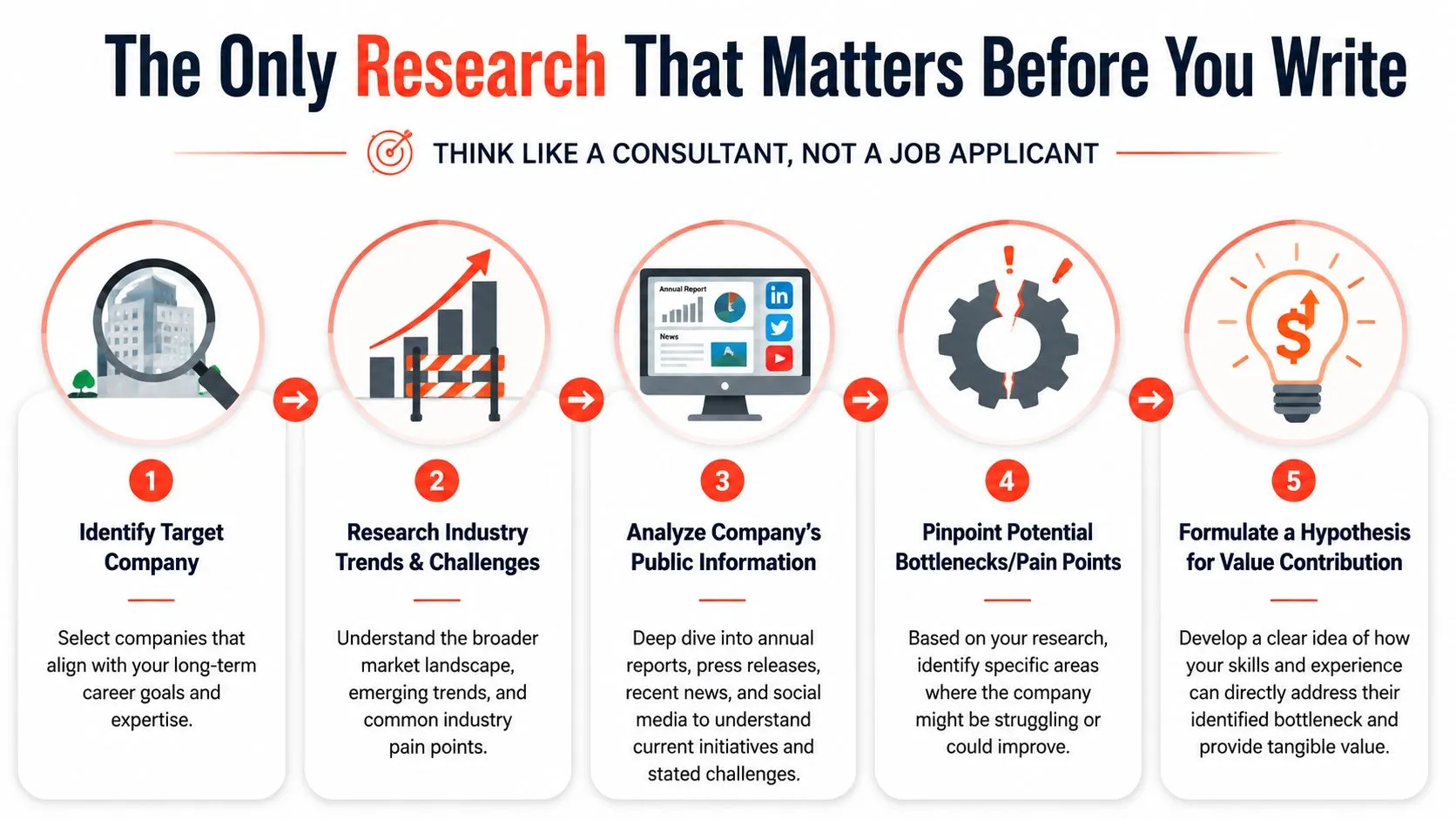
The Only Research That Matters Before You Write
Stop collecting trivia.
A letter of interest lives or dies on one thing: whether you can spot a business problem the company is likely dealing with right now. The About page will not give you that. Brand language is sanitized. Pressure shows up elsewhere.
Diagnose the bottleneck
Look for evidence of strain, transition, or missed opportunity. Start with these five areas:
-
Recent product changes
New pricing, a self-serve launch, a redesign, or a push into a new segment usually creates downstream problems in onboarding, messaging, support, or conversion. -
Leadership communication
Founder posts, product updates, podcast interviews, event talks, and shareholder letters often reveal priorities, tradeoffs, and pressure points more clearly than the careers page ever will. -
Customer friction in public
Reviews, Reddit threads, support forums, release comments, and documentation gaps show you where the customer experience breaks down. -
Hiring patterns
A sudden cluster of roles in customer success, operations, analytics, or reliability is rarely random. It usually signals where the company is trying to patch weakness or add capacity fast. -
Competitive pressure
If a close competitor changed packaging, pricing, or go-to-market strategy, assume your target company is evaluating a response.
Use this rule: write to the bottleneck, not to the brand.
Turn research into a usable angle
Good research is narrow. You do not need a full company profile. You need one credible observation you can connect to your work.
Career guidance from the University of Cincinnati's letter of interest guide gets the basics right: address a real person, show you understand the organization, and connect your experience to its needs. Fine. That is the floor.
The useful move is sharper. Convert what you found into a business hypothesis the reader can recognize immediately.
| What you found | What it might mean | What you can say |
|---|---|---|
| New self-serve product | Onboarding or activation friction | “Your shift toward self-serve suggests early user activation now matters more than before.” |
| Expansion into a new market | Process strain across teams | “Expansion like this usually exposes handoff gaps between sales, ops, and delivery.” |
| Repeated support complaints | Messaging or UX confusion | “I noticed the same issue surfacing across reviews, support conversations, and onboarding touchpoints.” |
That is the standard. You are not proving interest. You are proving judgment.
If you want to sharpen that kind of differentiation across your wider materials, this guide on standing out in job applications with stronger positioning is useful because it forces you to make a real case instead of repeating generic strengths.
One more smart move. If the company is active on X, study the replies, quote posts, and recurring participants around its announcements. That is where product friction, buyer objections, and industry priorities show up in plain language. This walkthrough on discover your ideal audience on X is useful for the same reason. It helps you identify who shapes the conversation around the company, not just who runs the company account.
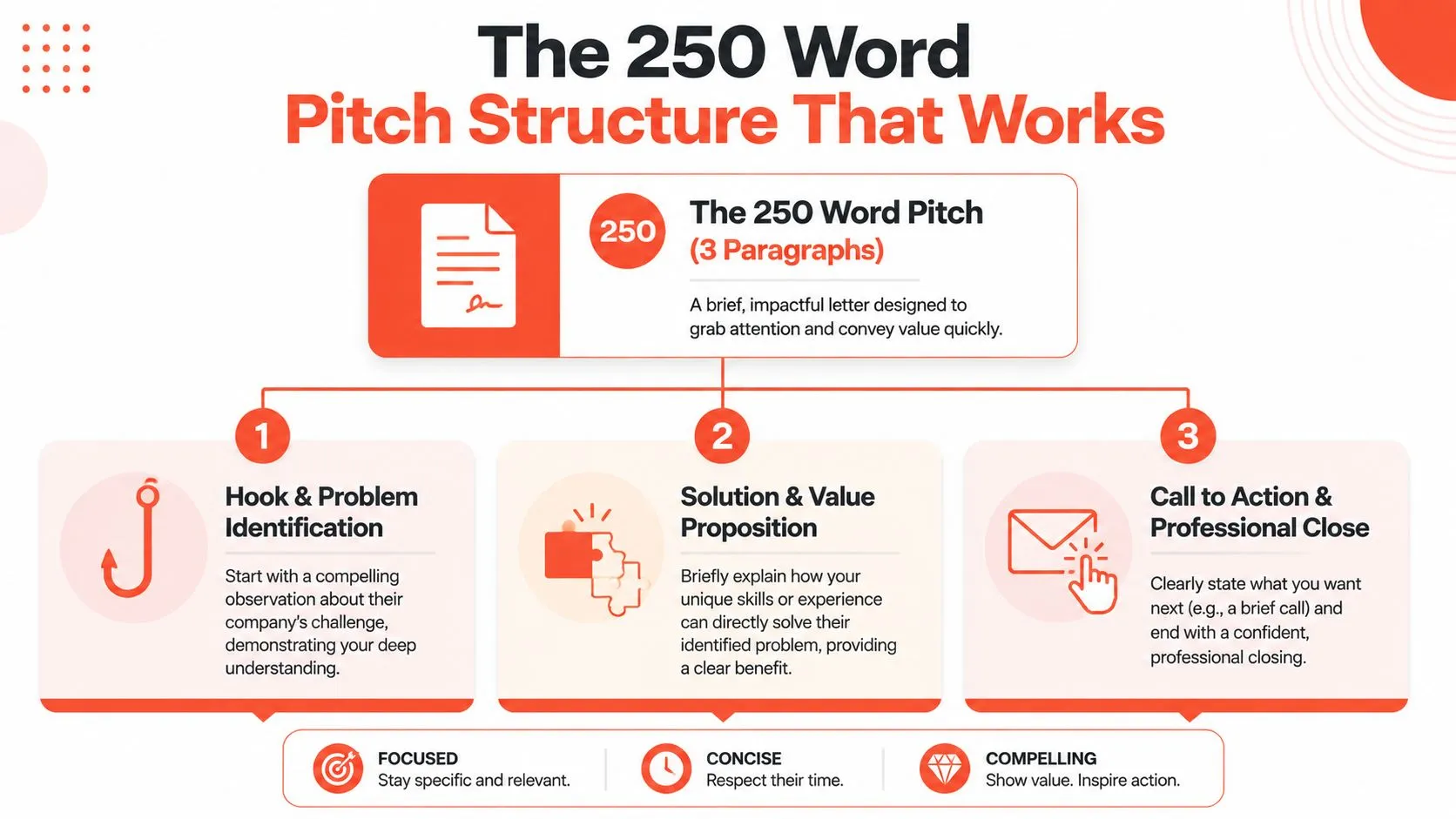
The 250 Word Pitch Structure That Works
A letter of interest fails when it reads like a mini cover letter. Nobody asked for your background summary. What gets attention is a tight unsolicited pitch that identifies a likely business problem, shows relevant pattern recognition, and makes an easy next step obvious.
Keep it short. Around 200 to 300 words is the standard for this format, as noted in Teal's guidance on effective letter of interest length. I'd tighten that further. Aim for 250 words because brevity signals judgment.
Paragraph one with a business observation
Your first lines carry the whole letter.
Weak opener:
I am writing to express my deep interest in your company, which is a leader in its industry.
That sounds like a template because it is one.
Use an observation with consequences:
Your push into self-serve likely increased trial volume, but it also appears to push too much decision-making onto users before they reach first value.
That works because it does three jobs fast. It shows you paid attention. It frames a bottleneck. It positions you as someone who can diagnose operating problems, not just apply for openings.
Paragraph two with relevant proof
Now earn the right to be taken seriously. Tie your experience to the exact issue you named.
Use two short lines. Keep the proof close to the claim.
- Weak proof: “I have extensive experience in cross-functional collaboration and project management.”
- Strong proof: “In my current role, I helped simplify onboarding during a similar shift by tightening handoffs between product, success, and lifecycle teams. My work focused on reducing early confusion, clarifying first actions, and improving adoption.”
If you have credible numbers, use them. If you do not, use scope, decisions, and outcomes. Strong business writing follows the same logic used in crafting effective executive summaries. Lead with relevance, cut background, make the commercial value obvious.
If you need help tightening this section so it sounds like a pitch instead of an application, study a few cover letter samples with stronger structure. Borrow the discipline, not the generic language.
Here's a video that reinforces the core idea of writing a direct, credible pitch rather than a bloated letter:
Paragraph three with a low-friction ask
Close like a consultant, not a candidate.
Ask for a brief conversation or offer to share a few observations. Keep the tone calm and specific.
- “If this is an active priority, I'd be glad to share a few observations.”
- “Open to a short conversation if this is a live issue for the team.”
- “Happy to send a brief note on the friction points I noticed.”
The full structure
| Paragraph | Job | What it should do |
|---|---|---|
| 1 | Hook | Name a specific business bottleneck or likely friction point |
| 2 | Proof | Show you have solved similar problems or worked in similar conditions |
| 3 | Ask | Suggest one easy next step with little commitment |
That structure works because it respects how busy decision-makers read. They scan for judgment, relevance, and risk. Give them all three in 250 words.
Letter of Interest Examples That Get Replies
Examples expose the difference between a cold note that sounds expensive and one that sounds unemployed.
Weak letters talk about interest. Strong letters diagnose a problem the company is already paying for, whether they have named it yet or not. That matters even more for career changers, returners, and early-career candidates. If your background is not a clean match, your argument cannot rely on job titles. It has to rely on judgment.
Use the examples below the same way you would study sample cover letters with stronger structure. Steal the discipline. Skip the recycled language.
Example for a mid-level professional
Hook
Dear Ms. Patel,
I noticed your push toward self-serve onboarding for mid-market accounts. That usually speeds up acquisition, but it also creates drop-off when activation steps, handoffs, and education are still built for high-touch support.
Proof
In my current operations role, I helped address that kind of transition by tightening the path between signup, customer success, and lifecycle messaging. My strongest work sits in the messy middle where new users stall before first value. I identify where friction starts, simplify the path, and help teams turn a promising product experience into a usable one.
Ask
If activation is a current priority, I'd be glad to send a few observations on where your onboarding flow may be losing momentum.
Sincerely,
[Name]
Example for a career changer
Hook
Dear Mr. Lewis,
Your expansion into regulated client environments stood out to me. The offer looks credible, but the buying journey still asks cautious buyers to make a trust leap too early.
Proof
I'm moving from enterprise compliance into B2B product marketing, but the work has been consistent. I reduce decision friction in high-scrutiny environments. For years, I've translated complex requirements into language buyers, legal teams, and internal stakeholders can act on. That skill applies directly when a company needs sharper proof, clearer process signals, and messaging that lowers perceived risk.
Ask
If that trust gap is on your team's radar, I'd welcome a short conversation or I can send a brief note with a few specific observations.
Best,
[Name]
Example for an early-career applicant
Hook
Dear Hiring Team,
I spent time reviewing your API documentation after your latest developer update. The product looks thoughtful, but the first-use experience asks new users to process too much before they get a quick win.
Proof
I'm early in my career, so I do not pretend to have a long list of big titles. What I do have is relevant pattern recognition. My coursework and independent product analysis have focused on onboarding clarity, technical communication, and developer experience. In project work, I've been strongest at spotting where dense systems create confusion and rewriting flows so users can act faster.
Ask
If useful, I'd be happy to send a short teardown of the first-run experience or talk briefly about what I noticed.
Regards,
[Name]
Read these examples closely and you'll notice a pattern. None of them ask for a chance to prove themselves. Each one presents a business issue, shows relevant judgment, and proposes a low-friction next step. A cover letter responds to an opening. A strong letter of interest responds to a bottleneck.
The No-BS Dos and Don'ts of Cold Outreach
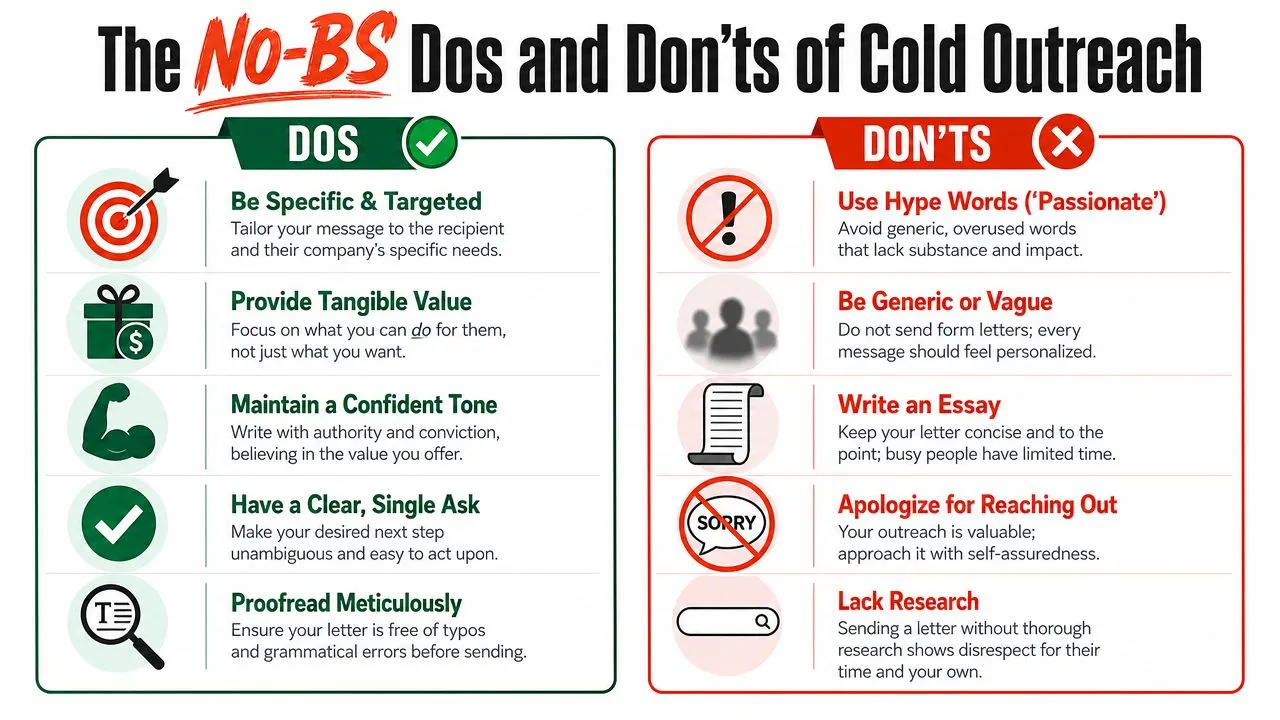
Tone decides whether your message sounds like a peer or a supplicant.
Do this
- Lead with an observation: Show that you noticed a change, a constraint, or a likely bottleneck.
- Sound like an adult: Calm language beats hype words every time.
- Make one ask: A short call, a brief reply, or permission to send a note.
- Use one useful proof point: A relevant outcome, project, or pattern from your past work.
Stop doing this
- Don't say you're passionate: That word has been emptied out by overuse.
- Don't praise the company like a fan account: Flattery without insight feels cheap.
- Don't attach your resume unprompted if the message itself is weak: The letter should earn the next step.
- Don't obsess over clever wording in the email subject before nailing the actual pitch: If you need help with subject line mechanics, these practical ideas for a subject for job application are a better starting point than guessing.
Real enthusiasm shows up as effort. You tested the product. You noticed the friction. You formed an opinion.
Your Final Polish and Follow Up Checklist
A weak finish ruins a smart pitch. Good candidates lose replies here because they slip back into job-seeker mode right before sending.
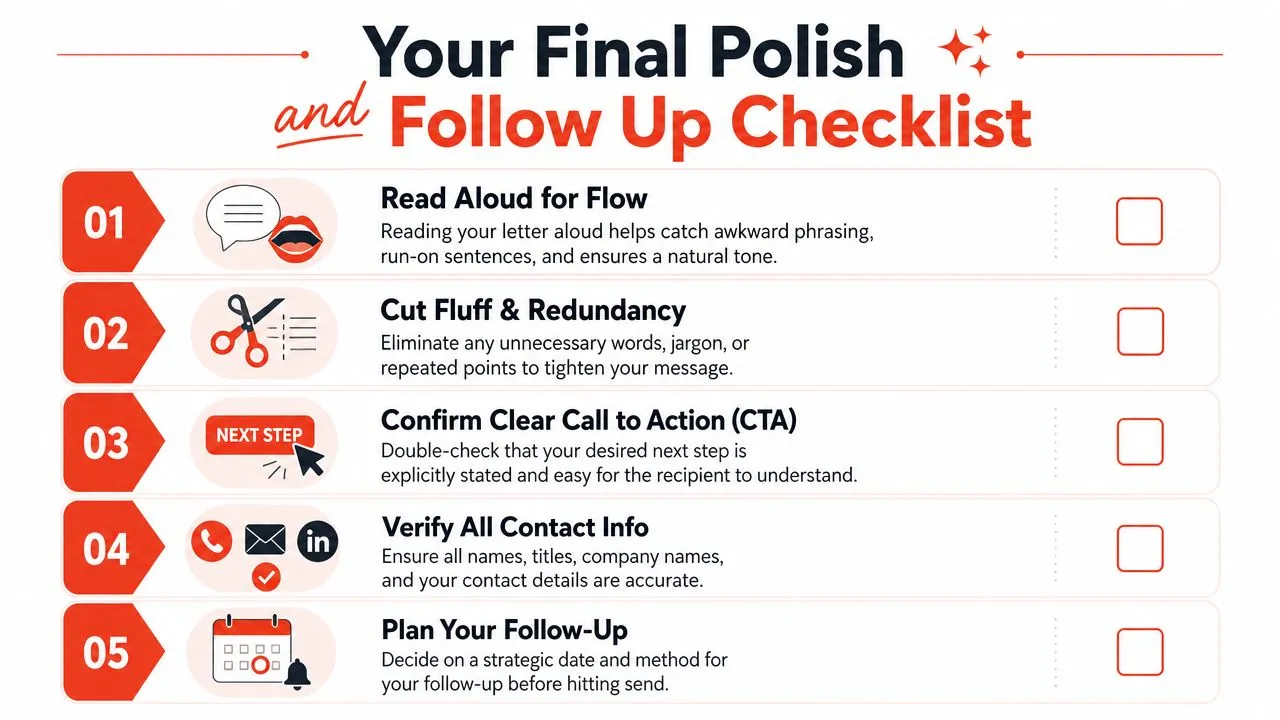
Your final pass should answer one question. Does this read like a useful outsider who spotted a business problem, or like someone hoping to be considered? If it sounds needy, vague, or inflated, fix it before it leaves your outbox.
Run this check before sending:
- Read it aloud: Clunky sentences sound rehearsed and insecure.
- Cut every sentence that exists to impress: Delete buzzwords, throat-clearing, and any line that repeats your value without proving it.
- Check the recipient details twice: Wrong names, titles, or company references signal careless outreach.
- Stress-test your core claim: Make sure your observation about the company is specific enough to feel real, not copied from a template.
- Keep the ask narrow: Ask for one small next step, not a call, feedback, and a referral all at once.
- Set your follow-up before you send: One short follow-up is enough. If there is no reply, move on.
The point of this article is simple. A letter of interest works when it acts like a cold business pitch. You are not asking a company to discover your potential. You are showing that you noticed a bottleneck, understand the stakes, and may be able to help.
If that still feels hard, the problem usually is not grammar. It is positioning. StoryCV helps turn messy experience into sharper professional narratives through a guided writing process, so you can explain your value without sounding generic.