The most popular lab technician resume advice is backwards. It tells you to collect keywords first and hope an ATS delivers your application to a human. But ATS compliance is only hygiene. The interview comes from proving that you improved a laboratory operation, protected result quality, reduced rework, increased throughput, or kept instruments and records reliable.
Clinical laboratory technologists and technicians formed a substantial U.S. occupation in May 2023, with 334,380 jobs and a mean annual wage of $62,870, according to the U.S. Bureau of Labor Statistics occupational employment data. That broad, structured market rewards resumes that show technical scope, credentials, and operational judgment. A list of duties won't separate you from candidates who performed similar work.
Why Most Lab Technician Resumes Get Ignored
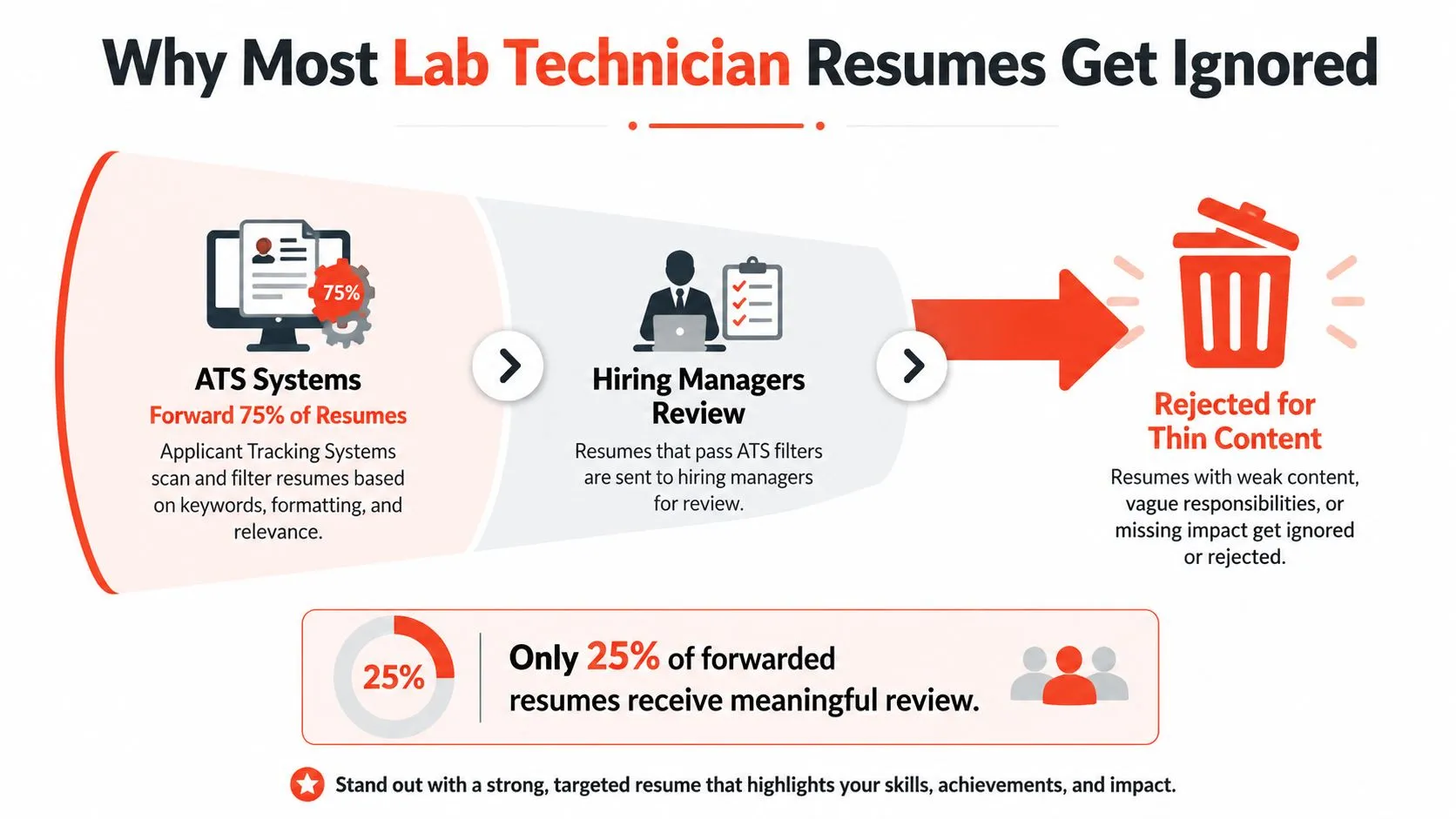
ATS isn't usually the final bottleneck for lab technician hires. A system may parse your resume successfully, identify the expected terms, and forward it to a recruiter. The recruiter then sees a document full of phrases such as “performed laboratory testing” and “maintained equipment,” but no evidence of what changed because you were there.
Broad resume research reports that about 75% of resumes are rejected before a recruiter sees them, while formatting problems can account for up to 25% of ATS rejections. Those figures come from the clinical laboratory technician ATS checklist. Fix parsing first, but don't mistake parsing for persuasion.
A hiring manager wants to understand your operating level quickly. Did you handle a heavy specimen queue? Did you improve turnaround time? Did you reduce repeat testing, instrument downtime, documentation errors, or contamination risk? Clinical and industrial candidates often blur together because their resumes describe activity instead of consequence.
Use the three-question audit
Run every bullet through these tests:
- Improvement: Would a hiring manager know what you improved?
- Bench reality: Can they picture you handling the samples, assays, analyzers, records, or investigations?
- Proof: Is there a number, scope marker, instrument, standard, or outcome that supports your contribution?
If every role fails all three, keyword stuffing won't rescue the document. A lab technician resume should read like a compact operational record, not a copied job description.
The BLS projects 2% employment growth from 2024 to 2034 and about 22,600 openings per year on average, despite growth being slower than the average for all occupations. The BLS outlook for clinical laboratory technologists and technicians also reports a $61,890 median annual wage in 2024 and says the occupation typically requires a bachelor's degree to enter. Stable demand doesn't make vague resumes acceptable. It makes clear differentiation more valuable.
The Format That Parses and Reads Cleanly
Treat formatting as a quality-control check. It should make your evidence easy to find, not compete with quantified operational impact.
Use a single-column, reverse-chronological layout. Place your name and contact details first, then use conventional headings such as Summary, Professional Experience, Skills, Certifications, and Education. Standard labels help software and hiring managers process the document, as described in standard lab technician resume section guidance.
Keep the design plain:
- Font: Choose Arial, Calibri, Helvetica, or Times New Roman at 10 to 12 pt, consistent with ATS-friendly fresher lab technician resume guidance.
- Structure: Use clear dates, aligned job titles, ordinary bullets, and enough white space.
- File: Save as PDF when the posting accepts it. Use DOCX when requested or when the application system handles Word files more reliably.
- Filename: Use
Firstname_Lastname_LabTechnician_2026.pdf, or another clear equivalent.

Remove anything that can break parsing
Keep contact details out of headers and footers. Avoid tables, text boxes, images, decorative icons, logos, columns, and text inside graphics. These elements can separate dates, hide keywords, or scramble reading order.
For a fresher, one page is the right default. Experienced professionals can use a second page when it proves relevant technical scope, especially across a long technical history. Cut old responsibilities that add no evidence.
ATS compatibility is hygiene. The interview case comes from clear results, reliable scope markers, instruments, methods, and outcomes. Clean formatting protects that evidence from being misread.
Turning Bench Work Into Bullets Hiring Managers Believe
A reliable bullet follows this pattern:
Action verb + task + tool or method + measurable result.
The formula isn't a cage. It's a way to force precision. “Responsible for ELISA testing” says almost nothing. “Ran ELISA assays using a plate reader, processing samples within the laboratory's defined workflow and documenting results in LIMS” gives the reader a real activity, but it still needs scale or outcome when you can provide it.
Use the transformation below as a model. The figures are placeholders for your own verified records, not numbers to copy.
| Weak Original Bullet | Rewritten Impact Bullet | Metric Added |
|---|---|---|
| Responsible for running ELISA assays | Ran [number] ELISA assays per [shift/week] using [plate reader or method], recording results in [LIMS] and maintaining [verified accuracy, repeat, or QC result] | Assay volume and quality outcome |
| Performed QC on chemistry analyzers | Performed daily QC on [analyzer name], investigated out-of-range controls, and documented corrective action to support [verified pass rate or reduced repeats] | QC result or repeat rate |
| Processed patient samples | Processed [number] patient specimens per [shift/day] in a high-volume core lab, prioritizing STAT work and meeting [verified turnaround-time measure] | Specimen volume and TAT |
| Calibrated HPLC instruments | Calibrated [HPLC model] with [method or standard], documenting [verified calibration pass rate] and escalating deviations through the approved procedure | Calibration outcome |
| Maintained chain of custody | Maintained chain of custody for [number or category] forensic specimens, reconciling transfers in [system] and preventing [verified discrepancy or rejected-sample result] | Specimen scope and discrepancy control |
| Troubleshot instrument downtime | Diagnosed [instrument issue] using [maintenance or troubleshooting method], restoring service and saving [verified downtime hours or delayed runs] | Downtime or recovery measure |
Reconstruct the evidence
You don't need perfect memory. Check laboratory logs, QA reports, maintenance records, batch records, turnaround-time dashboards, inventory files, and supervisor feedback. If you can defend an estimate and label it appropriately, use a cautious scope marker such as “approximately” rather than inventing precision.
Cut “responsible for,” “helped with,” and “worked on.” Replace them with processed, validated, calibrated, investigated, reconciled, maintained, trained, documented, or reduced. Then add the instrument, method, standard, workload, or result.
Practical rule: Three to five strong bullets per role beat a dense block of routine duties.
A useful guide to writing resume achievements can help you separate what you did from why it mattered. Your finished lab technician resume should tell a consistent operational story: you handled technical work, recognized problems, protected quality, and made the workflow more dependable.
The Skills and Certifications Section That Signals Competence
A flat skills list is easy to ignore. Divide yours into three technical blocks, then place certifications and licensure in their own section.
Core techniques might include PCR, ELISA, Gram staining, HPLC, titration, culture maintenance, specimen processing, and quality control. Instruments and platforms can name Roche cobas, Beckman DxH, Agilent ChemStation, or Sciex MassHunter. Software and regulatory knowledge may include Sunquest, Epic Beaker, LIMS, 21 CFR Part 11, GLP, ISO 17025, and HIPAA.
Don't list every tool you've touched. A hospital manager needs evidence of specimen handling, test performance, QC, LIS use, and compliance. An industrial or QC manager may prioritize method execution, calibration, deviation investigation, GLP, GMP, LIMS, and documentation discipline.
| Category | Clinical Lab Must-Have | Industrial / QC Lab Must-Have | Nice-to-Have for Both |
|---|---|---|---|
| Techniques | Specimen handling, PCR, ELISA, Gram staining, QC | Sample analysis, titration, HPLC, method execution, QC | Additional assay methods |
| Instruments | Roche cobas, Beckman DxH, automated analyzers | HPLC systems, plate readers, analytical instruments | Vendor-specific platforms |
| Systems | LIS, Sunquest, Epic Beaker, HIPAA workflows | LIMS, 21 CFR Part 11, electronic records | Excel or dashboard reporting |
| Standards | Clinical documentation and laboratory compliance | GLP, GMP, ISO 17025, deviation control | Audit participation |
| Credentials | Relevant clinical certification or state licensure | Relevant technical certification or training | Vendor training and badges |
For context on how standards shape laboratory operations, Herbilabs explains ISO lab standards in a practical overview. Use the credential block to show issuing body, credential number when disclosure is appropriate, and year. Don't bury an active certification inside a skills paragraph.
Replace vague soft skills with observable work. “Team player” becomes documented shift handoffs across benches, trained new technicians on SOPs, or supported method transfer to manufacturing. Add recent CEUs, vendor training, or a relevant badge when it supports the target role.
Your resume skills section should make competence scannable, then your experience bullets should prove those skills in use.
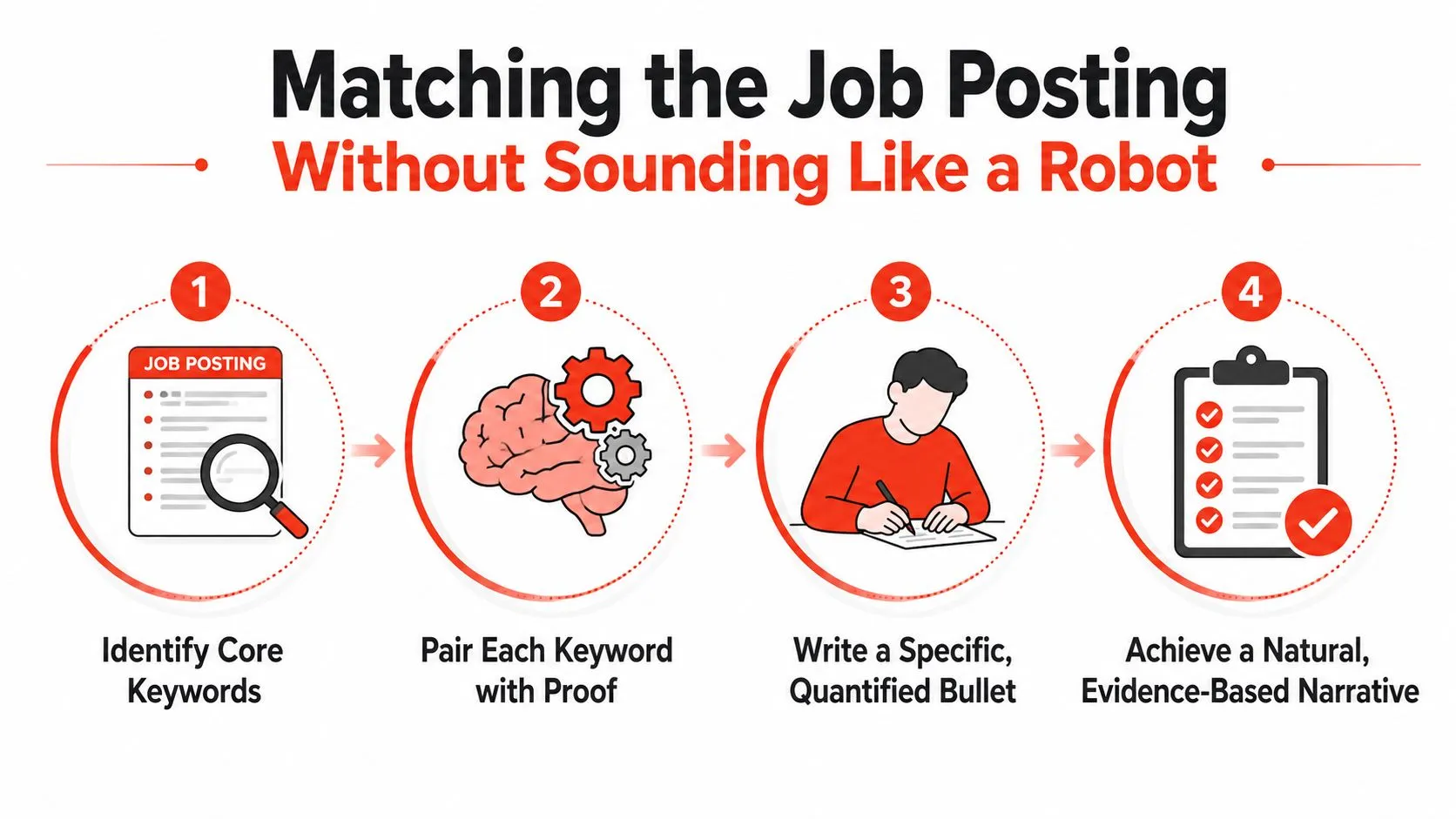
Matching the Job Posting Without Sounding Like a Robot
Mirroring a job posting is a hygiene check, not a strategy. The strategy is pairing each important phrase with evidence that a laboratory manager can verify.
Pull terms into four groups:
- Techniques: Western blot, qPCR, PCR-based testing, ELISA.
- Platforms: Liquid handlers, plate readers, automated analyzers, LIMS.
- Regulation: CLIA, CAP, GLP, GMP.
- Workflow verbs: Validated, qualified, investigated, calibrated, documented.
Then write one proof line for each cluster. If a posting emphasizes PCR-based infectious disease testing, CAP compliance, and high sample volume, “Performs PCR testing” is too thin. A stronger version would be: “Ran [verified weekly volume] PCR reactions under CAP procedures, investigated contamination events, and contributed to a redesigned workflow that reduced rework by [verified amount].”
The structure matters more than keyword density. Name the technique, show the setting or standard, and attach a scope or result you can defend. If the posting says “qualified,” don't claim qualification unless you performed or supported qualification work.
Watch the short video only as a supplement to your own review. It shouldn't replace reading the posting line by line.
Before saving the file, ask:
- Truth: Have I used only techniques and instruments I can discuss?
- Proof: Does each major keyword have a scope, result, or concrete example?
- Fit: Did I remove unrelated tools that dilute the target?
- Language: Do the phrases sound like my work, not pasted text?
Use this guide to tailoring a resume to a job description for the mechanics. The final document should sound like a capable technician, not a search engine trying to win a vocabulary contest.
Hybrid Lab Roles and Why Your Resume Should Prove Them
The modern lab technician often sits between the bench and the digital workflow. LIS configuration, LIMS records, instrument middleware, automation, inventory controls, scripting, and QC dashboards can matter as much as manual technique. Skill guidance for lab roles increasingly highlights LIS and LIMS, automated analyzers, calibration, and compliance, while the Enhancv lab technician resume guide emphasizes operational outcomes and broader capabilities such as quality management, project management, infection control, and training.
Don't hide hybrid work in a miscellaneous skills line. Put it under the relevant job, where the reader can see the problem, tool, and result together.
Strong structures include:
- System ownership: “Owned LIS order entry and result routing in Epic Beaker across multiple benches, reducing misrouted results by [verified amount].”
- Workflow automation: “Automated reagent inventory tracking in Excel with Power Query, replacing a manual log and improving [verified reconciliation or reporting outcome].”
- Data reconciliation: “Wrote a Python script to reconcile [verified number] monthly QC values, freeing [verified time] for review and investigation.”
- Instrument integration: “Supported automated analyzer connectivity with the LIS, resolving interface exceptions and documenting corrective actions.”
The bracketed fields matter. Never borrow attractive numbers from someone else's example. Pull yours from inventory records, QC exports, middleware logs, maintenance tickets, or manager feedback.
The strongest hybrid bullet answers three questions at once: What system did you use? What problem did it solve? What changed afterward?
This positioning helps a hiring manager see more than a technician who can execute a protocol. It shows someone who can trace a result through the workflow, spot where data or materials fail, and improve the handoff between people, instruments, and systems. That distinction is especially useful when clinical and industrial candidates appear similar on paper.
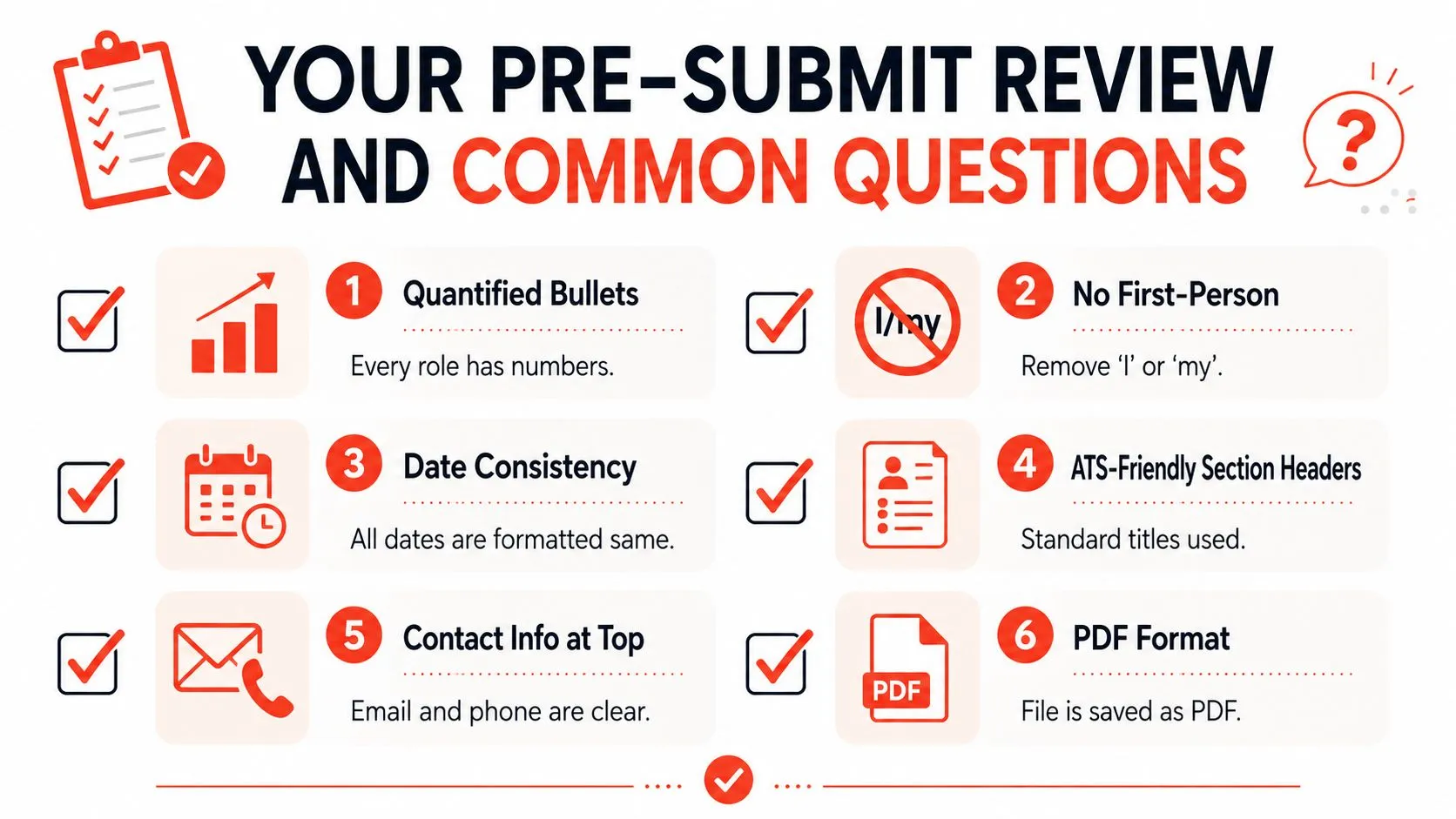
Your Pre-Submit Review and Common Questions
Run this review before every submission. Keep it quick and strict.
- Quantified bullets: Each role includes a defensible scope marker, result, or operational measure.
- No first-person pronouns: Remove “I,” “my,” and “me.” Resume bullets should show actions, not personal narration.
- Date consistency: Check that titles and employment dates match your LinkedIn profile within 30 days.
- File control: Save a PDF with a clear filename such as
FirstnameLastname-LabTechnician-Resume-2026.pdf. - Skills proof: Tie every important skill to a specific experience, project, rotation, or coursework bullet.
- Fast-skim test: Ask a friend to read the resume quickly and explain your value in one sentence.
Four questions candidates ask
Should hobbies appear? Include them only when they add technical depth or a credible connection. Amateur microscopy or a Python side project can support your case. Generic hobbies take space away from evidence.
How should you handle an employment gap? Add a one-line context note, then show certifications, CEUs, volunteer laboratory work, coursework, and skills kept current. Skip the apology.
Can one resume target clinical and industrial labs? Build two variants. Techniques, systems, standards, and proof points may overlap, but the emphasis should match each setting.
What belongs on a new graduate resume? Lead with clinical rotations, relevant coursework, CAP-CLIA familiar procedures, instruments used, and a skills-first format. Coursework cannot replace experience, but it gives a manager concrete evidence to assess.
Judge the document by response patterns, not one application. Send it to 10 roles before judging the document, then review screens, replies, and requests for clarification. ATS compatibility is a hygiene check. Quantified operational impact is what makes your contribution legible.
StoryCV is an Online Resume Writer, not a template library, and it uses a guided interview to turn your real lab work into clear, quantified resume bullets. Visit StoryCV to start with a fully written role and build a lab technician resume that balances ATS compatibility with human judgment.