
Most advice tells you to make a law enforcement cover letter sound impressive. That's backwards. For a sworn position, your letter becomes part of the story investigators will later verify, so an inflated claim can create more trouble than a modest, documented one.
The rule is simple: write what you can prove, and translate it for the person reading it. A police hiring panel wants eligibility, judgment, and service outcomes. A corporate reader may interpret “command presence” or “enforcement” as aggression unless you explain the underlying work in terms of de-escalation, documentation, and coordination.
Why Your Cover Letter Is a Background Document
A law enforcement cover letter isn't just an introduction. It's an early evidence document.
During a background investigation, applicants may need to account for employment history, training, conduct, performance, and statements made throughout the application packet. If your letter says you “led complex investigations” but your dates, assignment history, or resume don't support that description, the issue isn't poor writing. It's an inconsistency. In a public-safety hiring process, that can become an integrity concern.
That's why vague claims are more dangerous than modest ones. “Dedicated professional with excellent judgment” sounds harmless, but it gives the reader nothing to verify. “Completed academy training, maintained accurate incident documentation, and coordinated follow-up with detectives on assigned cases” is narrower, clearer, and safer, provided it's true.
Practical rule: If a sentence could trigger a background question, make sure you know the exact dates, scope, and outcome behind it.
Two rules govern every claim
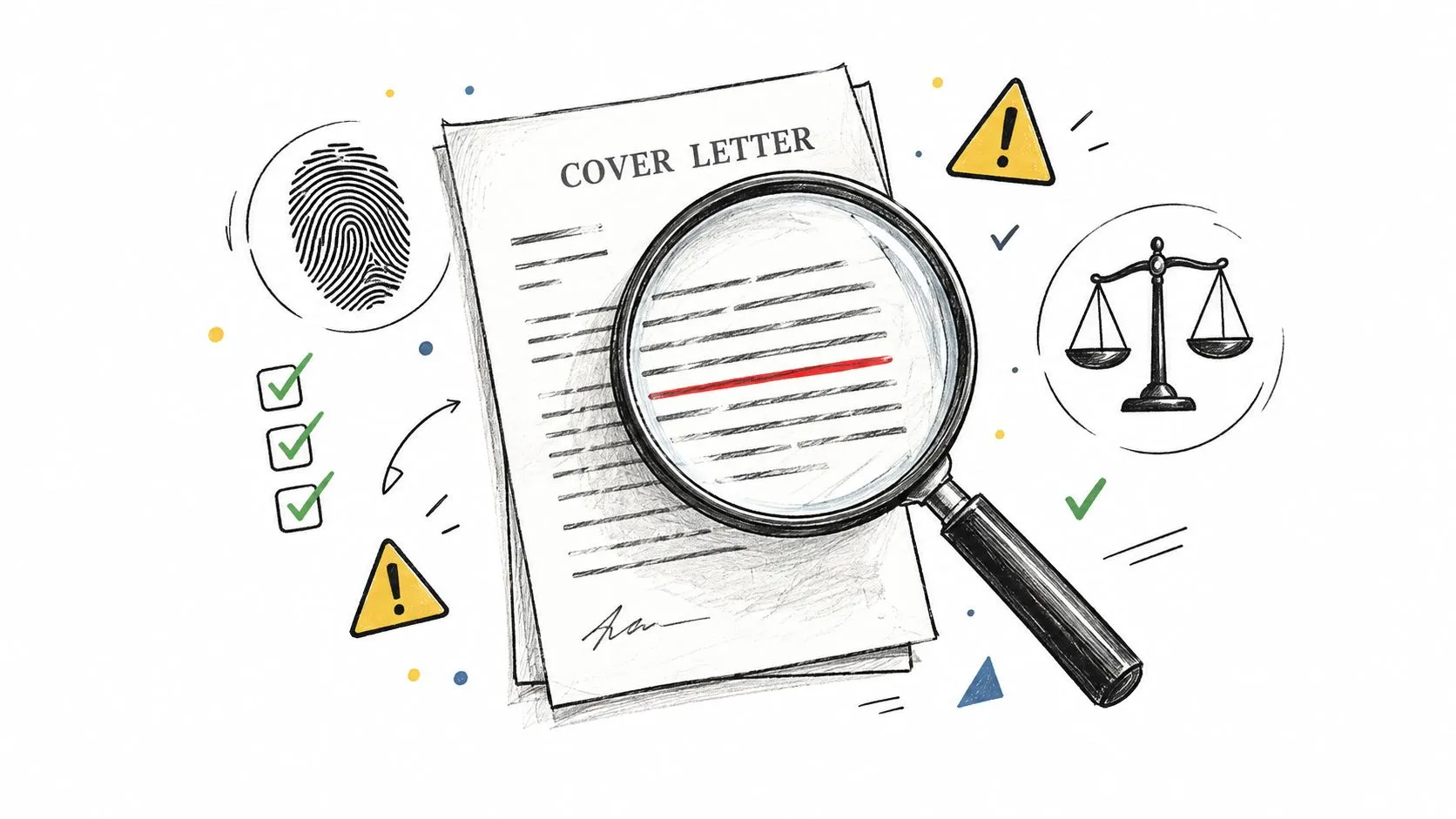
For sworn applicants, use this test:
- Can I verify it? Tie the statement to a certification, assignment, duty, documented result, commendation, or training record.
- Would my background investigator hear the same story? Your cover letter, resume, application forms, oral-board answers, and interview responses should describe the same experience without exaggeration.
The same principle applies when an officer moves into a civilian role, but the reader changes. Corporate employers may not understand policing shorthand, and some terms carry a different emotional weight outside the profession.
“Maintained control during enforcement operations” can become “de-escalated volatile situations while protecting people, preserving evidence, and coordinating with partner agencies.” “Command presence” can become “calm decision-making and clear communication under pressure.” The work hasn't changed. The translation has.
If you're struggling to remember the details behind your assignments, use an interview-based writing process rather than a template. StoryCV, for example, asks questions about the work you did and turns the answers into resume-ready writing. That approach can also help you identify which details belong in the letter and which belong in the application record. For the basic distinction between the two documents, see this guide to resume versus cover letter.
The One Page Structure That Screeners Expect
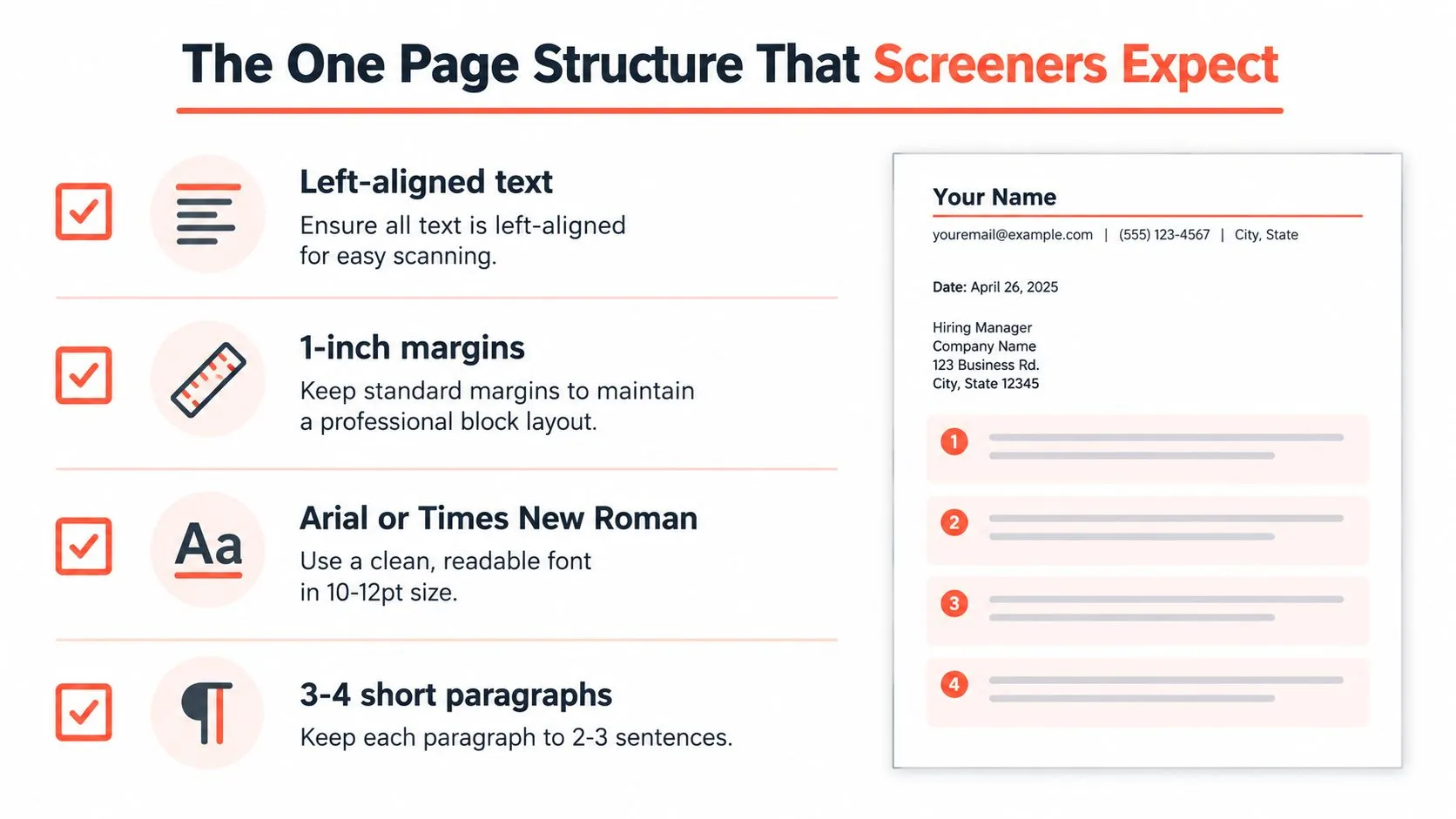
A strong law enforcement cover letter should look like a professional business letter, not a creative portfolio. Current law enforcement guidance consistently recommends one page, three to four short paragraphs, left-aligned text, 1-inch margins, and readable fonts such as Arial or Times New Roman. See the law enforcement cover letter format guidance for the standard layout.
Use a clean header with your name, phone number, email address, and location. Add the date, the recipient's name and title when available, the department, and the department address. Don't bury the position in a vague opening. Name the exact role and department in the first sentence.
Put eligibility before personality
The first two lines should answer the screening question, “Can this person be considered for the role?”
For a municipal police position, lead with POST certification, academy enrollment, or another credential named in the posting. If you're a lateral applicant, state your current role and relevant assignment. If you're changing careers, identify the training or regulated requirement you've completed and explain the connection to the job.
A reliable order looks like this:
- Opening paragraph: Exact role and department, followed immediately by your credential, academy status, or directly relevant experience.
- First body paragraph: Training and field experience connected to the posting. Mention the operational setting, not every duty you've ever performed.
- Second body paragraph: One or two documented outcomes, certifications, or community-facing examples that show judgment and fit.
- Closing paragraph: State that you're requesting an interview and provide a professional sign-off.
Keep each paragraph short. The letter should support the resume, not repeat it.
Format for fast review
Use left alignment throughout. Keep the font plain and readable. Avoid graphics, colored sidebars, elaborate headers, and dense blocks of text. A hiring panel should be able to locate your role, credential, evidence, and request for an interview without hunting.
A concise close works better than a dramatic one:
I'd welcome the opportunity to discuss how my patrol experience, documentation standards, and community-facing work align with the department's needs.
That sentence does its job. It doesn't make a promise you can't prove, and it asks for the next step directly.
Turn Duties Into Evidence With Numbers
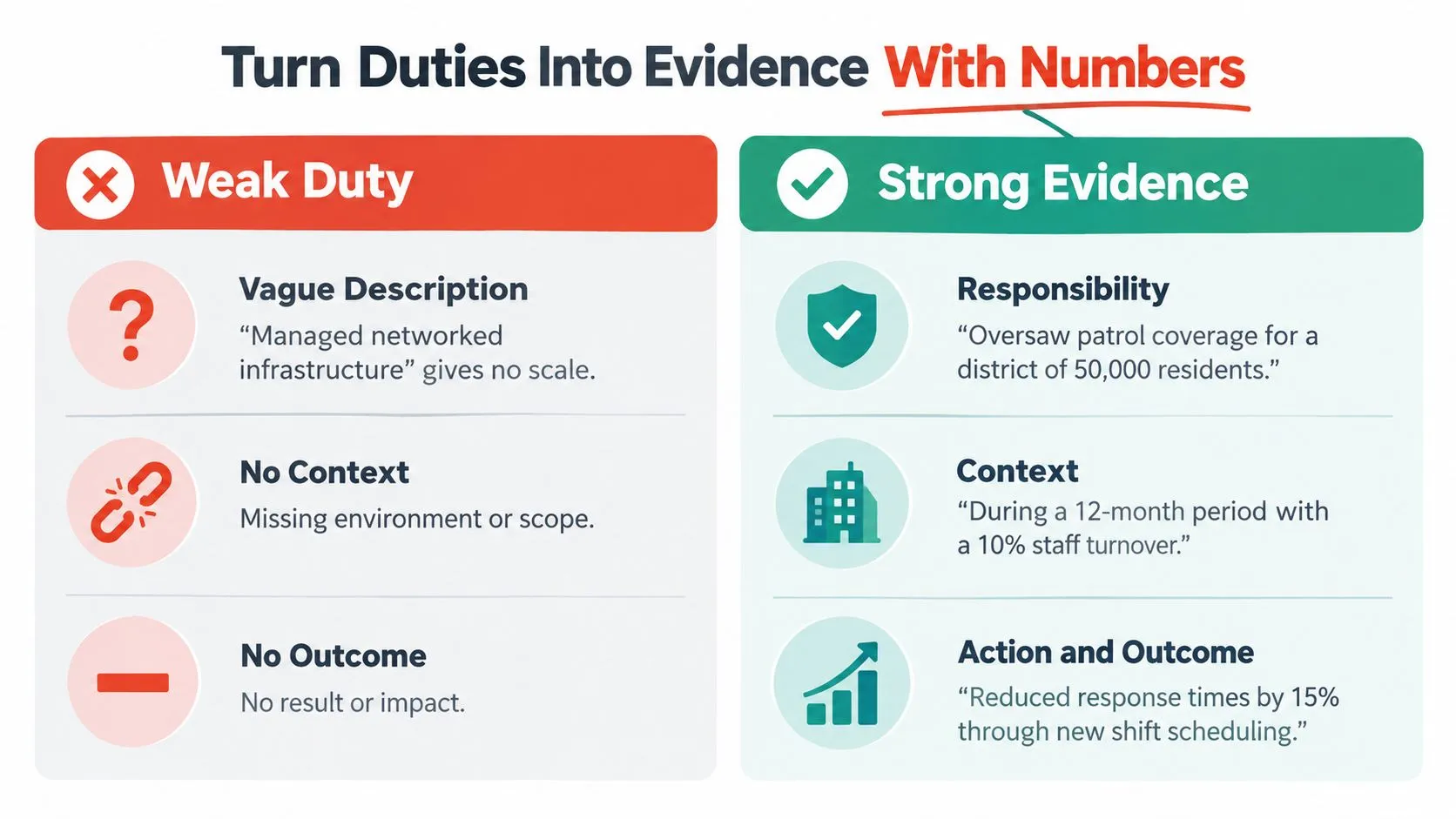
“Patrolled assigned areas and responded to calls” describes a job. It doesn't show how you performed it.
The useful sequence is responsibility, context, action, outcome. Start with what you owned. Add the environment or scope. Explain what you changed. Finish with a result that can be checked.
Consider the difference:
- Weak: Managed networked infrastructure.
- Strong: Managed a 600-device Cisco network across 14 sites, maintaining 99.99% uptime.
The second version works because it provides scale and an outcome. The same thinking applies to policing.
- Patrol: “Oversaw patrol coverage for a district of 50,000 residents during a 12-month period with 10% staff turnover, then adjusted shift scheduling to reduce response times by 15%.”
- Investigations: “Reviewed assigned case files, coordinated evidence follow-up, and helped reduce incidents from 31 to 12.”
- Operations: “Reworked shift coverage and cut response time to 6.8 minutes.”
Those examples come from the evidence-based style recommended in current law enforcement cover-letter guidance, including specific metrics for law enforcement applications. Use them only if they describe your actual work. Never borrow a number because it sounds credible.
Remember operational details
Your strongest evidence may not be a headline achievement. It might be a detail that shows reliable judgment:
- The type of calls or cases you handled.
- The population or territory you served.
- The systems used for reports, evidence, or dispatch.
- The agencies or community groups involved.
- The training or certification that enabled the work.
- The documented result, if one exists.
Avoid rounded language such as “improved performance” unless you can explain what improved. A precise result can feel more trustworthy because it points to a real record, but precision without documentation is still a problem.
Write the sentence you can defend
A cover letter gives you limited space, so choose evidence with a clear relationship to the posting. If the department emphasizes report quality, write about accurate, timely documentation. If it emphasizes community policing, write about communication, conflict resolution, and follow-through. If it emphasizes investigations, show how you preserved information, developed leads, or coordinated case work.
Use the same method when building your supporting resume. This guide to metrics in a resume helps separate activity from impact.
Write for the Right Reader From Patrol to Corporate
The same experience needs different language depending on the reader. Don't send a municipal police letter to a federal agency with the names changed. Don't send a sworn-service vocabulary list to a corporate security director and expect them to translate it for you.
| Audience | Use This Language | Proof to Lead With |
|---|---|---|
| Municipal police department | POST certification, academy enrollment, patrol, report writing, community engagement, lawful enforcement | Credential status, relevant assignments, documented service outcomes |
| Federal agent role | Investigations, regulated requirements, clearance status, evidence handling, interagency coordination | Clearance information when requested, investigative training, operational documentation |
| Corporate security or operations | De-escalation, risk assessment, incident documentation, policy compliance, multi-agency coordination | Preventive action, accurate reporting, stakeholder communication, continuity of operations |
Municipal police applications
Lead with eligibility. A first sentence such as “I'm applying for the patrol officer position with the department, and I'm currently enrolled in the required academy program” gives the screener an immediate reason to continue. Follow it with evidence tied to the department's posting, not a generic list of law enforcement virtues.
Federal roles
Federal applications can involve more specific disclosure requirements. If the posting asks for security-clearance information, address your status accurately and briefly. Don't attach references or recommendation letters to the cover letter unless the instructions ask for them. Those materials often belong to later stages.
Civilian transitions
Corporate readers need the business consequence of your policing work. Replace “commanded personnel” with “coordinated teams during time-sensitive incidents.” Replace “enforced compliance” with “applied policy consistently and documented exceptions.” Replace “controlled volatile scenes” with “de-escalated conflict, protected people, and preserved accurate incident records.”
The point isn't to soften your experience. It's to make the transferable skill visible without forcing a civilian reader to decode police terminology.
Screening and ATS Details That Get You Flagged or Filtered
A polished letter won't rescue an application that ignores the posting. Submission instructions are part of the screening process, and some jurisdictions may not review cover letters during the exam phase at all. Follow the department's directions exactly, including file type, naming conventions, required attachments, and submission channel. See the guidance on police officer application instructions.
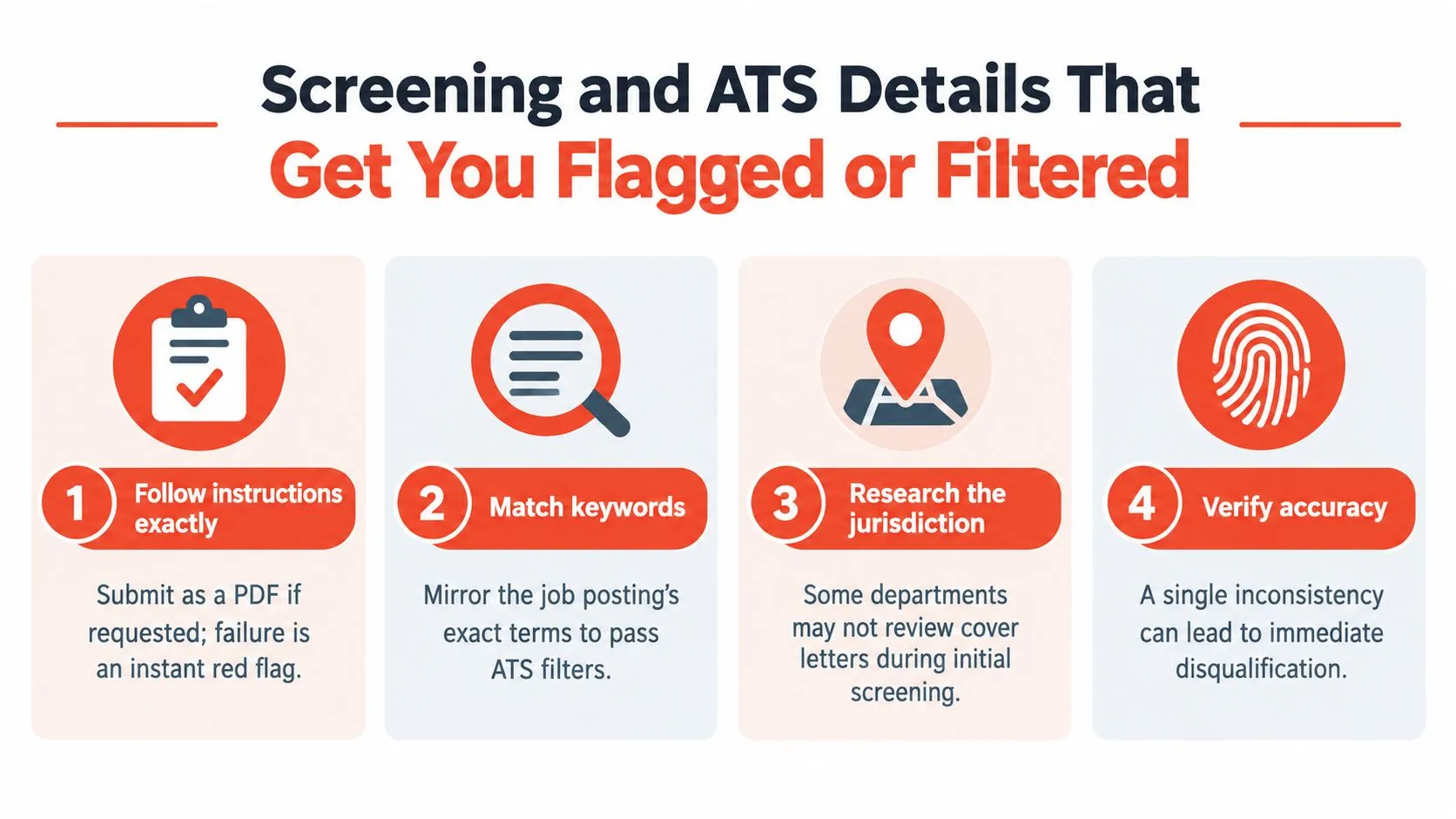
Four avoidable problems
- Generic salutation: Replace “To Whom It May Concern” with the hiring manager, chief, recruiter, or department name when the posting provides it.
- Conversational tone: Humor, slang, and dramatic claims weaken the professional record. Write with calm confidence.
- Copied language: A letter that names the wrong department, city, position, or agency signals careless targeting.
- Invisible eligibility: Put certifications, academy status, and required qualifications where a screener can see them immediately.
ATS software may compare your document with the posting's language, but human reviewers still decide whether your claims make sense. Mirror accurate terms from the announcement, especially the official role name and required credentials. Don't stuff keywords into sentences that don't describe your work.
The law enforcement labor market remains steady rather than explosive. U.S. projections published in 2026 estimate 3% growth in police and detective occupations between now and 2034, about as fast as the national average, with roughly 62,200 openings each year from new jobs and replacement demand, according to this law enforcement hiring overview. That gives agencies room to compare applicants carefully, so basic accuracy and role awareness matter.
A clean application gets reviewed. A careless application creates questions before anyone reaches your achievements.
Four Law Enforcement Cover Letter Samples You Can Adapt
These samples are deliberately compact. Replace every bracketed detail with your own verified information. Don't copy the claims, names, or outcomes unless they're yours.
Entry-level police officer with academy enrollment
Dear Chief [Name],
I'm applying for the police officer position with [Department]. I'm currently enrolled in [academy or POST program], and my training has prepared me in report writing, lawful procedure, defensive tactics, and community communication.
During training and my prior work as [role], I developed a record of [specific responsibility or documented achievement]. I'm particularly interested in [department-specific program or responsibility] because my experience with [relevant activity] has prepared me to communicate clearly, follow procedure, and remain accountable under pressure.
I'd welcome the opportunity to discuss my qualifications and explain how my training aligns with the department's requirements.
Respectfully,
[Name]
The opening proves eligibility. The middle connects training to the department. The close requests an interview without overselling.
Lateral officer with measurable results
Dear [Hiring Manager or Chief Name],
I'm applying for the lateral police officer position with [Department]. In my current assignment with [Agency], I serve as [role or assignment] and have handled [relevant area of responsibility].
In [documented period], I [action] in response to [operational context], contributing to [verified outcome]. I also maintain [relevant certification, documentation standard, or specialized training], which aligns with the department's need for [specific posting requirement].
I'd appreciate the opportunity to discuss my experience, current standing, and interest in serving [Department].
Respectfully,
[Name]
This version avoids empty claims such as “above-average officer.” It gives the panel a responsibility, context, action, and outcome. The police officer cover-letter examples support the one-page, three-to-four-paragraph approach.
Veteran translating military police experience
Dear [Hiring Manager],
I'm applying for the [role] position with [Department or Agency]. My military police experience includes [relevant assignment], where I developed disciplined procedures for incident response, documentation, and coordination with personnel from multiple units.
In [setting], I [specific action] to address [specific operational need]. That work required clear communication, accurate records, sound judgment, and consistent policy application. Those skills align directly with [requirement from the posting].
I'd welcome an interview to discuss how my background can support [organization's mission].
Respectfully,
[Name]
The translation matters. “Maintained order” is broad. “Coordinated incident response and produced accurate documentation across multiple units” tells a civilian or federal reader what you did.
Career changer moving into corporate security
Dear [Hiring Manager],
I'm applying for the [corporate security role] with [Company]. My background in policing has prepared me to assess risk, de-escalate conflict, document incidents accurately, and coordinate responses with internal and external partners.
In my previous role, I [specific action] within [context], resulting in [verified outcome]. I'm interested in [Company] because the position requires [specific posting requirement], and my experience applying policy under pressure would support consistent, professional risk management across the organization.
I'd welcome the opportunity to discuss how my incident-response and coordination experience can support your security operations.
Sincerely,
[Name]
Treat these as starting points, not scripts. The sample cover letter guidance can help with general application writing, but your law enforcement letter still needs your dates, credentials, assignments, and verifiable outcomes.
StoryCV helps you turn real work into clear, resume-ready writing by asking questions about the assignments, context, actions, and outcomes behind your experience. Visit StoryCV to work through your policing background or civilian transition and find the specific language your cover letter can defend.