The popular advice is wrong: a management consultant covering letter shouldn't begin with your motivation, your admiration for the firm, or a polished summary of your career. It should begin with proof.
A reviewer is deciding whether your application deserves more attention. Your letter has one job, show structured thinking, measurable impact, and credible fit before the reader moves on. Keep it to one page, make every sentence earn its place, and treat the document as a compact argument rather than a ceremonial note.
Why Most Management Consultant Covering Letters Fail in 30 Seconds
A consulting covering letter is a 30-second proof document. It must show, almost immediately, that you can frame a problem, make a sound decision, and produce an outcome someone can verify. A hiring reader is not searching for a warmer version of your CV. They are deciding whether your evidence deserves another thirty seconds, as the 30-second review process for management consultant covering letters makes clear.
The benchmark is clear. In a controlled study of 7,287 mock applications, applications without a cover letter produced a 10.7% callback rate, generic letters produced 12.5%, and personalized letters produced 16.4%. Personalized letters generated about 53% more interviews than applications without a letter, according to the 2026 cover-letter benchmark.
A targeted letter will not rescue weak experience. It can make strong experience easier to recognize by translating it into the language of consulting: problem definition, analytical judgment, stakeholder influence, and measurable impact.
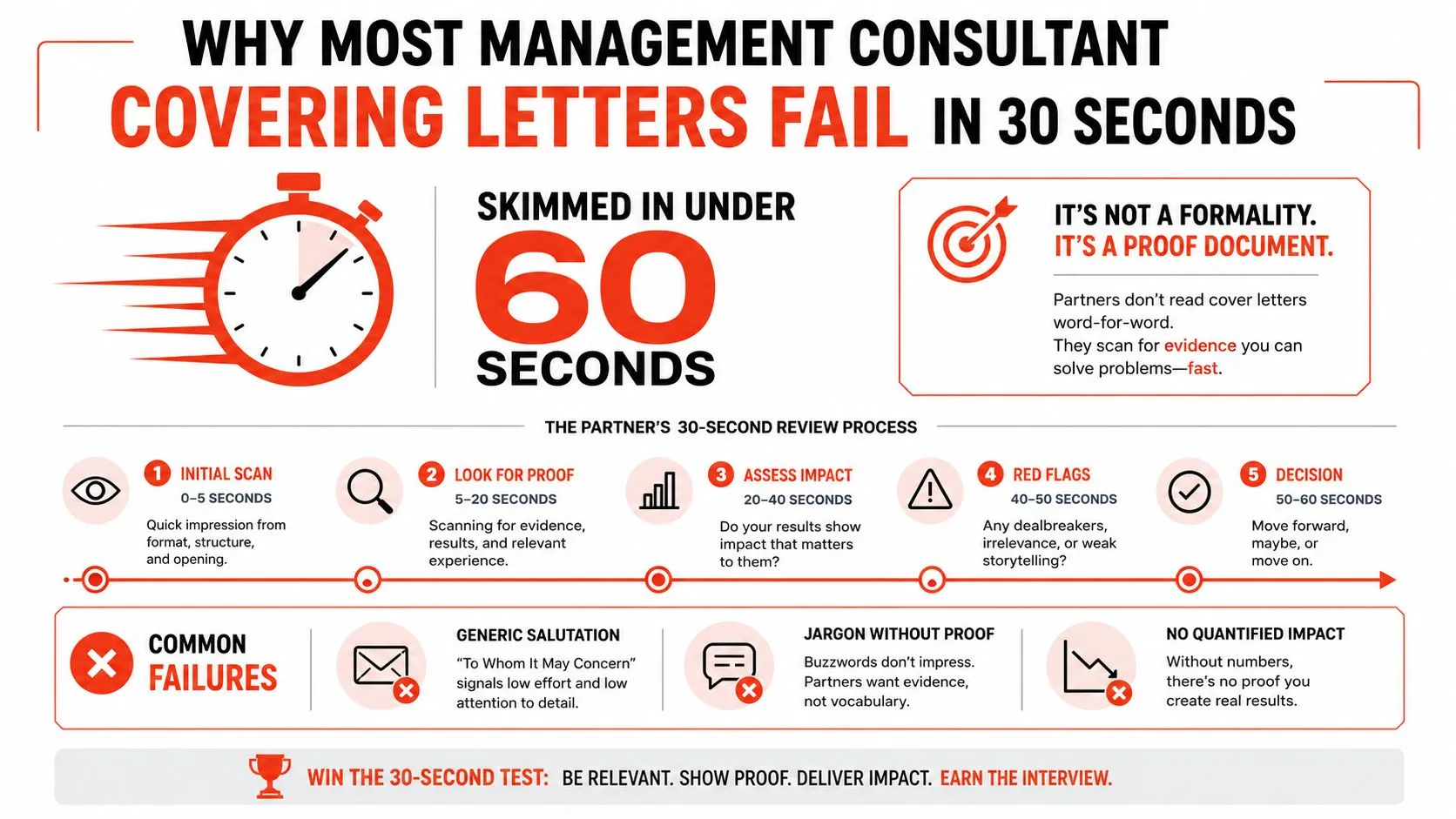
What the skim reader wants
Your first two sentences need to answer three questions:
- What role are you targeting?
- Why should this reader care about your background?
- What proof suggests you can perform the work?
“I'm passionate about problem solving and excited by the opportunity to join your prestigious firm” answers none of them. It is interchangeable, unsupported, and easy to skip. A partner needs a reason to continue, not another declaration of enthusiasm.
Use a concrete opening:
“I'm applying for the Associate role at Northbridge Strategy after leading a pricing redesign that improved contribution margin by [verified result] across [business area].”
Replace the placeholders with your real result. Never borrow a number to make the sentence appear stronger.
Skimming is triage
The reader's speed is a workload issue, not necessarily a quality judgment. Hiring teams scan large application stacks, while your letter competes with the CV, application form, referrals, and interview evidence.
One hiring summary reports that 37% of recruiters spend around 30 seconds reading a cover letter, while 15% spend two minutes or longer. The same source identifies poor writing as a common rejection trigger. Clarity must come before originality. See the research summary on cover-letter reading behavior.
Applicant behavior and employer behavior remain out of sync. A 2025 survey summary found that only 35.4% of recent hires consistently submitted cover letters with every application, while 42.5% wrote them for some applications but not all. Yet 79% of employers still read cover letters, according to Resume.io's cover-letter statistics. Optional does not mean irrelevant. It means fewer applicants provide useful evidence.
Write for the next thirty seconds, not for completeness. Your CV records the breadth of your career. The management consultant covering letter should make one or two high-value stories impossible to miss.
The Four-Part Structure That Delivers Results
A management consultant covering letter earns attention by putting proof before background. Build it from four parts: a hook, a value bridge, evidence, and firm fit. Keep the close brief. It should finish the argument, not introduce another one.
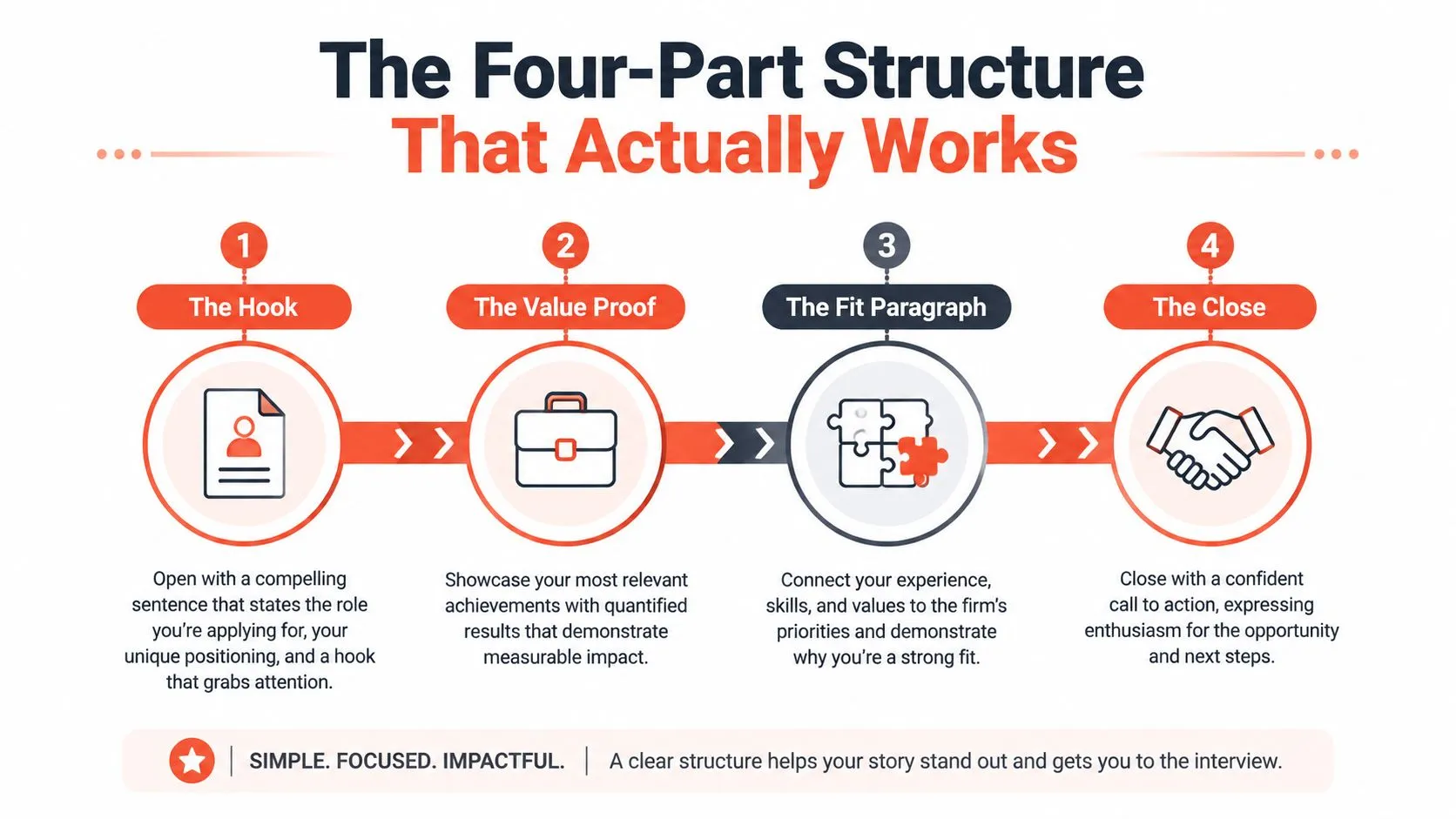
One, the hook
Open with one sentence naming the role, firm, your positioning, and one defensible proof point. Keep it under 25 words when clarity survives the compression.
- Do: “I'm applying for the Senior Consultant role at Vale Advisory, bringing experience in operating-model redesign and [verified outcome].”
- Don't: “I am writing to express my strong interest in this exciting opportunity.”
State why you are writing, which role you want, and where you found it, following this university careers guide to application letters. Put relevant proof immediately after that basic information. The first sentence should give the reader a reason to continue.
Two, the value bridge
Use two sentences to show what you repeatedly deliver and who benefits. Career changers must translate previous work into consulting language rather than listing unrelated responsibilities.
A corporate strategy manager might write: “I turn ambiguous growth questions into decision-ready analysis for executive teams. My work combines market sizing, financial modeling, and stakeholder alignment to move recommendations into implementation.”
Choose the pattern that connects your background to the role. A list of capabilities creates no signal unless it shows how those capabilities produce business value.
Three, the evidence
Use one or two compact stories, each built around an engagement spine:
- Context and business problem.
- Constraint or complication.
- Your specific action.
- Verifiable outcome.
The consulting cover-letter guidance from Management Consulted recommends experience-based stories instead of resume repetition. Follow that principle. A resume bullet records an event. Your letter must show how you framed the problem, made choices, and moved toward a result.
Use savings, revenue uplift, cycle-time reduction, risk reduction, or adoption gains only when you can defend the figure. If the result is not verified, describe the business consequence without manufactured precision.
Four, the fit and close
Connect your evidence to the firm's practice, office, or sector. Refer to a genuine conversation, a specific publication, a relevant case, or a researched area of work. Generic praise signals that you could have sent the same letter elsewhere.
Close in two sentences. Reaffirm the role, thank the reader, and invite a conversation. Use cover letter advice for job seekers as general guidance, then sharpen the proof and prioritization for consulting. You can also compare this structure with StoryCV's guidance on a cover letter for a job application, then rewrite the language so it reflects your own experience.
Three Annotated Examples You Can Model
The examples below use bracketed metrics where a candidate must insert a verified result. That's deliberate. A fabricated number is worse than a qualitative statement.
Example one, corporate strategy to generalist consulting
Clean draft
Dear Hiring Manager,
I'm applying for the Consultant role at Meridian Partners, bringing corporate strategy experience across growth planning, pricing, and operating-model decisions.
In my current role, I was asked to assess whether a regional business should enter an adjacent market while leadership faced limited data and a short decision window. I structured the problem into market attractiveness, customer economics, competitor response, and execution requirements, then built a scenario model with commercial and finance stakeholders. The recommendation supported an investment decision that produced [verified revenue or margin outcome].
I've also led a cost-transformation workstream across procurement and operations. By mapping spend categories, testing supplier assumptions, and aligning business owners around a prioritized implementation plan, I helped deliver [verified savings or cycle-time result]. The work strengthened my ability to move from analysis to practical action.
Meridian's work in growth strategy and performance improvement matches the problems I most enjoy solving. I'd welcome the opportunity to bring structured analysis, executive communication, and implementation discipline to your client teams.
Sincerely,
[Name]
Annotations
- Opening proof: The candidate positions corporate strategy as relevant without apologizing for not having consulting experience.
- Engagement spine: The first story moves from ambiguous question to structured analysis to decision.
- Transferable signal: “Commercial and finance stakeholders” shows cross-functional influence.
- Fit signal: The firm reference is specific enough to demonstrate research, but it doesn't sound flattering for its own sake.
Example two, senior consultant to boutique partner track
Clean draft
Dear [Name],
I'm applying for the Principal role at Alder & Co., where I can extend my experience leading complex transformation programs for industrial clients.
Over the past several years, I've led engagements involving operating-model redesign, post-merger integration, and performance management. On a transformation for a multi-site manufacturer, I created the diagnostic approach, directed the workplan across [verified team size], and presented trade-offs to the executive committee. The client adopted the recommendation, contributing to [verified cost, revenue, or delivery outcome].
My second focus has been building teams and expanding client relationships. I developed a reusable performance-management offering, coached consultants through delivery, and supported proposals that converted into [verified number or value of wins]. That combination of delivery leadership and commercial judgment is the contribution I'd bring to Alder.
Your specialist focus on industrial transformation is a strong match for my experience. I'm particularly interested in the firm's model of giving senior practitioners direct ownership of client relationships and team development. I'd value a conversation about the role.
Best regards,
[Name]
Annotations
- Senior positioning: The letter leads with scope and ownership, not a list of capabilities.
- Commercial proof: The second story shows that partner-track candidates need more than delivery experience.
- Firm fit: Boutique applications should explain why the firm's model matters to the candidate's next contribution.
- Second-read trigger: The reader sees team leadership, client access, and business development in a compact space.
Example three, MBA applicant to summer associate
Clean draft
Dear Recruiting Team,
I'm applying for the Summer Associate role at Summit Consulting, combining an MBA focus in operations with experience improving customer and supply-chain decisions.
Before business school, I managed a product-operations initiative where customer complaints pointed to inconsistent service delivery. I analyzed the issue by segment, mapped the handoffs between teams, and tested a revised operating process with frontline managers. The pilot produced [verified service, cost, or time outcome] and gave senior leaders a clearer basis for scaling the change.
During my MBA, I worked with a student team on a market-entry recommendation for a healthcare business. I owned the customer-analysis workstream, challenged the initial hypothesis, and synthesized the findings into a recommendation for the client presentation. The experience confirmed that I want a role combining rigorous analysis with collaborative problem solving.
Summit's healthcare and operations work aligns with the questions I've pursued in both professional and academic settings. I'd welcome the opportunity to contribute as a Summer Associate.
Sincerely,
[Name]
| Example Profile | Opening Hook Proof Point | Engagement Spine Length | Firm-Fit Signal | Likely Skim Verdict |
|---|---|---|---|---|
| Corporate strategy career changer | Relevant strategy positioning plus verified business result | One detailed story and one compact story | Practice alignment | Keep reading if the result is credible |
| Senior consultant | Scope, leadership, and transformation ownership | Two senior-level stories | Boutique delivery and relationship model | Strong candidate for deeper review |
| MBA summer associate | Operations background plus academic bridge | One work story and one project story | Sector and problem-type connection | Viable if the proof is concrete |
Writing Like a Consultant on the Page
Consultant-grade writing doesn't mean stuffing the page with consulting vocabulary. It means making the logic visible.
Three moves do most of the work:
- Use an engagement spine. Connect the problem, constraint, action, and outcome in one coherent sequence.
- Quantify impact where the evidence exists. Use percentage terms, revenue, cost reduction, time saved, risk reduction, adoption, or headcount affected when you can verify the figure.
- Use toolkit language precisely. Terms such as stakeholder mapping, hypothesis-led analysis, structured problem solving, synthesis, recommendation, and trade-offs work when the story demonstrates them.
The wrong verb hides ownership. “Responsible for” describes a job boundary. “Helped with” removes agency. “Was involved in” tells the reader almost nothing.
| Weak Phrase | Consultant-Grade Alternative |
|---|---|
| Responsible for reporting | Built and presented a KPI dashboard for executive decision-making |
| Helped with cost reduction | Identified procurement levers and supported the cost-reduction recommendation |
| Was involved in the project | Led the diagnostic workstream across operations and finance |
| Worked with stakeholders | Mapped stakeholder interests and aligned decision owners |
| Assisted the team | Synthesized analysis into a recommendation for senior leadership |
| Passionate about problem solving | Structured an ambiguous business problem into testable hypotheses |
Before and after
Before
“I was responsible for helping the operations team improve the process. I worked with different stakeholders and contributed to recommendations that made the process more efficient.”
After
“When a fragmented handoff slowed customer onboarding, I mapped the process with operations, sales, and compliance, isolated the main delay, and recommended a revised workflow that reduced cycle time by [verified result].”
The second version gives the reader a problem, an analytical move, stakeholders, a recommendation, and an outcome. It also leaves room for the reader to ask a useful interview question.
Precision beats length: A shorter sentence with defensible proof creates more confidence than a paragraph of polished adjectives.
Your resume should carry the full inventory of achievements. Your management consulting resume can hold the broader toolkit, project history, and role chronology. The letter should select the evidence that changes the reader's view of your fit.
Tailoring for the Firm, the Role, and the ATS
A generic letter gets discarded because it makes the reader do the matching. Don't write, “I have strong analytical skills.” Show the analytical work, then connect it to the firm's needs.
Firm tailoring
Research the practice language, recent announcements, signature case work, and industry focus of the specific target. McKinsey, BCG, Bain, Accenture Strategy, Big Four advisory teams, and boutiques won't all describe their work in the same way.
- Do: Connect a real project to the firm's relevant practice or sector.
- Don't: Praise its reputation, global reach, or “unique culture” without evidence.
If you spoke with a consultant, name the person only when the conversation happened. Explain what you learned and why it changed or sharpened your interest.
Role tailoring
Your value bridge should change with the title.
- Analyst: Emphasize analytical rigor, research, synthesis, and dependable execution.
- Associate: Show ownership of workstreams, client communication, and recommendation development.
- Senior Consultant or Engagement Manager: Emphasize team leadership, executive influence, delivery risk, and commercial judgment.
- Strategy Lead: Connect enterprise-level decisions to measurable implementation and stakeholder alignment.
Mirror exact terms from the job description when they accurately describe your experience. Don't keyword-stuff. A reader can tell when “transformation,” “AI strategy,” or “stakeholder management” appears without a supporting story.
ATS tailoring
Applicant tracking systems parse text more reliably when the document uses clean formatting. Use standard headings, conventional fonts, normal spacing, and a readable PDF. Avoid tables, text boxes, decorative graphics, and unusual symbols in the file you submit, even if the document looks attractive on screen.
Use a clear subject line such as Application for Associate Role, [Name]. Name the file Firstname_Lastname_CoverLetter_Firm_Role.pdf. The filename is small, but careless document handling creates avoidable doubt.
The practical sequence is simple: firm first, role second, ATS third. Human relevance comes before machine readability. Both matter.
Common Mistakes That Get Letters Binned
A senior reader won't penalize you for lacking theatrical enthusiasm. They will penalize you for making the document harder to evaluate.
- Opening with “I am writing to apply”: It wastes the most valuable line. Name the role, your positioning, and proof instead.
- Repeating the CV in prose: The reader already has your chronology. Explain one decision and its consequence.
- Using “assisted” or “contributed” without evidence: Soft verbs make ownership unclear. State what you did and what changed.
- Padding with “passionate” and “driven”: These adjectives are claims without evidence. Replace them with a project story.
- Writing “To Whom It May Concern”: It sounds careless when a recruiter or hiring team can be addressed directly. Use a real name, “Dear Hiring Manager,” or “Dear Recruiting Team.”
- Exceeding one page: Consulting guidance treats one page as the practical limit, with a common target of 250 to 400 words, as summarized by Japply's management consultant cover-letter guidance.
- Ignoring the firm or practice: A generic letter tells the reader you'd send the same argument anywhere. Add a specific, researched fit signal.
- Closing with “I hope to hear from you”: It's passive and forgettable. Request a conversation with calm confidence.
- Submitting
CoverLetterFinalv3FINAL.pdf: The filename signals poor document control. Use the firm, role, and your name.
Typos are especially damaging because the letter is a writing sample. Proofread it aloud, then ask a consulting-aware reviewer to challenge the logic, not just the grammar.
Editable Template and Quick-Edit Checklist
Use this as a starting frame, not a personality substitute.
Blank template
Dear [Recruiter or Hiring Manager Name],
I'm applying for the [Role] position at [Firm], bringing [specific positioning] and a record of [quantified impact or verified outcome].
In [context], I faced [business problem] under [constraint]. I [specific action], using [method or toolkit], which led to [verified result]. This demonstrates my ability to [consulting-relevant capability].
I also [second experience]. By [action], I [outcome]. That experience strengthened my ability to [transferable consulting signal].
[Firm]’s work in [practice, sector, or office focus] matches my experience in [relevant area]. [Specific conversation, publication, case, or firm detail] reinforced my interest in contributing to [specific role or client problem].
Thank you for your consideration. I'd welcome the opportunity to discuss how I could contribute as [Role].
Sincerely,
[Name]
Annotated completed version
“I'm applying for the Associate role at Crest Advisory, bringing healthcare operations experience and a verified record of reducing onboarding cycle time.”
That opening names the role, firm, positioning, and proof. The following paragraphs should explain the problem, your intervention, the measurable result, and why Crest's relevant practice needs that combination.
If you're comparing writing or editing tools, a Coverfairy tool review can help you assess whether a product supports useful revision rather than producing another generic template. Judgment still belongs to the candidate.
Quick-edit checklist
- Role and firm test: Does the letter name the exact role and firm?
- Opening test: Is the opening hook under 25 words?
- Proof test: Does the letter include one verified quantified result?
- Transfer test: Does it translate non-consulting experience into consulting language?
- Filler test: Have you removed unsupported claims such as passionate, driven, and hard-working?
- Length test: Does the document fit on one page without tiny type or cramped margins?
- File test: Is the file named
Firstname_Lastname_CoverLetter_Firm_Role.pdf? - Accuracy test: Are the firm, role, names, dates, and results correct?
- Read-aloud test: Does the argument sound clear when spoken?
A management consultant covering letter gets judged quickly. Read it aloud once before sending it, and cut every sentence that doesn't improve the case.
StoryCV is an Online Resume Writer, not a template library. It uses a guided interview to uncover the context, achievements, and nuance behind your work, then turns that material into clear, ATS-compatible career narratives. If your experience is strong but difficult to articulate, visit StoryCV and start with one fully written role for free.