
Most marketing resumes don't fail because they lack keywords. They fail because the writer translated useful work into polished fog. “Led growth initiatives” may sound senior, but it tells an ATS and a recruiter almost nothing about the channel, tool, or result. A strong marketing keywords resume uses the language of the job posting without turning into a bag of buzzwords.
StoryCV's position is simple. We're not a tool or a template library. We're an Online Resume Writer that applies editorial judgment at software speed. The job is to turn real work into language that software can parse and a tired hiring manager can trust.
Why Marketing Resumes Fail at Keywords
The popular advice says to add more keywords. That's usually wrong.
One independent industry report says 98% of Fortune 500 companies use Applicant Tracking Systems, while 75% of resumes never reach a human reviewer because they fail an initial keyword scan. The same report says the first screening takes only 2–3 seconds per resume, and that candidates often need a 60–80% keyword match to advance. The ATS benchmark and keyword guidance explain why exact language matters, but they don't justify keyword stuffing.
The problem is translation. A marketer may have improved acquisition, rebuilt lifecycle emails, or positioned a product for a new audience. Yet the resume says “supported campaigns” or “managed initiatives.” The experience is there. The vocabulary is missing.
The useful formula: action verb + channel or discipline + tool or audience + defensible result.
A hiring manager needs to see what you changed. An ATS needs recognizable terms such as digital marketing, SEO, paid media, marketing automation, Google Analytics, or conversion rate optimization. Both readers are looking for the same signal, just in different ways.
Keyword alignment beats keyword volume
A second ATS report says the average unoptimized resume is missing 52% of the keywords in its target job description. Another benchmark puts the average resume at only 48% keyword coverage, with a median first-submission ATS score of 48 out of 100. It also reports that 51% of resumes score below 50 and 42% score below 40. These figures come from ATS keyword matching data, and the lesson is practical: a generic list of marketing terms won't rescue a resume that doesn't match the role.
Independent benchmarking reaches the same conclusion. In an analysis of 30,688 resumes, the average resume matched 48.3% of its target job, 53.8% matched less than half of the requirements, and only 9.8% reached a strong 80%+ match. The resume-job match study makes the case for role-specific evidence, not bloated Skills sections.
Your resume gets read twice. First, software extracts and compares language. Then a human checks whether the claims make sense. Put SEO in a Skills section without showing how you used it, and you may pass a filter but lose the reader. Put it inside a clear achievement, and the same keyword does real work.
Pulling the Right Keywords From Job Postings
Stop downloading generic “top marketing keywords” lists. Your target job posting already contains the vocabulary you need.
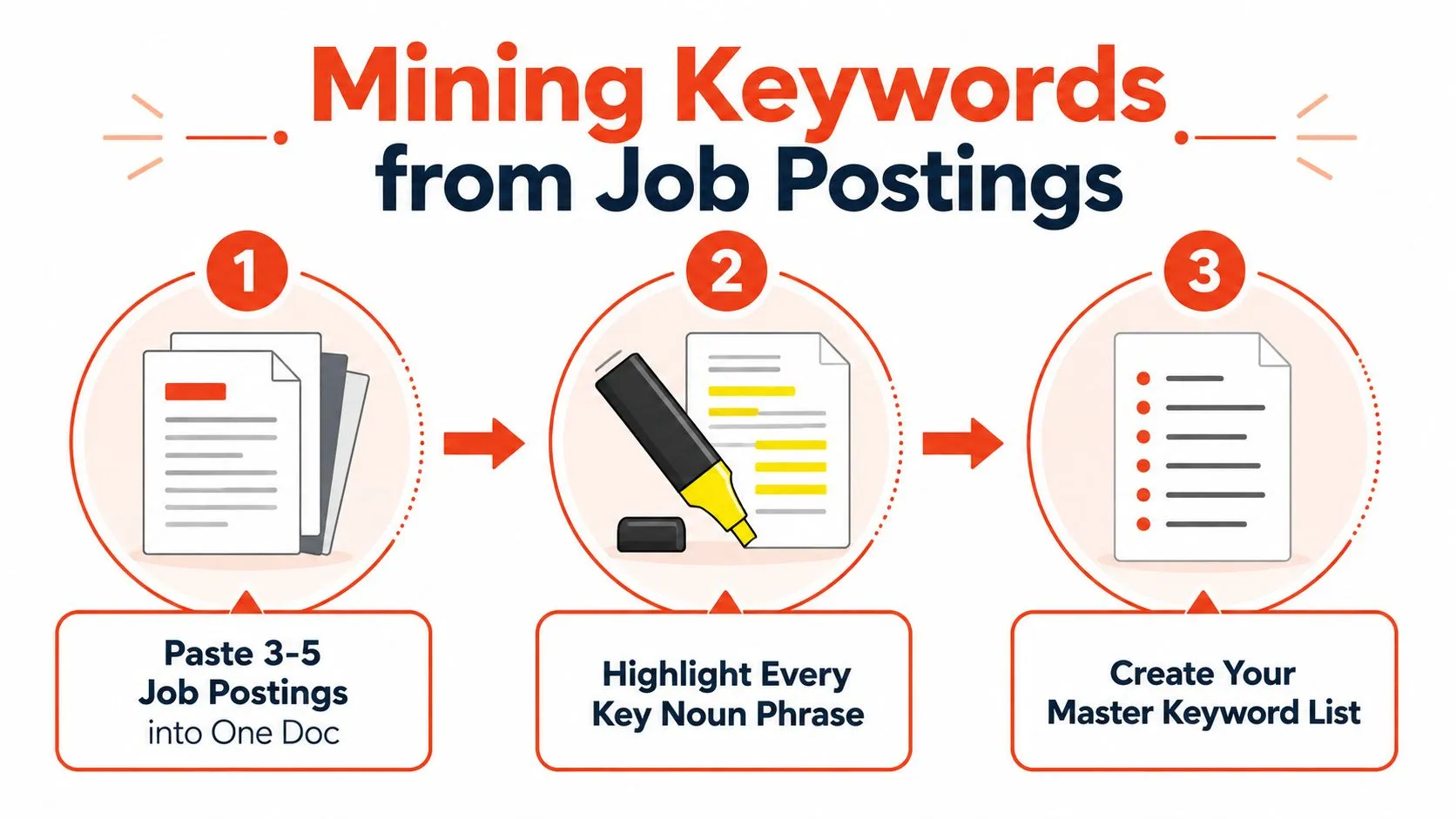
Start by collecting three to five real postings for the same kind of role. Put them in one document, then mark every phrase connected to a channel, tool, audience, responsibility, or outcome. A posting asking for “demand generation experience with B2B SaaS” already gives you several usable terms: demand generation, B2B, SaaS, and experience. Don't replace “demand generation” with your preferred phrase, “lead gen,” if the employer uses the former.
Build three useful buckets
Sort the highlighted phrases into categories. This keeps the list usable instead of turning it into a word cloud.
- Channels: SEO, paid social, lifecycle marketing, email marketing, content marketing, and search engine marketing.
- Tools: HubSpot, Salesforce, Looker, Mixpanel, Google Analytics 4, and Meta Ads Manager.
- Outcomes: MQLs, pipeline, CAC, retention, ROAS, CTR, and conversion rate optimization.
Then separate requirements from preferences. Phrases in the qualifications and experience sections deserve priority over nice-to-have tools. If HubSpot appears as a required platform and Marketo appears as a bonus, HubSpot belongs in your strongest evidence. Marketo belongs only if you've used it.
A useful cross-check is to review multiple postings and keep terms that recur across them. One ATS keyword method recommends reviewing 5–8 real postings and treating words that appear in at least 3 of 5 as core keywords. This practical ATS keyword method gives you a repeatable filter, but relevance still matters more than repetition.
For each term, ask:
- Did I do this work? If not, leave it out.
- Can I prove it? Attach a result, deliverable, scope, or clear responsibility.
- Would a recruiter recognize the wording? Replace internal jargon with standard language.
- Does the phrase fit this role? A product marketing keyword won't strengthen a growth resume unless the work supports it.
For additional context on how employers phrase responsibilities and requirements, review this guide to job post writing for hiring teams. Then tailor your resume using this guide to matching a resume to a job description.
The final list should be short enough to use. If you can't connect a keyword to something you did, it isn't a keyword. It's decoration.
Mapping Keywords to Measurable Achievements
A keyword becomes credible when it sits inside proof. Otherwise, your resume is just repeating the job ad back to the employer.
Rank terms by how central they are to the role. Put priority keywords in the summary and near the top of your first relevant role. Use supporting terms in later experience bullets. Keep contextual tools and methods in the Skills section when they're relevant but don't have a standalone achievement behind them.
| Priority | Where It Goes | Example Phrase | Proof Required |
|---|---|---|---|
| Core | Summary and top bullets | Demand generation | Pipeline, MQLs, campaign scope, or program ownership |
| Supporting | Experience bullets | Marketing automation | Workflow, platform, audience, or process outcome |
| Contextual | Skills section and relevant bullets | Google Analytics 4 | Reporting, analysis, dashboards, or optimization work |
For every core phrase, use this structure:
Action verb + marketing channel + tool or method + result
“Managed email campaigns” is a task. “Built and launched a 12-touch nurture sequence in HubSpot that lifted MQL-to-SQL conversion 28% in one quarter” is evidence. The example works because it names the channel, the platform, the workflow, and the outcome.
The figures in a bullet must come from your records. Don't invent a percentage because the job posting asks for conversion optimization. Use a defensible proxy instead:
- Scale: audience size, list size, send volume, or number of campaigns.
- Complexity: markets served, stakeholder groups, product lines, or channels coordinated.
- Business connection: MQLs, pipeline, retention, CAC, ROAS, CTR, or conversion rate.
- Operational result: reporting cadence, launch speed, process adoption, or content output.
A proxy isn't a consolation prize. It's better than a fabricated result and often gives the reader a clearer sense of your responsibility. “Built lifecycle reporting for regional marketing and sales stakeholders” proves more than “data-driven marketer” when you don't have a clean revenue metric.
Put the phrase where the proof lives
Don't hide your strongest keyword in a dense list at the bottom. If the role emphasizes paid media, your first relevant bullet should show the channel. If it emphasizes product positioning, your strongest product marketing bullet should name the positioning work directly.
For more ways to turn responsibilities into evidence, use this guide to quantifiable achievements. The principle is straightforward: keywords identify the skill, while the achievement proves you can use it.
Rewrites for Growth, Content, and Product Marketing
Start with the same weak bullet:
Owned marketing campaigns.
The problem isn't that it's inaccurate. The line reveals nothing about channel, scope, or outcome. A hiring manager can't tell whether you ran paid acquisition, built content, launched a product, or coordinated a calendar.
Translate the claim for the role in front of you.
| Role | Before, Generic | After, Role-Specific | Keywords Added | Metric Shift |
|---|---|---|---|---|
| Growth marketing | Owned marketing campaigns | Optimized paid acquisition and lifecycle marketing across Google Ads and HubSpot, improving CAC and activation through structured A/B testing | Paid acquisition, lifecycle marketing, Google Ads, HubSpot, CAC, activation, A/B testing | From activity to efficiency and funnel outcomes |
| Content marketing | Owned marketing campaigns | Built an SEO content strategy and editorial calendar, publishing search-led articles that increased qualified organic traffic and supported lead generation | SEO content strategy, editorial calendar, organic traffic, lead generation | From campaigns to audience and discoverability |
| Product marketing | Owned marketing campaigns | Led product positioning and go-to-market messaging for a new SaaS release, aligning sales enablement with buyer needs and launch goals | Product positioning, go-to-market, SaaS, sales enablement, buyer needs | From execution to launch narrative and adoption |
These versions translate one vague statement into three hiring contexts. Choose the phrasing that matches the work you performed.
Growth marketing
The growth version names the engine: paid acquisition, lifecycle marketing, and A/B testing. Include Google Ads and HubSpot only when you used them. CAC or activation signals funnel responsibility and gives the reader a business outcome to evaluate.
Use a real figure when your records support one. Without a clean result, show defensible scope through the number of experiments, audiences, campaigns, or channels managed. Never manufacture a lift to satisfy a keyword in the posting.
Content marketing
“Wrote blog posts” narrows the work too far when you handled search strategy, editorial planning, distribution, and lead generation. Name SEO, the publishing system, and the business purpose.
Connect the audience work to an outcome. Qualified organic traffic, search visibility, lead generation, newsletter growth, or content-assisted pipeline can all strengthen the bullet when your records support the claim.
Product marketing
Product marketers often compress substantial work into “Helped launch a product.” That wording hides positioning, research, messaging, enablement, and cross-functional leadership.
Name the strategic layer. Product positioning, go-to-market strategy, buyer personas, competitive analysis, and sales enablement identify decisions and responsibilities, not merely deliverables. Finish with the change you can defend, such as clearer sales conversations, launch readiness, adoption, or qualified demand.
Small choice, large difference: name the channel instead of the tactic, pair the keyword with proof, and finish on the result.
Your weakest bullet benefits most from one accurate channel, one recognizable tool or discipline, and one outcome you can defend.
Passing the ATS Without Sounding Like a Robot
An ATS generally extracts resume text, compares it with terms in the job posting, and assigns a match score. It doesn't understand visual hierarchy the way a human does. Columns, graphics, text boxes, and decorative labels can make a polished resume harder to parse.
The safest test is brutally simple. Save a copy of your resume as plain text, open it in a basic editor, and read from top to bottom. Names, job titles, dates, section headings, and bullets should appear in the right order. This plain-text ATS parsing test describes the same principle: if the copied text is scrambled or incomplete, the parser may see that mess too.
Three quiet score killers
- Hidden table text: A keyword placed in a table cell, sidebar, or design element may not land where you expect in the extracted text.
- Header-only placement: A keyword in the summary or headline has less credibility if no experience bullet shows how you used it.
- Acronym mismatch: Write search engine optimization (SEO) once when both forms matter. Then use the shorter version naturally.
Use standard headings such as Summary, Experience, Skills, and Education. Keep the layout single-column and readable. Don't sacrifice clarity for a visual trick that only the recruiter sees.
Recruiting teams also use specialized systems and workflows, so resources about dreach for executive search firms can help explain the broader screening environment. Your own practical check remains more important than any software score.
For bullet-level guidance, see this ATS resume bullet points guide. A clean file gives the ATS usable text, while a clear bullet gives the human a reason to keep reading.
The Short List of Habits That Actually Move the Needle
A strong marketing resume is built through repeatable discipline, not a larger Skills section.
Use this checklist before each application:
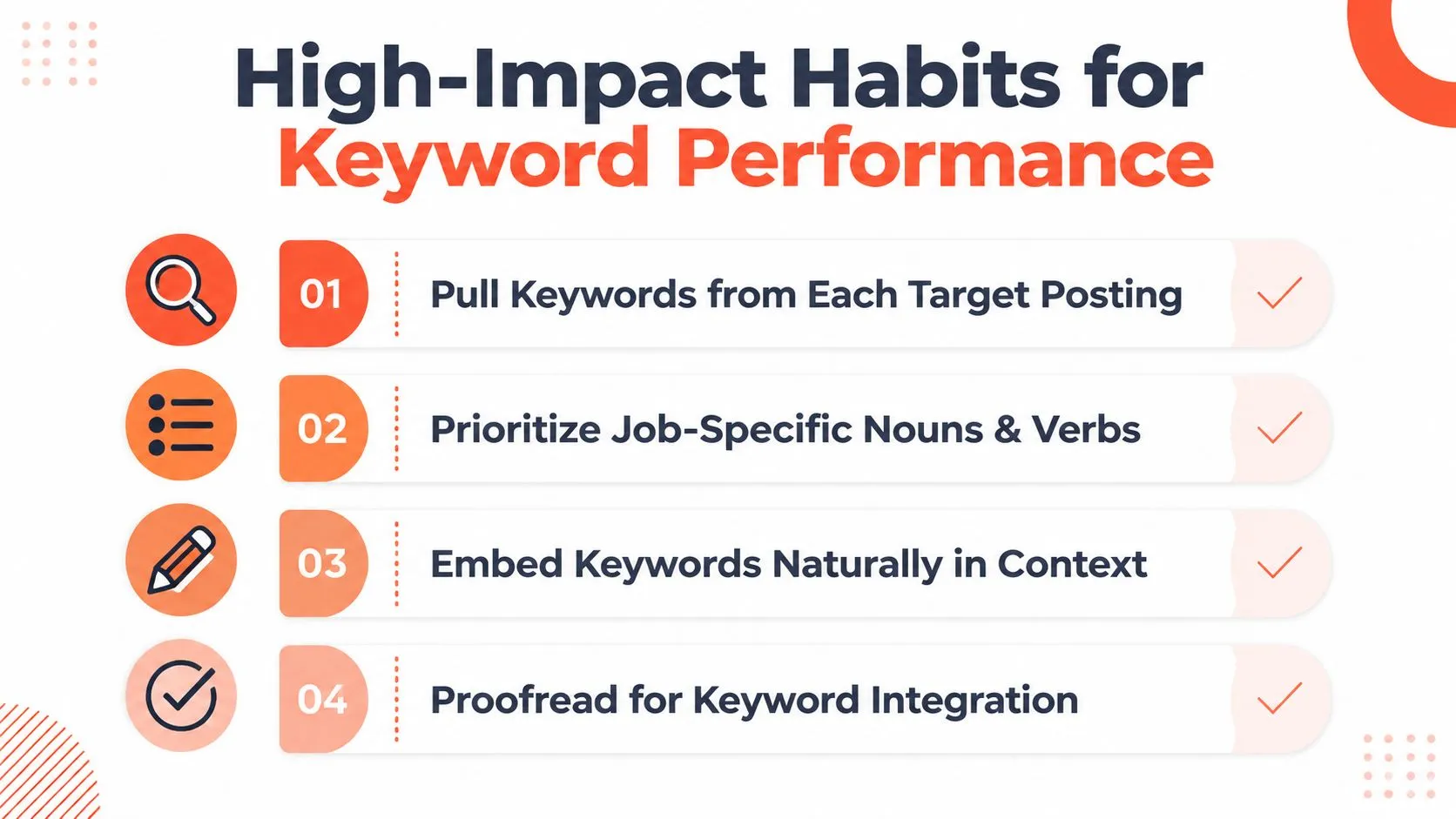
- Pull from the posting: Build the keyword list from the specific role, not a generic marketing glossary.
- Lead with evidence: Start each bullet with a clear verb, then name the channel, tool, or discipline.
- Use honest proof: Add a number you can defend, or use scope and complexity when a performance metric isn't available.
- Check the translation: Replace internal language with standard terms such as demand generation, SEO, marketing automation, or product positioning when those terms accurately describe the work.
The red flags are familiar: a wall of keywords in Skills with no supporting bullets, copy-pasted claims across unrelated roles, and tools listed without real experience. Those shortcuts make the document look optimized while making the candidate look vague.
One page is best for most professionals with under 10 years of experience, while two pages can work for people with 10+ years of highly relevant experience, according to this resume-length guide. Indeed's resume guidance also recommends one page for students, recent graduates, and professionals with one to 10 years of experience.
Your final question should be simple: can the reader see what you did, how you did it, and why it mattered?
StoryCV helps you turn real marketing work into clear, role-specific resume language without forcing keywords into empty bullets. Visit StoryCV, complete the guided interview, and start with one fully written role that balances ATS compatibility with a credible professional story.