Most mechanical engineer resume examples are useless.
They show a polished page and hide the thinking. You get a finished artifact, not the logic that made it strong. So people copy the wrong thing. They list tasks. They write bullets like “Responsible for CAD modeling” or “Assisted with testing.” That burns space and says nothing.
Your resume isn’t a work log. It’s a sales document.
The best resume example mechanical engineer pages get one thing right. They push quantifiable impact. Recruiters want proof that you improved something, reduced something, built something, or led something meaningful. That’s why examples with bullets like modeling 12 components in SolidWorks and improving design-to-prototype speed by 22%, or leading a $2M R&D project team of 6 engineers that cut production costs by 22%, hit harder than bland duty lists. Those examples come straight from BeamJobs’ mechanical engineer resume examples.
But even that advice is incomplete.
Metrics alone don’t save a weak resume. Context matters. Good bullets need action, scope, and result. Better ones also show judgment. Why this project mattered. What constraint you handled. Who you worked with. That’s the part most template libraries skip.
If you want the broader foundation first, this guide on how to create an effective resume is worth a quick read.
Now for the useful part. Not a gallery of pretty templates. A comparison of tools and guides that actually help you write a stronger mechanical engineering resume, plus four before-and-after rewrites you can steal the logic from.
1. StoryCV
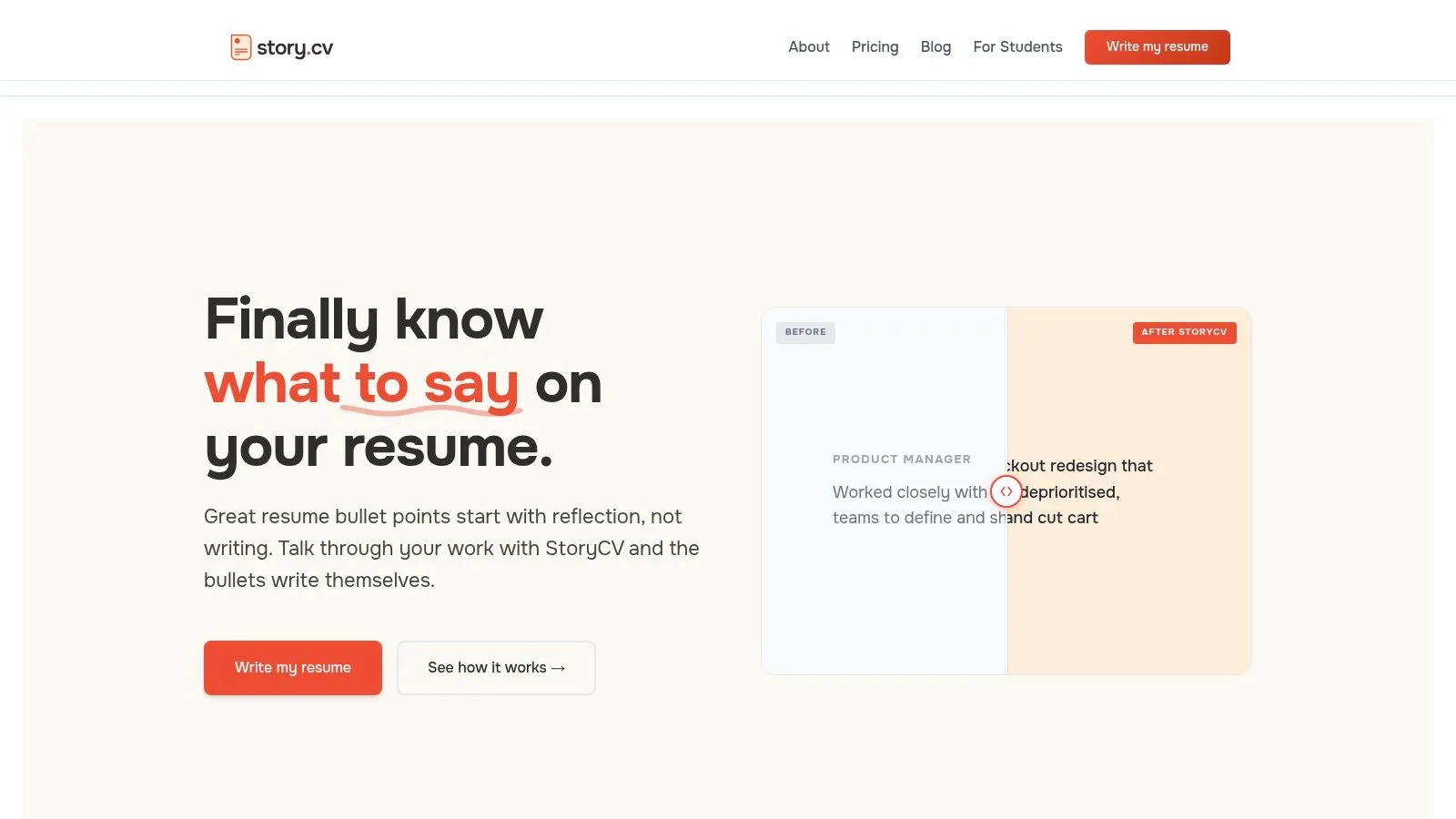
StoryCV is the best pick here if your problem is weak writing, not weak design.
That distinction matters. A mechanical engineer resume usually fails before formatting even enters the conversation. The draft is full of tasks, software names, and vague team mentions. The result looks busy and says very little. StoryCV fixes the harder part. It helps you turn raw experience into bullets that show judgment, scope, and results.
That makes it a better fit than another template library. The useful part is the rewrite. Messy before. Sharp after. Then the logic behind the change.
Why it works better than template-first tools
Mechanical engineering hiring is broader than it used to be. CAD still matters. So do SolidWorks, CATIA, Inventor, ANSYS, FEA, CFD, manufacturing process knowledge, and cross-functional communication. Employers also reward engineers who can explain tradeoffs, defend design decisions, and show they improved cost, quality, delivery, or performance. That shift shows up in Resume Worded’s overview of mechanical engineer resume expectations.
A lot of resume tools respond by cramming in more keywords. That is lazy advice.
StoryCV starts with the work itself. What changed because you were there? What constraint did you handle? What did you improve, prevent, speed up, simplify, or ship? That is the right order. Keywords matter, but only after the bullet has something worth reading.
Use this rule: Keywords get you through filters. Evidence gets you interviews.
StoryCV is especially useful for engineers with experience that does not fit neatly into a standard template. Mid-career hires. Career changers. Veterans. Returners. Engineers who owned real work but never got handed polished KPI reports.
Before and after examples you can steal
This is the angle that makes StoryCV useful. It does not just show polished outputs. It helps you see the rewrite process.
Before
- Responsible for HVAC system design for commercial buildings
- Worked with civil and electrical teams
- Ran simulations on pressure vessels
- Helped reduce production costs
Flat. Task-heavy. Forgettable.
After
- Redesigned HVAC systems for commercial building projects to improve system efficiency and support project requirements
- Coordinated with civil and electrical teams to keep design work aligned and reduce downstream rework
- Used FEA simulations to evaluate pressure vessel performance and support safety-focused design decisions
- Improved production economics by refining design choices and working with suppliers on cost-conscious part selection
Same engineer. Better framing. The rewrite adds purpose, context, and outcome. It stops sounding like a job description.
Here’s a second one.
Before
- Presented designs to clients and managers
- Reviewed data for functionality and accuracy
After
- Presented design concepts and prototypes to clients and internal stakeholders to win approval and move projects forward
- Reviewed technical data for accuracy and functionality to catch issues before release or implementation
Again, same underlying work. The stronger version explains why the work mattered.
That is the true skill. Not copying a template. Rewriting weak bullets so they persuade. If you want a practical framework, StoryCV’s guide on how to write achievement-based resume bullets is worth reading.
Best for and not best for
Best for
- Mid-level engineers: You have solid material but your draft undersells it.
- Senior engineers: You need stronger language around leadership, delivery, cost, and technical judgment.
- Career changers: You need help translating adjacent experience into clear engineering value.
Not best for
- People who only want a visual builder: StoryCV is content-first.
- Executives who want white-glove personal branding: A strong human writer may still be the better option.
If you want a resume example mechanical engineer resource that improves the writing, start here.
2. Indeed Career Guide
Indeed Career Guide’s mechanical engineer resume page is simple, free, and useful.
It’s not exciting. Good. Your resume doesn’t need excitement. It needs clarity.
Indeed gives you a grounded benchmark for what a mechanical engineering resume should include in plain English. If you’re staring at a blank page, this is one of the fastest ways to get unstuck.
Where Indeed helps
The page is strongest when you need structure.
It shows a full sample resume. It covers summary, experience, skills, and education. It also gives entry-level guidance, which matters if you’re trying to make internships, coursework, or projects look like actual experience.
That’s especially relevant because many mechanical resume resources still do a poor job helping recent graduates and returners frame non-traditional work. Personal projects, sustainable design work, and digital twin adjacent projects often get ignored in generic samples, even though those themes are becoming more important in hiring conversations.
Most people don’t need more templates. They need one solid sample and a better brain for rewriting their own bullets.
Indeed also lines up with a real gap in the market. A lot of examples show what “good” looks like but don’t explain how to uncover stronger stories from weak drafts. That’s why its plain sample can be useful as a baseline, even if it doesn’t go far enough on narrative.
A quick before-and-after using Indeed the right way
Don’t copy the sample. Use it to diagnose your own weak bullets.
Before
- Assisted with prototype development
- Worked on testing for new products
- Helped improve designs
After
- Built and tested early-stage prototypes, then translated test findings into design revisions that improved manufacturability and reduced rework
- Supported product validation by documenting failures clearly and feeding recommendations back to design and production teams
- Improved designs by identifying performance gaps, explaining the engineering tradeoffs, and pushing revisions through review
No fake numbers. No puffery. Just stronger framing.
Good fit and bad fit
Good fit
- New grads: It’s free and not confusing.
- Career returners: It gives you a conservative U.S.-style benchmark.
- Anyone rebuilding from scratch: It helps you organize the basics fast.
Bad fit
- People who already know the basics: You’ll outgrow it quickly.
- Anyone who needs deeper storytelling help: The sample is fine, but it won’t interview you or uncover nuance.
Use Indeed when you need a clean reference point. Don’t use it as a substitute for thinking.
3. Zety
Zety’s mechanical engineering resume guide is detailed, practical, and a little too template-happy. Still useful.
If you like step-by-step guidance, Zety does that well. It gives you sample bullets, formatting advice, and a builder that moves you through the usual sections without much friction.
What Zety gets right
Zety understands that engineers need concrete phrasing help.
It doesn’t just tell you to “show impact.” It gives examples of summary language, experience bullets, and skills placement. That matters if your current draft reads like a job description.
It’s also strong on format discipline. Clean layout. Reverse chronological structure. Clear sectioning. No weird design choices. That’s all good.
For mechanical engineers, that matters more than people think. Fancy layouts don’t save weak content. They usually make it worse.
If you’re tightening your skills section, this list of examples of technical skills in resume helps you avoid dumping software names without context.
Where it falls short
Zety pushes you toward a builder workflow. That’s fine until you hit the paywall for export.
It also leans heavily on the usual resume conventions. Summary. Skills. Experience. Education. That’s standard. The problem is that standard structure can tempt people into writing generic bullets.
A weak user follows the prompts and ends up with this:
Before
- Designed mechanical systems using CAD
- Managed multiple projects
- Improved efficiency
That’s dead language.
A better rewrite would be:
After
- Designed mechanical systems in CAD for active product development, balancing manufacturability, performance, and revision speed
- Managed parallel engineering workstreams while coordinating design updates, testing feedback, and production constraints
- Improved efficiency by removing bottlenecks in the design-review cycle and tightening handoff quality between teams
That’s what you should aim for inside any builder, including Zety’s.
Who should use it
Use Zety if
- You want a guided builder: You don’t want to think about layout at all.
- You need a fast first draft: It helps you move from zero to something usable.
- You like examples: It gives you enough to imitate.
Skip it if
- You hate paywalled exports: That friction is real.
- You need role-specific nuance: It won’t pull stories out of you.
Zety is solid for assembly. Not great for insight.
4. ResumeGenius
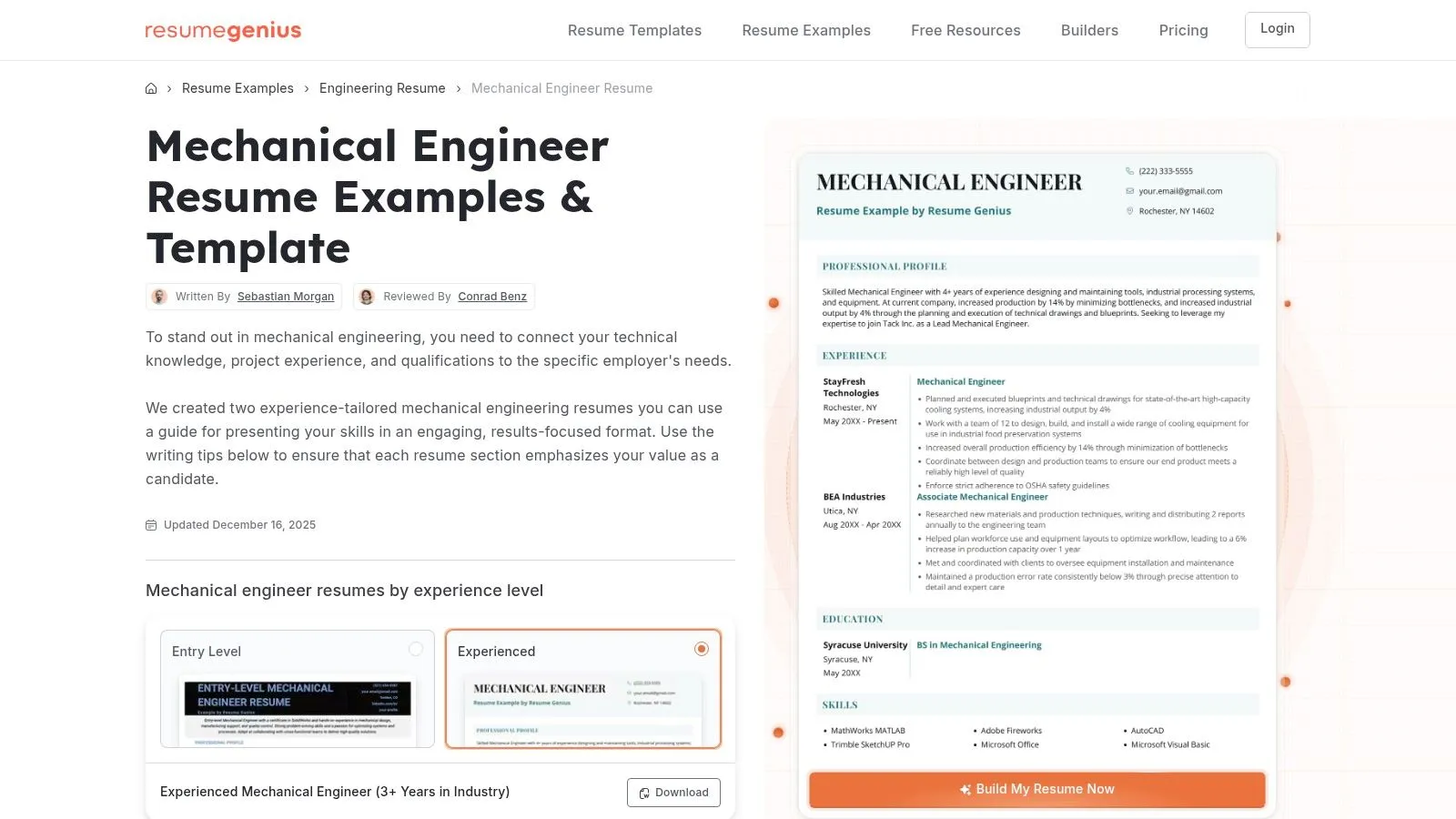
ResumeGenius is one of the better prompt-driven builders for people who need momentum.
It’s less about elegant writing and more about getting you moving. That’s not a bad thing. A mediocre draft you can edit beats a blank page you keep avoiding.
The main strength
ResumeGenius nudges you toward measurable bullets.
That matters because quantifiable achievements consistently make mechanical engineering resumes stronger. Published examples in this category keep hammering the same point for a reason. Recruiters respond when engineers show business value clearly, whether that’s cycle time reduction, cost reduction, accuracy improvement, or project scope.
The tool’s prompts can help you stop writing passive junk like this:
Before
- Responsible for design updates
- Assisted with manufacturing issues
- Worked with suppliers
And start with something closer to this:
After
- Updated component designs after test feedback to reduce downstream manufacturing issues and speed revision cycles
- Solved production problems by tracing failures to root causes and aligning fixes with manufacturing teams
- Worked with suppliers to improve part quality, lead time reliability, and design feasibility before release
That’s the right direction.
The weakness nobody says out loud
Prompted builders often make everyone sound the same.
That’s the tradeoff. You get speed. You lose some voice. For a resume example mechanical engineer searcher, that may be acceptable if you’re early in the process. It’s less acceptable if you already have meaningful experience and need sharper differentiation.
If a bullet could belong to any engineer at any company, it’s too generic.
The builder also puts download value behind payment. Again, standard playbook. Not shocking. Just annoying.
Best use case
Best for
- First-time resume writers: The wizard keeps you from stalling.
- Engineers with weak bullet habits: It forces a more impact-first structure.
- People who need a draft tonight: It’s quick.
Less ideal for
- Mid-senior professionals: You’ll need heavier rewriting.
- People with complex project history: Prompt logic can flatten nuance.
ResumeGenius is useful if you need a shove. Don’t confuse that with finished writing.
5. Enhancv
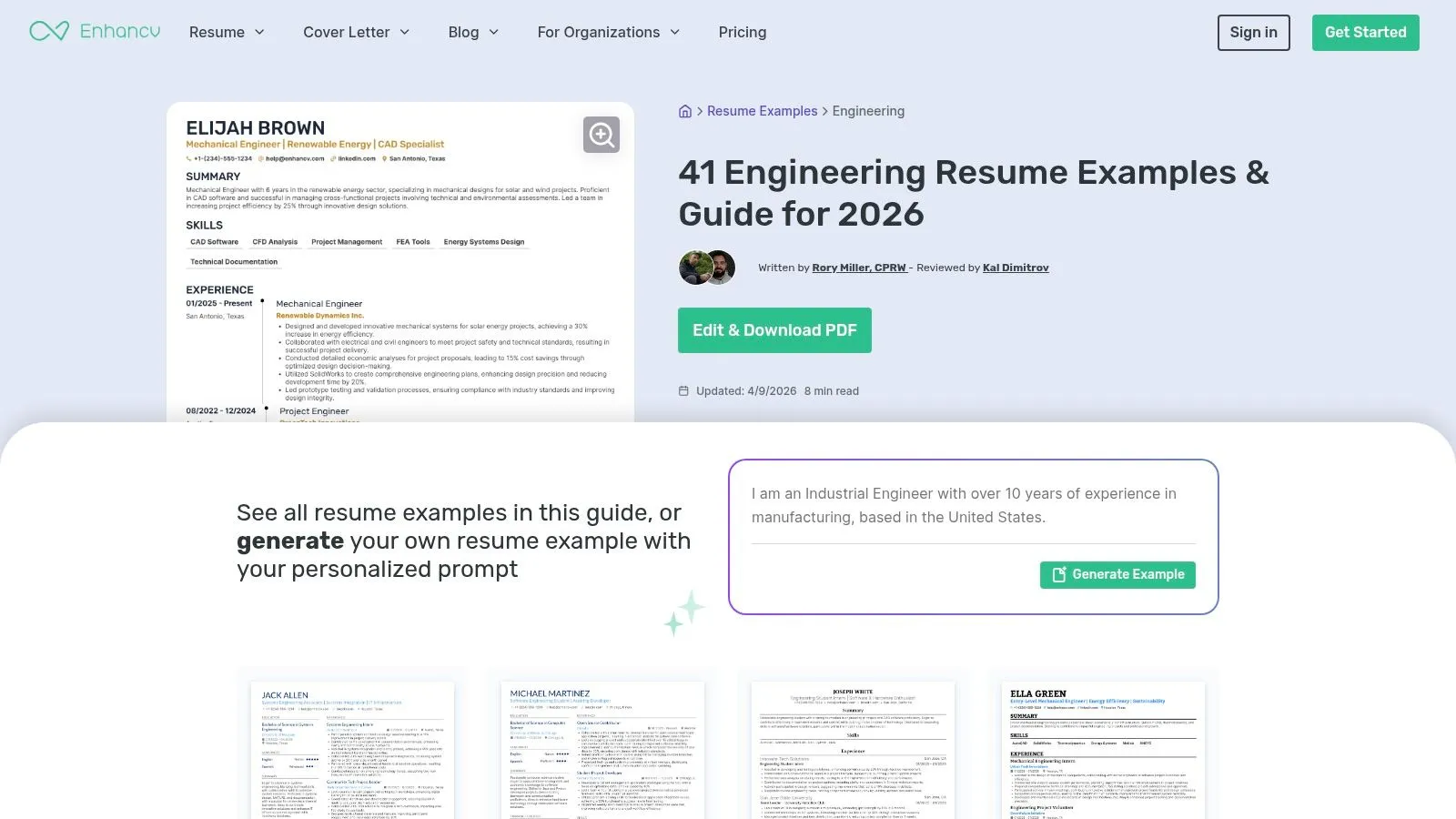
Enhancv is the design-forward option.
If you care a lot about presentation, or you want examples across subroles like mechanical engineer and mechanical design engineer, it’s strong. The templates look modern. The role library is broad. The editing flow is polished.
That said, style can become a distraction fast.
Where Enhancv earns its spot
Enhancv is good when your work is project-heavy and you need a cleaner way to show sections, skills, and highlights without the page looking like an engineering spec sheet.
It’s also useful if you’re earlier in your career. Visual separation can make internships, class projects, personal builds, and technical skills easier to scan.
If that’s you, this guide on a resume of an engineering student is a practical companion.
The role-specific examples are handy too. Seeing multiple mechanical-adjacent resumes can help you spot how different subfields emphasize different things. Design-heavy roles lean harder on CAD and prototyping. Operations-heavy roles usually benefit from stronger process, cost, and cross-functional language.
Where people misuse it
They over-design.
That’s the risk with Enhancv. Mechanical engineering hiring is still pretty conservative in many companies. If your resume looks like a brand deck, you’re doing too much.
The content still has to carry the page.
Try this contrast:
Before
- Skilled in SolidWorks, ANSYS, AutoCAD, and teamwork
- Passionate mechanical engineer with strong problem-solving skills
That’s fluff in nicer clothes.
After
- Used SolidWorks, ANSYS, and AutoCAD across design, simulation, and revision work, then communicated tradeoffs clearly with manufacturing and project stakeholders
- Solved mechanical design problems by combining analysis, test feedback, and practical production constraints instead of treating software proficiency as the whole job
That version has substance. Then design can help it, not hide it.
Use it with restraint
Best for
- Design-conscious candidates: You want a cleaner, more modern page.
- Entry-level engineers: You need stronger presentation for mixed experience.
- People comparing subrole examples: The role library helps.
Not great for
- Conservative employers: Some layouts may be too stylized.
- Anyone who thinks formatting fixes weak bullets: It doesn’t.
Enhancv is good at presentation. Just don’t let the template do the thinking for you.
6. Kickresume
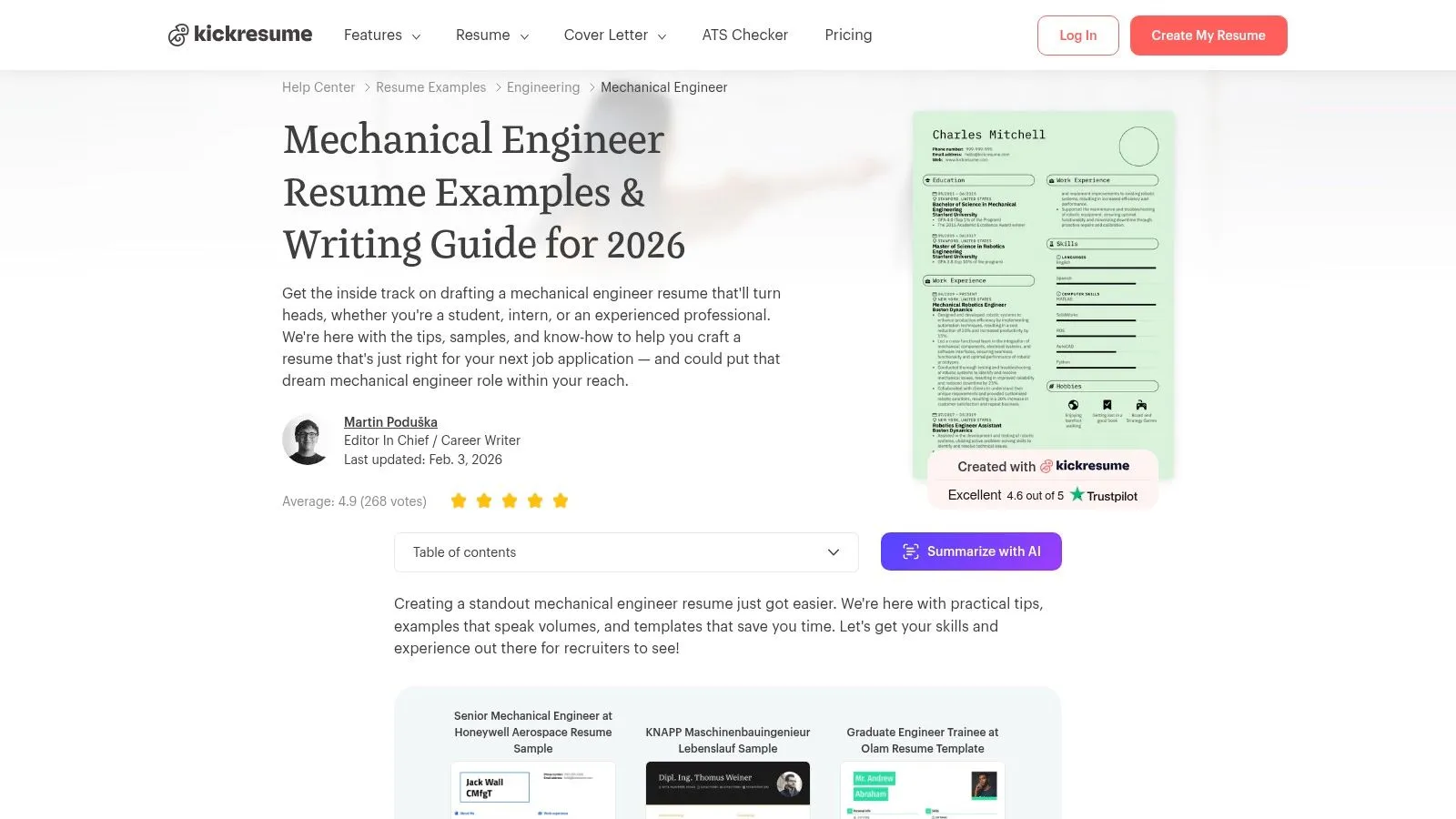
Kickresume is useful for one reason above all others. It lets you see a lot of finished resumes fast.
That sounds basic. It is. It’s also valuable.
Sometimes the fastest way to improve your resume is to study patterns. How peers title projects. How they order sections. How they compress technical work without drowning the page.
Why the example gallery matters
Kickresume’s gallery gives you more role variety than many competitors.
That helps mechanical engineers because titles vary wildly. Mechanical engineer. Mechanical design engineer. Manufacturing engineer. Project engineer. Product development engineer. Test engineer. Similar backbone. Different emphasis.
A gallery lets you compare tone and structure without reading five separate advice articles.
For example, a senior engineer should usually sound different from a junior one.
Weak senior bullet
- Led engineering team and supported product development
Better senior bullet
- Led engineering work across design reviews, technical tradeoff decisions, and cross-functional execution to keep product development moving under real constraints
That’s the kind of difference you start noticing when you scan enough real examples.
The tradeoff
More examples can also tempt lazy copying.
Don’t lift someone else’s voice whole. Borrow structure, not identity.
Steal the logic. Don’t steal the sentence.
Kickresume also leans visual. Usually clean. Sometimes a bit much for strict ATS environments. If you use it, simplify aggressively before sending to conservative employers.
Best fit
Strong fit
- People who learn by seeing examples: You want to compare several real resumes.
- Project-heavy engineers: Portfolio support can help if your work is visual or documented.
- Job seekers applying across related roles: The gallery helps you adapt tone.
Weaker fit
- People who need deeper rewriting help: Seeing examples won’t extract your own stories.
- Anyone likely to over-template: The nice designs can become a crutch.
Kickresume is a good inspiration library. Just keep your hands off the copy-paste habit.
7. Jobscan
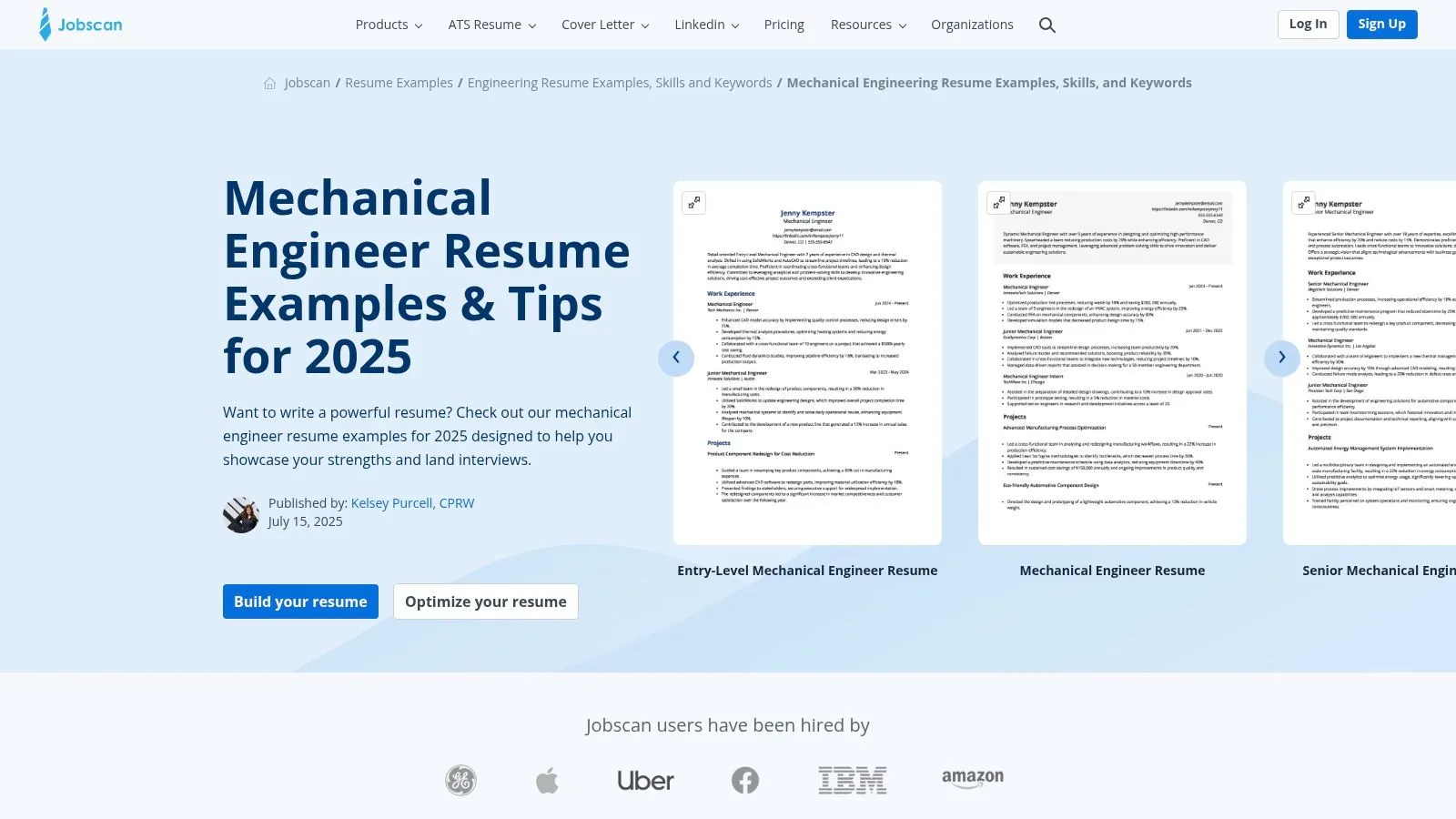
Jobscan is the ATS-first pick.
If your resume already reads well but keeps getting filtered out, Jobscan can assist. It focuses on keyword alignment, job description matching, and bullet shaping.
That’s useful. It’s also dangerous if you overdo it.
What Jobscan is actually good for
Mechanical engineers still need keyword discipline.
Skills like AutoCAD, SolidWorks, ANSYS, FEA, and CFD keep showing up across resume examples and employer expectations. Matching job-description language matters, especially when systems parse for exact phrases.
Jobscan helps you tighten that alignment. If the posting asks for FEA, root cause analysis, and Lean Manufacturing, your resume should reflect those phrases where they’re relevant.
It’s also useful for targeting different seniority levels. A junior resume may lean on coursework, software, and projects. A senior resume should foreground scope, decision-making, and stakeholder communication.
The trap
ATS optimization can turn a resume into a bag of keywords.
That’s not a resume. That’s bait.
A bad ATS-first bullet looks like this:
Before
- Used SolidWorks, ANSYS, FEA, CFD, Lean Manufacturing, Six Sigma, Root Cause Analysis, teamwork, and communication
That’s embarrassing.
A better version:
After
- Used SolidWorks and ANSYS to support design and FEA work, then applied root cause analysis with manufacturing partners to resolve recurring issues and improve production stability
Same keywords. Better sentence. Human-readable.
When to use it
Use Jobscan if
- You’re tailoring heavily: You apply to a smaller number of roles with deliberate customization.
- You suspect ATS mismatch: Your resume is good, but not aligned enough.
- You want keyword feedback: The scan workflow is efficient.
Don’t rely on it if
- Your bullets are still weak: Matching bad content to a job description still gives you bad content.
- You want beautiful templates: That’s not the point here.
Jobscan is a sharp tool for the final pass. It shouldn’t be the starting point.
Mechanical Engineer Resume Examples: 7-Source Comparison
A side by side table helps. It does not write the resume for you.
The value here is knowing what each source is good at, where it falls short, and how to use it without wasting hours polishing weak bullets. Some tools give you structure. Some give you examples. A few help you turn a messy, task-heavy draft into something that sells your work. That matters more than another shiny template.
| Tool | Implementation (🔄) | Resources & Cost (⚡) | Expected Outcomes (⭐📊) | Ideal Use Cases (💡) | Key Advantages (⭐) |
|---|---|---|---|---|---|
| StoryCV | Very low, guided interview that drafts content automatically | Free single role; subscription (~$39/mo) for unlimited edits/exports | Polished, ATS-aware bullets and role summaries with narrative focus | Students, career-changers, mid-level professionals, technical/business roles | ⭐ Narrative-first extraction, industry-aware wording, privacy-focused |
| Indeed Career Guide | Minimal, read editorial guidance and samples | Free, no downloads on-page | Clear, recruiter-aligned sample resumes and job-specific advice | New grads, career changers, low-cost benchmarking | ⭐ Credible, free U.S.-focused guidance |
| Zety | Moderate, online builder plus templates and editing tools | Freemium; exports require paid plan | Professional templates and quantified bullet examples ready for export | Users who want templates + step-by-step writing help | ⭐ Large template library; practical, actionable examples |
| ResumeGenius | Low, linear wizard with content prompts | Freemium; downloads behind paywall | Prompt-driven, numbers-first bullets and quick draft workflows | First-time users who need guided drafting | ⭐ Simple wizard; strong emphasis on measurable impact |
| Enhancv | Moderate, template-driven with AI suggestions and formatting controls | Freemium; many premium templates/features paid | Modern, visually polished resumes with content suggestions | Design-heavy roles or users wanting standout layouts | ⭐ Wide template variety and role-specific examples |
| Kickresume | Low to moderate, gallery plus in-app builder and portfolio support | Freemium; premium gets the best designs and features | Real-world resume examples and quick customizable templates | Users seeking real resume samples and portfolio integration | ⭐ "Real resume" library and cover letter pairing |
| Jobscan | Moderate, tooling-focused (scans, generators, alignment) | Freemium; subscription for unlimited scans/features | ATS-aligned resumes with measurable JD/resume match scores | Applicants targeting ATS-heavy systems and keyword matching | ⭐ Strong ATS optimization tools and resume scanning |
Here’s the blunt take. Template libraries are easy to browse and easy to overvalue. What improves a mechanical engineer resume is seeing weak bullets rewritten into sharper ones, then understanding why the rewrite works.
That is the gap this guide is built to fill.
Across these seven sources, the differences are simple. StoryCV and ResumeGenius help with drafting. Zety, Enhancv, and Kickresume help with presentation. Indeed gives solid baseline examples. Jobscan helps with final alignment against a job description. Useful. But none of that matters if the content still reads like a duty log.
Use these sources for parts, not answers.
Take the format from one place. Borrow phrasing ideas from another. Then do the hard part. Rewrite your bullets so they show decisions, scope, and results. That is why the before and after approach beats another gallery of polished samples. You need to see the bad version, the better version, and the reason for each change. That is how you build judgment, not just a prettier file.
Stop Documenting. Start Persuading.
Your resume is not a historical record.
It’s not there to prove you had a job. It’s there to argue that your work mattered. That you solved real problems. That you made engineering decisions with consequences. That you improved cost, quality, speed, safety, reliability, or delivery. If your resume doesn’t do that, it’s failing.
That’s why most resume example mechanical engineer pages fall short. They show polished outputs. They don’t show transformation. They don’t teach you how to take a weak bullet and make it persuasive.
So use this simple test.
If a bullet starts with “responsible for,” “assisted with,” “worked on,” or “helped,” rewrite it.
Start with action. Add scope. Add result. Then add context if it sharpens the point.
Here are the four patterns from the before-and-after examples above:
Task to outcome
- “Worked on HVAC design” becomes a bullet about reducing energy use and improving project efficiency.
Participation to contribution
- “Worked with other teams” becomes a bullet about accelerating delivery across cross-functional projects.
Tool to impact
- “Used FEA” becomes a bullet about improving structural performance and safety outcomes.
Activity to business value
- “Presented designs” becomes a bullet about winning projects and supporting decisions with large volumes of accurate data.
That’s the game.
You don’t need more templates. Templates are for layout. They don’t supply judgment. They don’t know which project mattered most. They don’t know whether your best story is a redesign, a failure you fixed, a supplier issue you solved, or a test process you cleaned up.
Start with a blank page.
Write the five things you’re proudest of from your last role. Not your duties. Your moments. The project you rescued. The redesign you pushed through. The analysis that changed a decision. The process you improved. The conflict you resolved between engineering reality and business pressure.
Then ask one question after each item.
So what?
If you can answer that clearly, you’re already writing a better resume.
If you can’t, you probably need an editor, not another builder.
That’s where StoryCV stands out. It doesn’t treat you like a box-filling machine. It pulls the story out of your work and turns it into bullets that sound like a capable professional wrote them. Fast. Clean. Useful.
If your resume still reads like a task list, try StoryCV. It helps you turn real engineering work into sharp, impact-driven bullets without spending your weekend fighting templates.