

The worst resume advice for job hoppers is still the most common. Hide the dates. Shrink the gaps. Hope nobody notices the pattern. That's amateur hour.
A hiring manager doesn't reject a resume because it has movement. They reject it when the movement looks random. 37% of hiring managers say job-hopping is a red flag, so a resume for job hoppers has to do more than list employers, it has to explain the career story fast, clearly, and without drama. CNBC's 2024 reporting makes the same point, the summary at the top is the place to connect short roles, gaps, and pivots into one coherent narrative, and it also notes that career gaps don't carry the same stigma they did five years ago, clarity still matters when the pattern includes multiple short stints or transitions (CNBC).
Why the Dates Are Not the Problem
Dates are not the issue. Bad context is. If your resume reads like a flat list of employers, recruiters assume the worst because they have to fill in the blanks themselves.
What hiring managers actually notice
They're not doing forensic accounting on every month. They're scanning for whether your moves make sense. The risk signal is a pattern that looks reactive, disconnected, or defensive. Visual noise, like a few short tenures, matters far less when the top of the page explains the arc.
That's why hiding dates is such weak advice. A recruiter can still see the timeline once they read the roles, and applicant tracking systems don't care about your feelings. If the story is thin, disguising the dates just delays the conversation.
Practical rule: explain the pattern first, then let the dates support it. Don't make the reader reverse-engineer your career.
The better move is to lead with progression, continuity, and value. If you changed employers to gain scope, build a niche, or cross into a new function, say that through the structure of the resume. The dates matter, but they're a supporting detail, not the headline.
Use a clean structure and keep the timeline honest. For more on the mechanics of placement and format, see how dates work on a resume.
Pick the Right Resume Format for Your Pattern
Format choice is the first real decision. Most guides avoid it because they want to sell a one-size-fits-all template. That's lazy. The right format depends on which part of your history needs the spotlight.
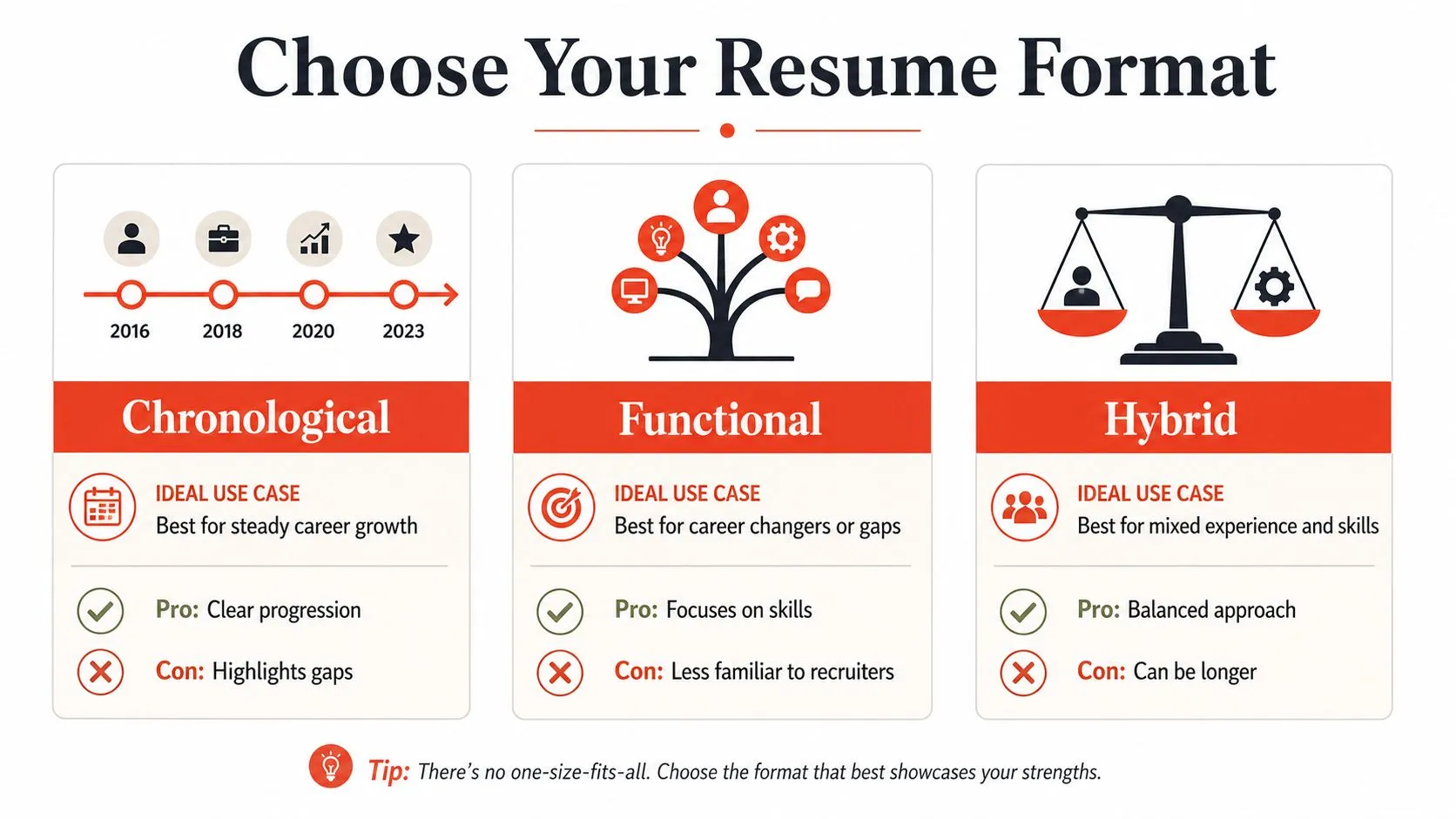
Chronological, functional, or hybrid
Chronological works when your roles moved in a sensible line and the changes were purposeful. It's the cleanest choice for mid-career professionals with three to five short roles, as long as the roles show growth, not drift. If the pattern is messy and the titles don't help you, chronological can expose that too fast.
Functional tries to hide the work history behind skills. That's why it tempts job hoppers. It also raises eyebrows with seasoned recruiters because it can feel evasive. Use it only when the target role cares far more about capability than chronology, and even then, keep it tight.
Hybrid is usually the smart play. It lets you place a strong summary and skills block above a trimmed work history, which is exactly what a resume for job hoppers needs when the story is about transferability, contract work, or a pivot. It's also the most practical option when you want the best evidence high on the page without pretending the timeline doesn't exist.
A simple rule works here. Put the strongest proof where the reader sees it first. If your value is in achievements and scope, not tenure, don't bury those bullets under a rigid timeline.
For a direct comparison of structure choices, functional versus chronological resume guidance is worth a look. And if you need to turn the finished draft into something narrative-driven quickly, StoryCV can help shape the content into a coherent resume without forcing you into a generic template.
If you're a contractor with several concurrent gigs, hybrid usually wins. If you're a career changer, hybrid can help too, because it gives your transferable skills room to breathe before the timeline starts talking.
A quick decision rule
- Choose chronological when your moves show promotion, scope growth, or clear progression.
- Choose hybrid when you need to foreground skills and achievements without erasing chronology.
- Avoid functional unless you have a very specific reason and you're ready for skepticism.
Cluster Roles and Choose Dates With a Rule
Short stints are not automatically a problem. Stupid presentation is. If you had multiple contracts, freelance projects, or overlapping roles, grouping them is often cleaner than pretending each tiny engagement deserves equal weight.
How to group work without looking slippery
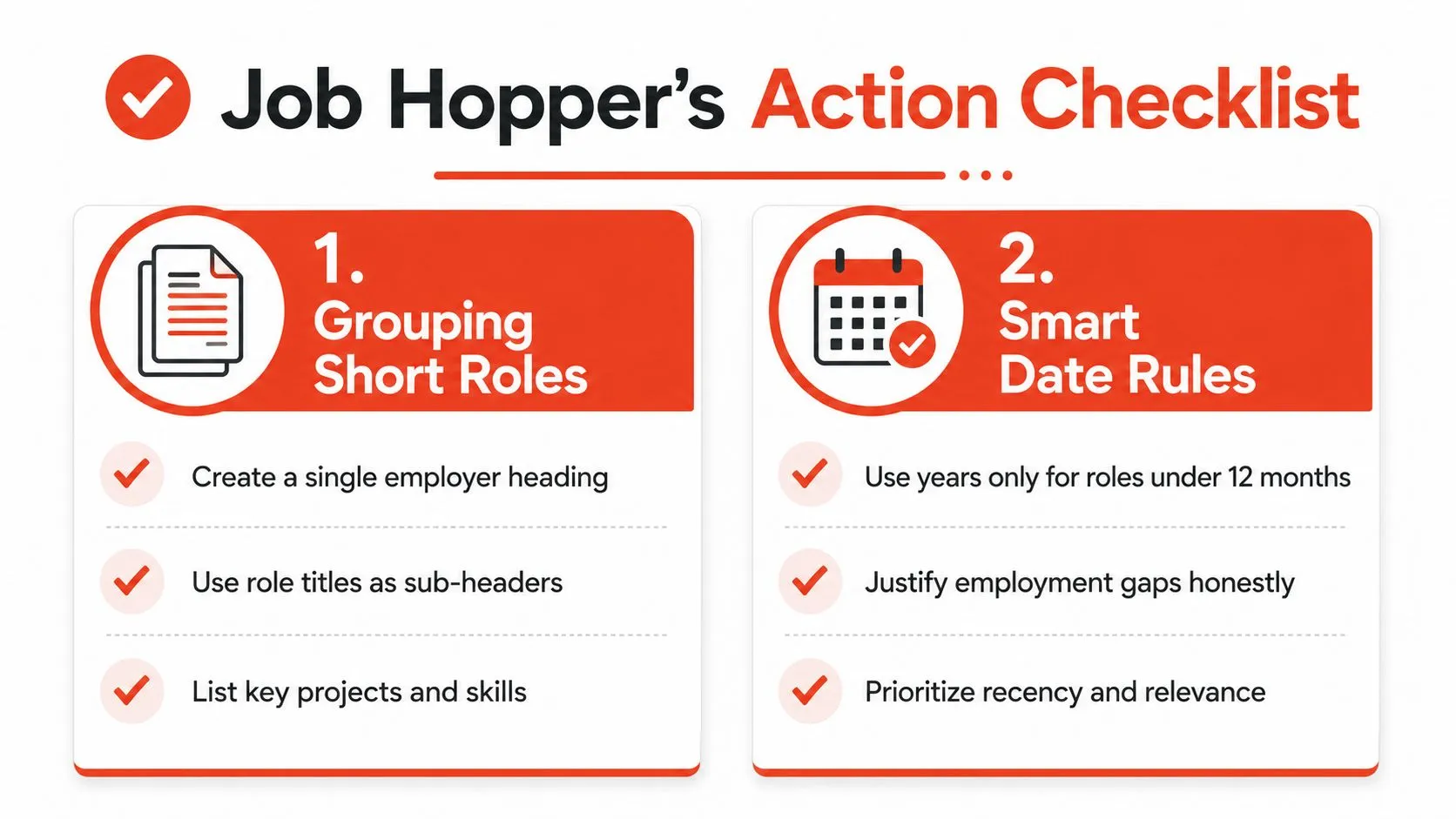
Use one heading for related contract or freelance work, then list the engagements underneath as sub-entries. That keeps the page readable and reduces the visual spam of repeated employer blocks. The point isn't to hide reality, it's to show that the pattern has structure.
A tech contractor might group four projects under one heading like this, then list the work as sub-roles with the client names or project types. That says “portfolio” instead of “drift.” An operations professional with three short roles, on the other hand, may want to keep them separate if each one built a skill the next job depended on. Same timeline, different narrative.
Decide how much date detail to show
Use month-year dates when the timing itself explains the move, like a promotion, a contract end, or a deliberate pivot. Use year-only when month detail adds noise and makes the reader obsess over a stint that wasn't the point. Compressing dates helps when the role was short and not essential to the target job, but don't use that as a hiding place for a story that still needs to be told.
Rule of thumb: if a stint was shorter than six months and doesn't support the role you want, compress it. If it taught a skill the next job needs, keep it visible and give it context.
There's one case people usually avoid. A real short tenure you'd rather not mention. BBC Worklife reports that many experts recommend keeping even a two-month stint on your CV and briefly explaining what you learned from it, because hiding it can look worse than owning it (BBC Worklife). That's the right instinct. If the omission creates a gap that's easier to question than the short role itself, keep the role and make it useful.
A better resume for job hoppers uses the least amount of chronology needed to stay credible. It doesn't pretend every stop was a milestone. It selects the pieces that prove movement had purpose.
Write Bullets That Prove Value, Not Tenure
Bullets are where the resume earns trust or wastes it. Weak bullets talk about duties. Strong bullets prove that you shipped something, improved something, or took on more scope than the title implied. That's the whole game.
Turn responsibilities into evidence
Start with the result, then name the scope, then connect it to the skill the next employer wants. That order matters. Recruiters skim for proof, not autobiography. Zippia's resume research says high-performing resume strategies often begin with action verbs, 40% emphasize quantifiable results, 29% stress relevant keywords and industry terminology, and a key skills section appears in 59% of effective resume strategies (Zippia). That lines up with what good resume writing already knows, evidence beats decoration.
Here's the before-and-after logic:
| Role Type | Before, Weak | After, Strong |
|---|---|---|
| Software engineer | Worked on product features and collaborated with teams. | Shipped core product features across two releases, improving handoff speed between engineering and design. |
| Operations lead | Responsible for daily operations and reporting. | Streamlined daily operations, coordinated reporting across teams, and carried process ownership into the next role. |
| Business analyst | Supported clients with analysis and presentation prep. | Built client-ready analyses and presentation materials that translated raw data into decisions for agency stakeholders. |
These rewrites work because they show movement with a payoff. They don't brag. They make the career path legible.
What to keep when the stint was short
Three bullets per role is usually enough for a short tenure. More than that starts to feel padded. If the accomplishment was modest, don't invent drama. State the scope, note what changed, and move on.
Use these evidence types when they're real:
- Promotion speed when a fast move upward shows trust.
- Scope expansion when you inherited more responsibility.
- Repeated renewals when contract work kept getting extended.
- Measurable delivery when projects were completed cleanly and on time.
If a role taught you something important but the results were limited, say so in one line and connect it to the next move. You're not writing a memoir. You're proving fit.
Build a Career Narrative That Preempts the Question
The summary is the most underused part of a resume for job hoppers. That's a mistake. It's the one place where you can explain the arc before the reader starts comparing start dates.

Three summary patterns that work
Intentional upward moves work best when your jumps were about gaining scope or title progression. Keep it to three lines. Mention your function, your strongest proof, and the kind of environment you're ready for next. Leave out apologies and self-criticism. Nobody hires uncertainty.
Skill-driven industry pivots need a different angle. Say what you do, what translated across the switch, and why that translation matters for the target role. Don't over-explain the old industry. The reader cares more about what you can do now than why you left.
Contractors and portfolio professionals need a summary that says you've worked across multiple environments and delivered consistent value. Name the kinds of work, not every client. The summary should make the varied timeline feel intentional, not scattered.
Keep the same story everywhere else
The summary is not a separate island. Every role entry should reinforce the same theme. If the top of the resume says you're a builder who moved for scope, the bullets should prove scope. If the summary says you're a strategist with cross-functional range, the work history should back that up.
The phrase to avoid is the one that sounds humble and weak at the same time, apologizing for the pattern. Don't write, “I've had several short roles.” That invites doubt before you've earned trust. State the pattern as a fact, then show the value it produced.
Pass the ATS Without Sounding Like a Robot
ATS failures on non-linear resumes usually come from sloppy setup, not from the job-hopping pattern itself. The parser does not care how many times you moved. It cares whether the file is readable, consistent, and keyword-matched enough to get through screening.
The four things that break the file
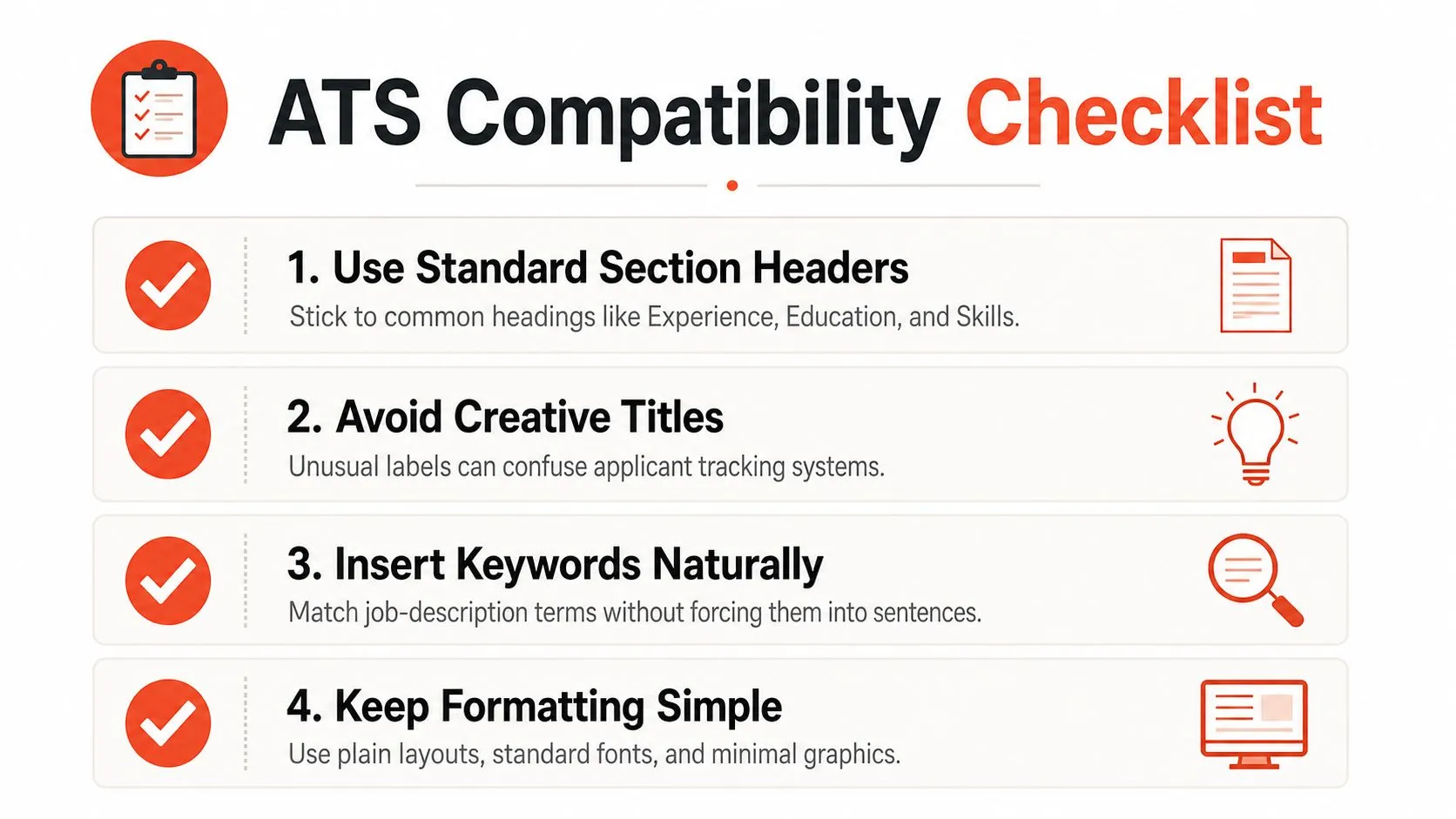
Inconsistent date formats confuse parsing and make the timeline harder to read. Pick one style and use it everywhere. Multi-column layouts look polished to people and messy to machines, so keep the structure simple. Headers and footers can hide contact info from the parser, so put the contact block in the body. Creative role titles can miss the keywords in the posting, so use the language the market searches.
The content needs the same discipline. Pull a few real terms from the job description and place them where they belong in your bullets. Keep them natural. If the role asks for project coordination, say project coordination. If it asks for stakeholder management, use that phrase only when the work supports it.
The AI resume screening guide is useful if you want a clearer picture of how automated screeners read a resume. If you want a tool that turns your history into a structured narrative without wrecking the layout, StoryCV does that without turning the process into a form-filling chore.
Submission checklist
- Standardize dates: Keep one format across every role.
- Run a parser check: Use a free ATS preview before you send it.
- Echo the posting: Work in three to five real keywords where they fit.
- Keep contact info visible: Put it in the body, not trapped in a header.
- Treat the file like a filter test: If a machine cannot read it cleanly, a recruiter will not rescue it.
- Keep your keyword choices honest: Match the posting, not a fantasy version of the role.
- Use plain text labels: “Experience,” “Skills,” and “Education” beat clever section names every time.
Speed still matters. Zippia says applicants should submit resumes within 1 to 4 days of a posting. That does not make a weak resume better. It does mean you need a clean file ready to send fast, not a polished mess that still needs fixing.
If you want a cleaner way to move fast, a resume workflow can help you grow faster on X without losing control of the details.
If the ATS cannot read it, nothing else matters.
Talk About the Moves in the Interview
The resume gets you the meeting. The interview keeps it. If you sound defensive, the room goes cold fast. If you sound clear, the pattern stops looking like a liability.
The structure is simple. One sentence on what the role was. One sentence on why it ended. One sentence on what carried forward. That's it. No excuses. No monologue.
“Roles ended because of restructuring” is fine if that's true. “I outgrew the scope and wanted more ownership” is fine too. What doesn't work is vague blame, gossip about managers, or long explanations that make the move sound messy.
Use words like scope, growth, and deliberate choice. Avoid sounding like you're asking permission for your own career. The same story should show up in the resume and the interview. If the resume says progression, the interview should sound like progression. If the resume says pivot, the interview should sound like a pivot.
The candidate who wins is usually the one who sounds calm, specific, and done apologizing.
If you want a resume for job hoppers that reads like a coherent career story instead of a list of exits, get your draft out of the weeds and into a sharper structure with StoryCV at StoryCV.