
The popular advice is to start with a template. That's backwards. A strong resume for a paraprofessional teacher starts with the records you already create, especially IEP logs, behavior charts, and intervention notes.
You're not short on experience. You're short on translated evidence. Schools need to see how you support certified educators, reinforce instruction, manage behavior, and track student progress. Your resume should make that work visible without exposing confidential student information.
Your Best Resume Material Isn't in a Template
A template can arrange your resume. It cannot prove your impact. Your strongest evidence comes from the records you create during ordinary school days.
Paraprofessionals, also called teacher assistants, teacher aides, or paraeducators, support certified educators rather than work as licensed teachers. Their duties may include supervising students, reinforcing lessons individually or in small groups, preparing materials, grading assignments, and tracking progress, as described in this overview of paraprofessional responsibilities. A list of those duties still reads like a job posting unless you show the results.
“Assisted teacher.” “Supervised students.” “Helped with classroom management.”
Those lines describe presence, not contribution. A principal needs to see what improved because you were there.
Start with proof, not formatting
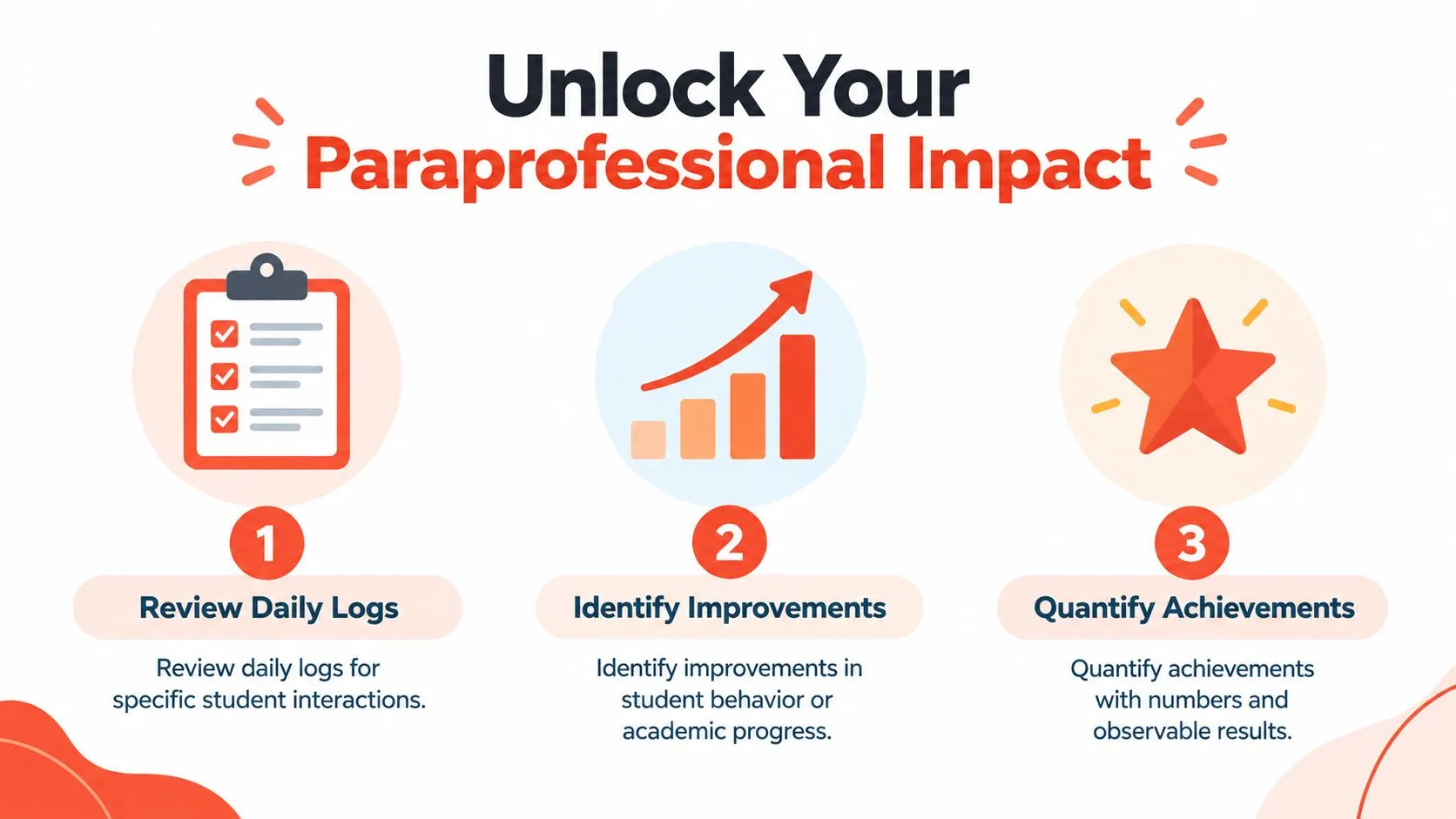
Open your secure files, binder, or completed progress-monitoring forms before choosing a template. Daily IEP data logs, behavior charts, small-group records, and intervention notes contain details that memory usually loses.
Review them for evidence such as:
-
Student reach: The number of students or groups you support during a typical week.
-
Instructional volume: How often you reinforce reading, math, communication, or life-skills practice.
-
Documented support: The intervention time you record.
-
Behavior response: Situations you help de-escalate and the return to learning that follows.
-
Team contribution: Observations you share with teachers or the special education team.
Turn those details into resume evidence without exposing confidential information. Use aggregated, anonymous descriptions. Leave out student names, diagnoses, and identifying circumstances.
Practical rule: Show the scale, method, and result of your work, never a student's identity.
Paraprofessional staffing has become an important labor-market signal. U.S. data cited by the National Council on Teacher Quality shows paraprofessionals increased by about 3.6 per 1,000 students, while teacher staffing grew more slowly. Your resume should make your effectiveness in this expanding role easy to recognize.
Find Your Impact in Your Daily Data Logs
Your strongest resume evidence may be sitting in a progress-monitoring form, not in a template.
Pull your permitted records before writing a single bullet. Memory preserves the broad story, while your documentation captures the frequency, duration, response, and outcome of your support. That detail shows the scope of your work without exaggeration.
Review the right records
Examine IEP progress notes, behavior tracking sheets, small-group logs, communication records, classroom incident documentation, and teacher-provided intervention records. Keep confidential information out of your resume and your working notes. Use student counts, group descriptions, and observable results instead of names, diagnoses, or identifying circumstances.
Build a private evidence list around these questions:
-
Who did you support? Record the number of students or groups, not names.
-
What did you support? Identify reading, math, communication, transitions, self-regulation, daily living, or another documented area.
-
How often did you provide it? Use daily, weekly, or recurring only when your records confirm the pattern.
-
How long did it take? Capture documented intervention or support minutes.
-
What changed? Note observable progress, stronger participation, improved task completion, fewer disruptions, or successful transitions.
-
What did you prevent or resolve? Include documented de-escalation or incidents resolved without administrative referral only when the record supports it.
-
Who used your observations? Note when teachers or teams relied on your progress data to adjust instruction or behavior strategies.
Turn entries into resume evidence
A log entry becomes useful resume evidence only after you connect your action to an observable result.
Weak:
- Assisted students during reading intervention.
Stronger:
- Supported small-group reading intervention, documented student responses, and shared progress observations with the classroom teacher to guide follow-up instruction.
Use a quantified version when your records support it:
- Delivered recurring small-group reading support for [number] students, documenting [number] minutes of intervention each week and reporting progress patterns to the instructional team.
Use the figures you recorded. Do not borrow numbers from sample resumes, estimate a percentage for effect, or claim an outcome you did not track. If the record shows change without a percentage, describe that change plainly.
Your daily records provide the personal evidence behind the broader role. They show how you support instruction, respond to behavior, and contribute information that helps the team make decisions. That is the material hiring managers need to see.
Structure Your Paraprofessional Resume for a 7-Second Scan
A fancy resume hides the evidence you worked to collect. A clean one lets the reader find it.
Hiring managers often spend about 7.4 seconds on an initial resume scan, according to resume review research from Wobo. That's enough time to notice your name, target role, recent employer, summary, and a few prominent outcomes. It isn't enough time to decode decorative columns or hunt through dense paragraphs.

Use a straightforward order
Build the document as a single-column resume with clear section labels:
-
Header: Full name, phone, professional email, city, and state.
-
Professional summary: Two or three sentences naming your role, experience level, strongest support areas, and one verified achievement.
-
Professional experience: Reverse chronological order, with evidence-led bullets under each role.
-
Skills: Only skills demonstrated in your experience or requested in the job posting.
-
Certifications and education: Credentials, dates, and relevant training.
Your summary should do useful work immediately. For example:
Paraprofessional with experience supporting special education and inclusive classrooms through small-group instruction, behavior support, and IEP progress monitoring. Documented student responses and collaborated with certified educators to adjust daily support. Recorded [verified result] across [verified scope].
Replace the bracketed details with your own records. Don't use a generic achievement just to fill the space.
Leave out photos, elaborate graphics, rating bars, and multi-column designs. Applicant Tracking Systems can process simple text more reliably, and human readers can scan it faster. The format should serve your evidence, not compete with it.
Use this reading order:
Name and target role → summary → current position → quantified bullets → skills → certifications → education.
The resume shouldn't feel like a scrapbook. It should feel like a clear explanation of how you help students and teachers.
Write Achievement Bullets Not Job Descriptions
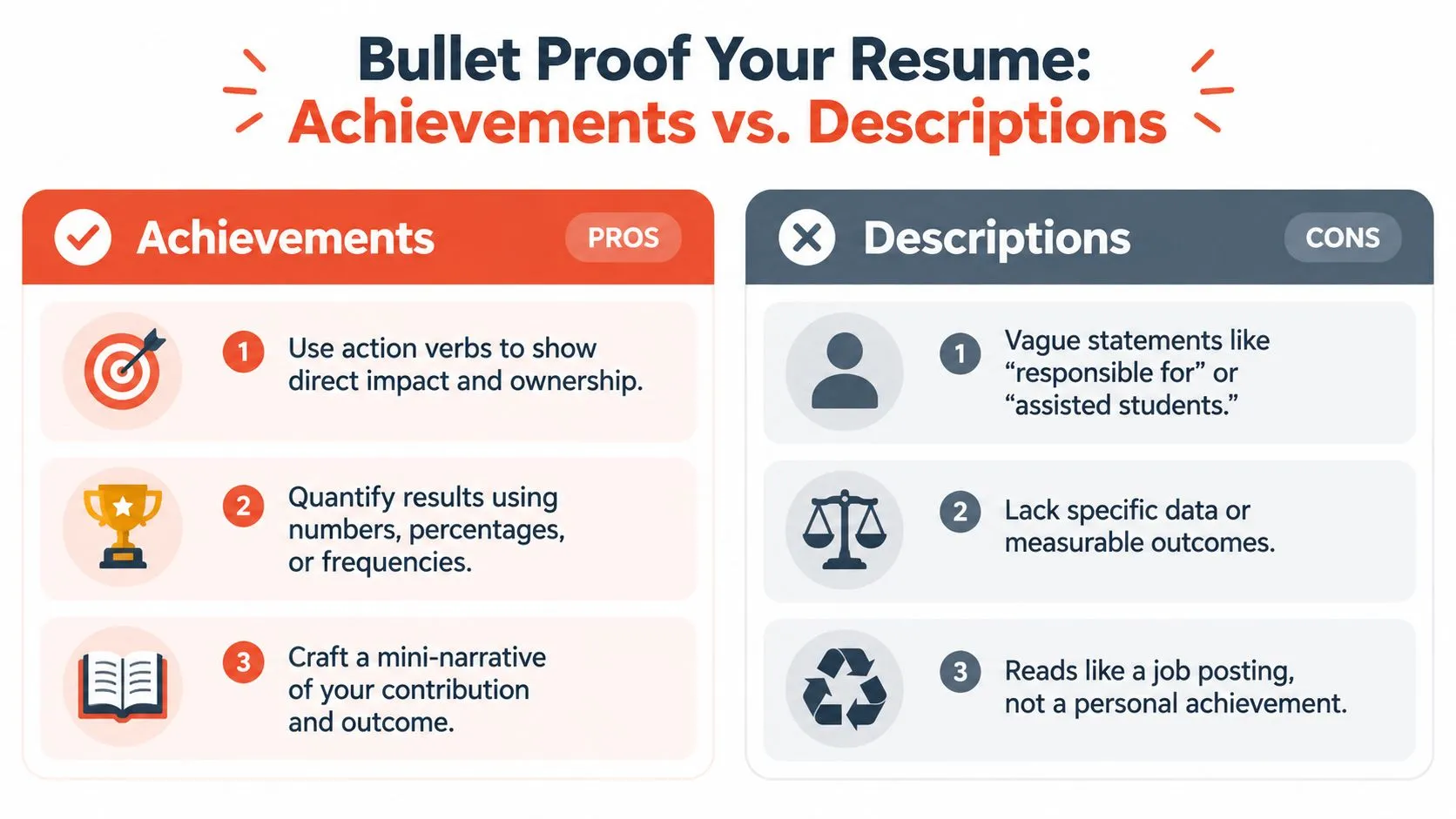
A duty tells the reader what the position required. An achievement shows what you handled, how you handled it, and what the record supports.
Use this basic pattern:
Action + support provided + documented scope or outcome
Don't force every bullet into the same sentence. Some results will be academic. Others will involve behavior, communication, independence, safety, or coordination.
Upgrade the language
Weak:
-
Assisted teacher with classroom activities.
-
Supervised students.
-
Helped students with behavior.
-
Worked with children with IEPs.
Better:
-
Reinforced teacher-led lessons through small-group and one-on-one practice, using prepared materials and documented student responses.
-
Supervised classroom and transition routines while redirecting students toward safe, productive participation.
-
Used agreed behavior-support strategies to de-escalate incidents and help students return to instruction.
-
Tracked progress toward assigned IEP goals and communicated observations to the certified educator.
Best, when your documentation supports the specifics:
-
Reinforced reading instruction for [number] students through [frequency] small-group sessions, recording fluency or comprehension observations for teacher review.
-
Documented [number] minutes of intervention each week across academic and behavioral support activities.
-
De-escalated [number] documented behavior incidents without administrative referral by applying classroom-approved regulation and redirection strategies.
-
Adapted [type of material] for students receiving IEP support, helping them participate in [assignment or routine] alongside peers.
Never invent the result. If you only know that a student completed more work after a strategy change, write that. Don't convert it into a percentage unless your records provide the percentage.
A quantified bullet earns attention. A defensible quantified bullet earns trust.
Use informal experience correctly
You may have relevant experience without a formal school title. Tutoring, babysitting that included homework or reading support, camp counseling, after-school programs, and volunteer classroom work can belong on your resume when you describe the educational responsibilities clearly. Guidance for career changers emphasizes translating these experiences into school-relevant impact statements, as explained in this paraprofessional resume guidance for informal experience.
A babysitting bullet could become:
- Supported homework completion and reading practice while maintaining routines, communicating concerns to caregivers, and adapting activities to the child's needs.
A camp-counselor bullet could become:
- Led structured activities, supervised group transitions, and used calm redirection to maintain participation and safety.
Keep the formatting readable. This effective list formatting guide is useful when your bullets start becoming crowded or inconsistent. For more role-specific phrasing, review these teacher resume bullet points, then replace generic language with your own documented evidence.
Showcase Your Skills and Certifications as Proof
The Skills section shouldn't be a keyword junk drawer. It should confirm what your experience bullets already prove.
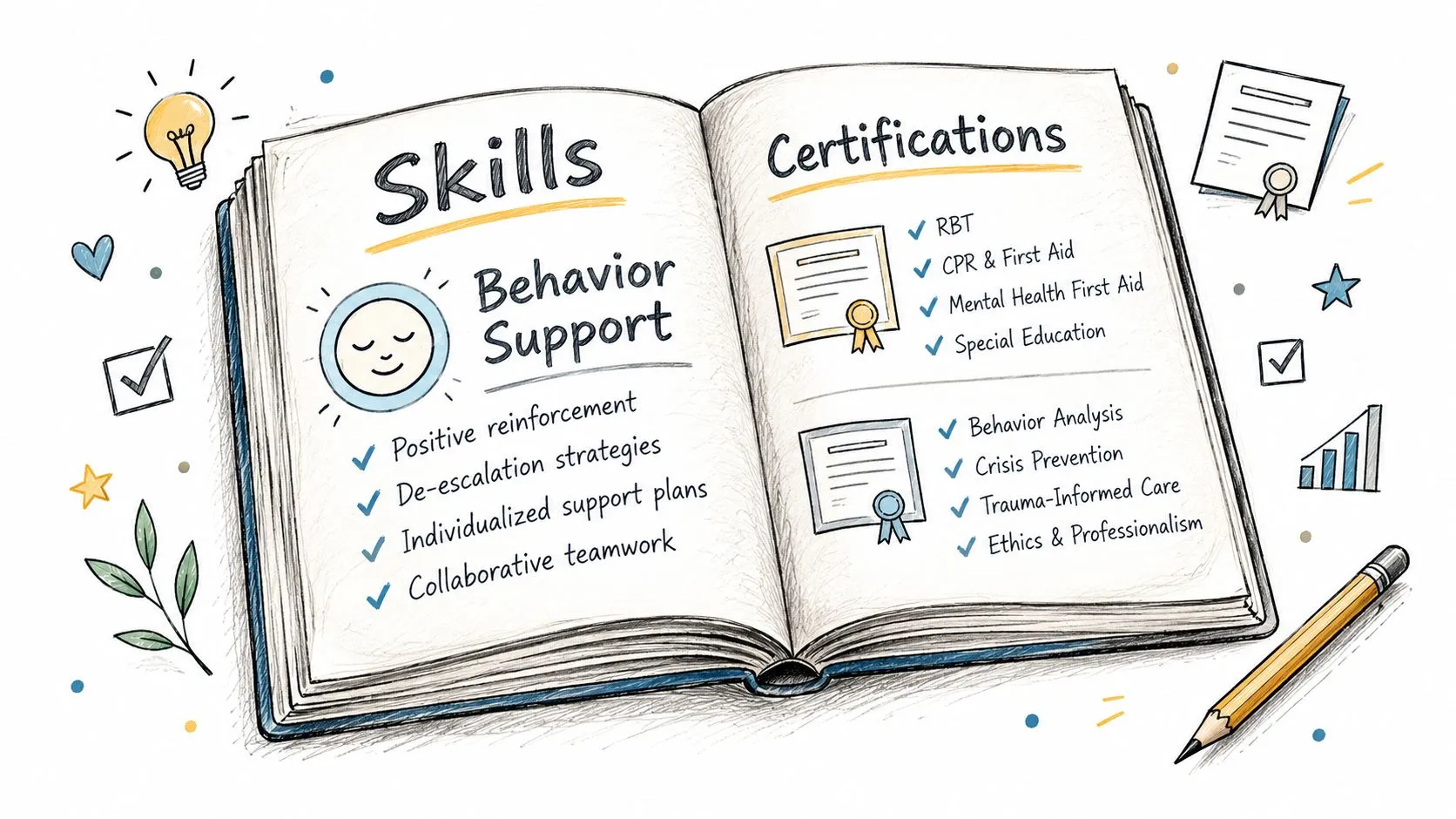
Organize skills around the work schools need:
Behavior support
Include de-escalation techniques, Positive Behavioral Interventions and Supports, trauma-informed practices, student supervision, crisis-prevention procedures, and behavior data collection when you have applied them.
Instructional support
Use small-group instruction, IEP goal tracking, differentiated instruction, lesson reinforcement, adapted materials, academic prompting, and progress monitoring when those terms match your experience.
Collaboration and care
Add communication with teachers and families, classroom organization, transition support, accessibility awareness, and teamwork. Keep the list focused. A short, relevant skill set carries more weight than a long inventory of personality traits.
Certifications add credibility because they show formal preparation. List the credential name, issuing organization when relevant, and completion or expiration date. Common paraprofessional requirements include a high school diploma or GED, student experience, and CPR or first-aid knowledge. Preferred qualifications may include an associate's degree in early childhood development or education and experience supporting students with special needs, according to this paraprofessional job-description guidance.
Write credentials plainly:
-
CPR and First Aid Certified, expiration date
-
Registered Behavior Technician, issuing organization, date
-
Paraprofessional assessment or certificate, state or district, date
-
Trauma-informed practices training, provider, date
Only list credentials you hold. Use this guide on how to put certifications on a resume to keep the section precise.
Tailor Your Resume and Handle the ATS
Your core resume should stay stable. The top half should change for each serious application.
Read the posting for the exact language the school uses. If it asks for IEP support, classroom behavior management, small-group instruction, or special education experience, use those terms where they accurately describe your background. Don't add a keyword because it might help. Add it because you can support it with a real example.
Make the match visible
Adjust these elements first:
-
Target title: Use the role name from the posting when it accurately reflects the position.
-
Summary: Lead with the student population, classroom setting, or support method the school emphasizes.
-
Recent experience: Move the most relevant data-backed bullets to the top.
-
Skills: Mirror legitimate terminology from the posting.
-
Credentials: Place required certifications where the reader won't miss them.
The ATS is only one reader. A school employee still needs to believe your claims. Keywords help the system classify your resume, but your daily data turns those keywords into evidence.
If you're applying through volunteer or school-support routes, check whether the organization requires screening before placement. This guide to school volunteer background screening can help you understand what that process may involve. Keep screening information separate from your achievement story unless the application specifically requests it.
A clean file name also helps you stay organized, such as FirstName_LastName_Paraprofessional_Resume.pdf. Before submitting, use this ATS resume optimization guide to check formatting, headings, and keyword alignment without flattening your voice.
Your final test is simple. Can a principal identify the students you support, the methods you use, and the evidence of your impact in one quick scan? If not, edit the top half before you send it.
StoryCV is an online resume writer that interviews you about your experience and turns your answers into clear, ATS-compatible resume content, including the data you collect in paraprofessional work. Start with your documented logs and visit StoryCV to build a resume that shows what you changed, not just what your job description said.