
The most popular advice for a network engineer resume is wrong: listing every protocol you've touched doesn't make you look senior. It makes your career look like a lab checklist.
A hiring team needs to understand what you changed, how much infrastructure you owned, and what improved because you did the work. That's the difference between a protocol inventory and a resume that gets read.
Your Resume Is Not a Protocol Inventory
BGP, OSPF, MPLS, STP, and EIGRP belong on a network engineer resume. They just shouldn't be the entire story.
A flat skills block turns years of engineering into a junior-style checklist. It tells a recruiter that you've encountered technologies. It doesn't tell them whether you designed a resilient WAN, reduced incident impact, improved latency, automated configuration work, or protected critical connectivity.
A resume is a translation document. You're translating infrastructure work that often stays invisible into language a non-technical recruiter and an ATS can both process. “Maintained Cisco environment” is technically accurate and professionally useless. “Operated a multi-site Cisco estate, improved incident resolution, and standardized configuration changes with automation” gives the reader something to evaluate.
Practical rule: Every protocol should support a scope, action, or result. If it doesn't, it's probably taking space from a stronger line.
The employment market gives this role enough weight to justify a sharper document. One US labor-market dataset estimates 168,129 employed network engineers, 72,346 active job openings, and an average salary of $83,557. It also projects 5% growth from 2018 to 2028, implying about 18,200 new jobs over that period, according to Zippia's network engineer employment trends. In the UK, vacancy data reports a £60,000 median salary, 1,464 permanent jobs, and 1,120 contract jobs, with a £475 median daily rate, across the measured period in IT Jobs Watch's network engineer data.
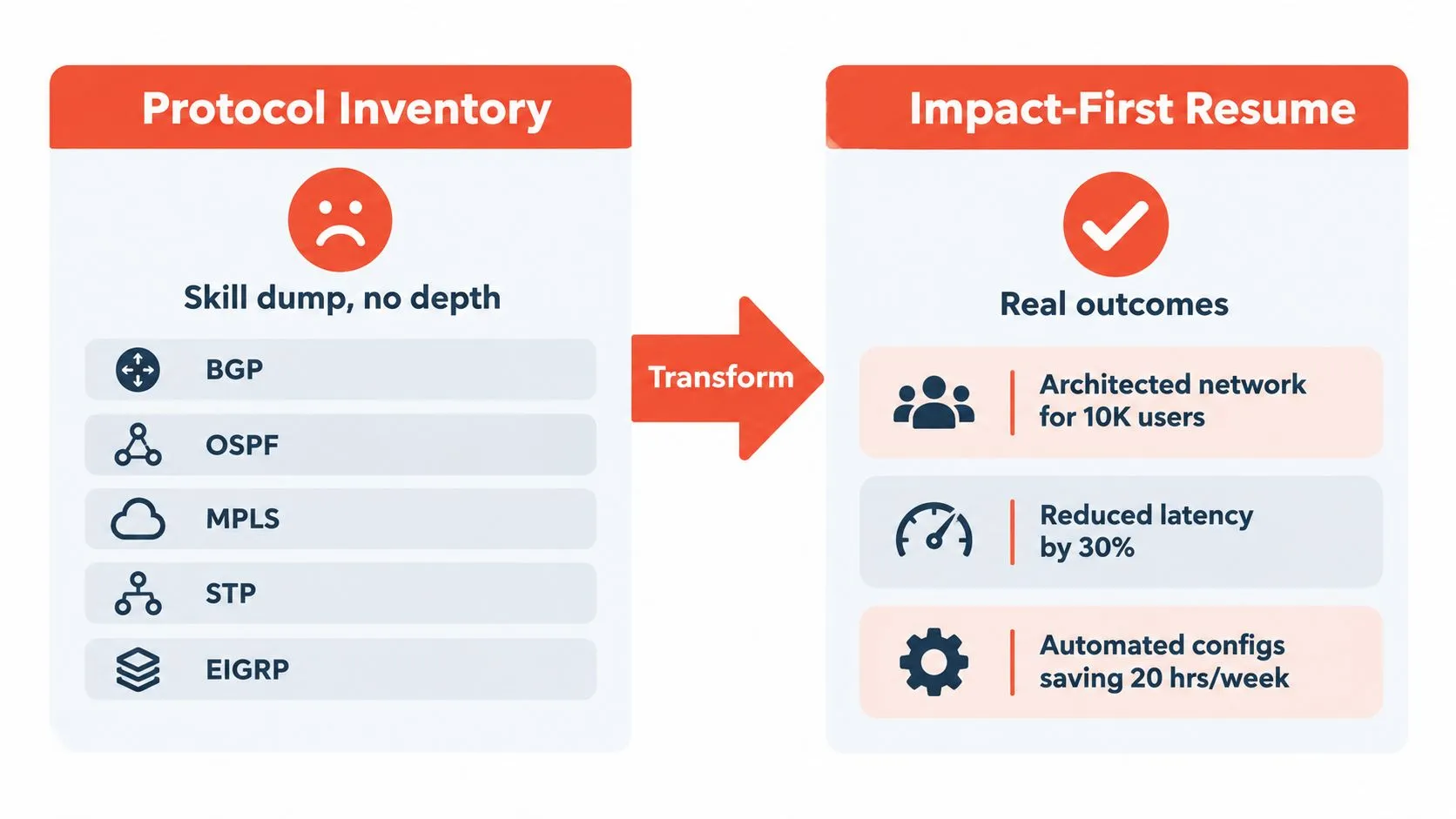
Use the technical skills resume examples as a reference for naming technologies, but don't copy its worst habit into your document. A list can help an ATS find BGP. Only an outcome shows that you knew what to do with it.
The protocol-list reflex also sends the wrong seniority signal. Senior engineers make decisions about reliability, capacity, risk, cost, and operational effort. If every bullet could have been written by someone who only configured the device, your resume is describing the bottom of your responsibilities, regardless of your actual title.
The Skeleton That Survives Every ATS
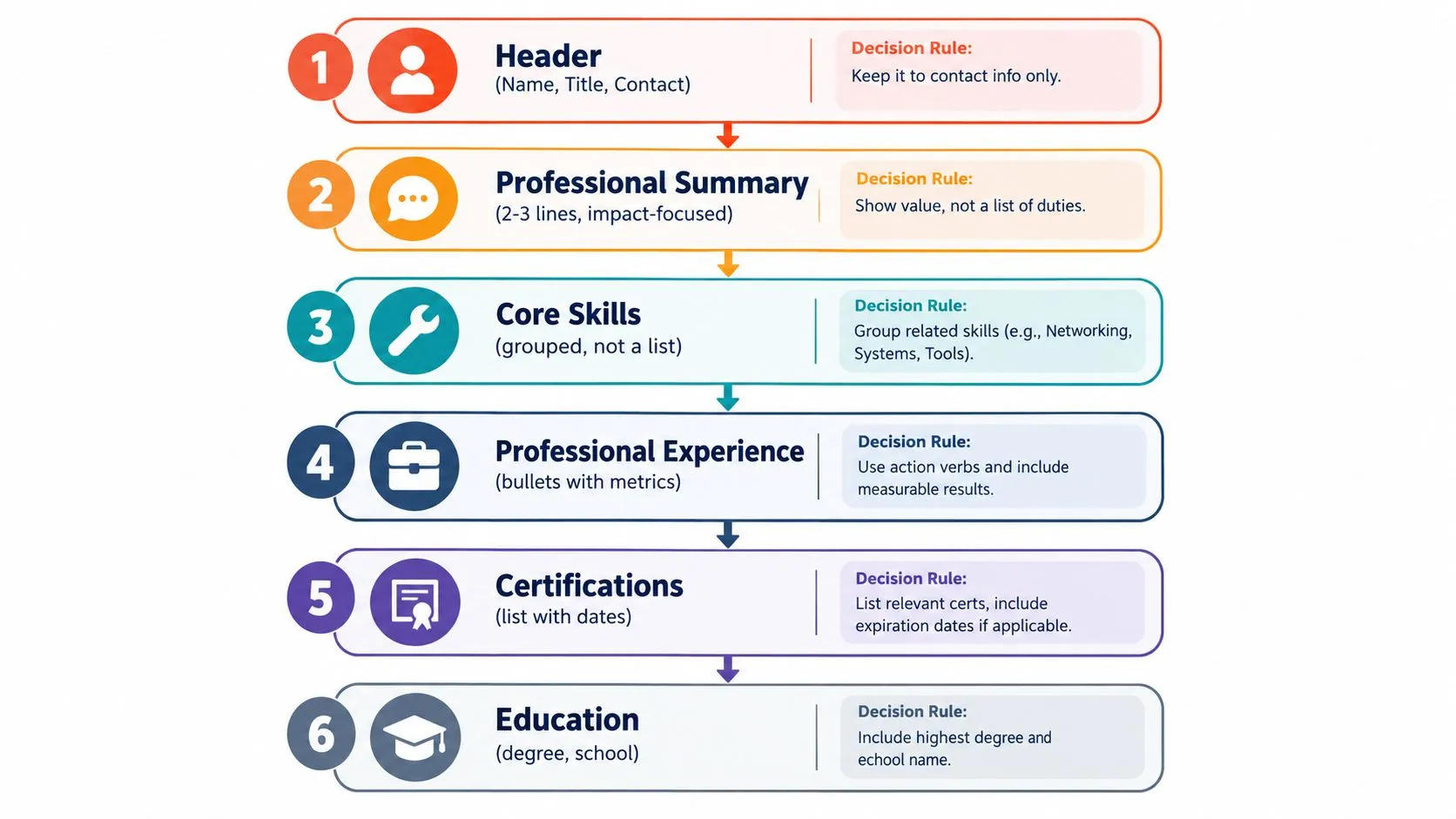
A strong network engineer resume has a boring structure because boring structures are easy to parse and easy to scan. Use reverse chronology, standard fonts, clear section headers, and enough white space for a recruiter to find the signal quickly. Neutral resume guidance for network engineers supports that structure and recommends quantifying devices, uptime, MTTR, and sites supported.
Header and summary
Keep the header to your name, target title, location, phone, email, and a professional link if it adds value. Don't use a graphic banner or bury contact details in a decorative layout.
Your summary has one job. Answer what kind of network engineer you are, what stack you use, and what scale you've supported in two or three lines. For example:
Network engineer specializing in enterprise LAN/WAN, Cisco and Juniper infrastructure, BGP, OSPF, firewalls, and network automation. Experienced supporting distributed environments through design, incident response, security controls, and infrastructure standardization.
That says more than “results-driven IT professional with excellent communication skills.”
Skills and experience
Group skills by how the work gets done, not alphabetically:
- Routing and switching: BGP, OSPF, EIGRP, MPLS, VLAN, STP, VXLAN
- Cloud and automation: Azure networking, Python, Ansible, Terraform, API integration
- Monitoring: Wireshark, SNMP, NetFlow, network performance monitoring
- Security: firewalls, VPN, segmentation, access policies, NAC
- Platforms: Cisco IOS, Cisco Catalyst, Juniper Junos, Palo Alto, Fortinet
Experience bullets should follow outcome, action, scope. Lead with the result when you have one, then name the technology and the environment that made the work meaningful.
“Configured firewalls” is a task. “Strengthened perimeter controls by redesigning firewall policies across distributed sites” is a responsibility with context. Add a defensible measure whenever you have one.
Certifications and education
Put CCNA, CCNP, CCIE, JNCIS, and PCNSE in a dedicated Certifications section. Don't hide credentials in the skills block, where parsers and recruiters may miss them.
Education can stay to one line unless you're early in your career. Labs also get one line unless they prove a capability you can't demonstrate through employment. If the resume exceeds two pages, cut labs, old coursework, generic soft skills, and repetitive maintenance bullets before cutting relevant project outcomes.
A network engineer resume should default to one page for early-career candidates and two pages for experienced engineers, based on guidance from The Interview Guys' network engineer resume recommendations. Don't turn it into a project archive.
Writing for Junior, Senior, and Architect
The same infrastructure stack should read differently at each level. Consider a large enterprise running Cisco Catalyst Center and Juniper edge equipment across many sites. The junior engineer proves hands-on reliability. The senior engineer proves ownership. The architect proves judgment.
| Resume Writing by Seniority Level | Junior | Senior | Architect |
|---|---|---|---|
| Primary signal | Hands-on execution and ticket ownership | Infrastructure scope and operational outcomes | Design authority and strategic trade-offs |
| Strong bullet | Configured VLANs and assisted with switch changes under senior review. | Owned switching standards across enterprise sites, coordinating maintenance, incident response, and cross-team changes. | Defined the target campus architecture, evaluated Cisco and Juniper options, and set the migration roadmap. |
| What to quantify | Tickets, changes, incidents, tools used | Devices, sites, MTTR, uptime, migrations | Cost model, risk reduction, roadmap scope, vendor decisions |
| What to avoid | Pretending to own architecture | Listing only configuration tasks | Writing like the primary escalation engineer |
A junior bullet can be task-heavy because the reader is assessing technical foundation and learning velocity. “Resolved connectivity tickets using Wireshark and documented root causes” is useful when the candidate is proving operational competence.
A senior bullet should move upward. “Reduced recurring connectivity incidents by standardizing switch-change procedures and coordinating network, platform, and service desk teams” shows ownership beyond the command line. Add the actual device or site scope if you can defend it.
An architect's resume should spend less time on routine troubleshooting. “Selected the target routing and security architecture, compared vendor capabilities, and established a phased migration plan” communicates decision-making. The technical terms still matter, but they support the architecture story instead of replacing it.
If every bullet could be written by a junior with the same tools, the senior engineer is writing too far down the stack.
Metrics That Prove You Did the Work
Infrastructure work is quiet when it succeeds. That's precisely why your resume needs evidence.
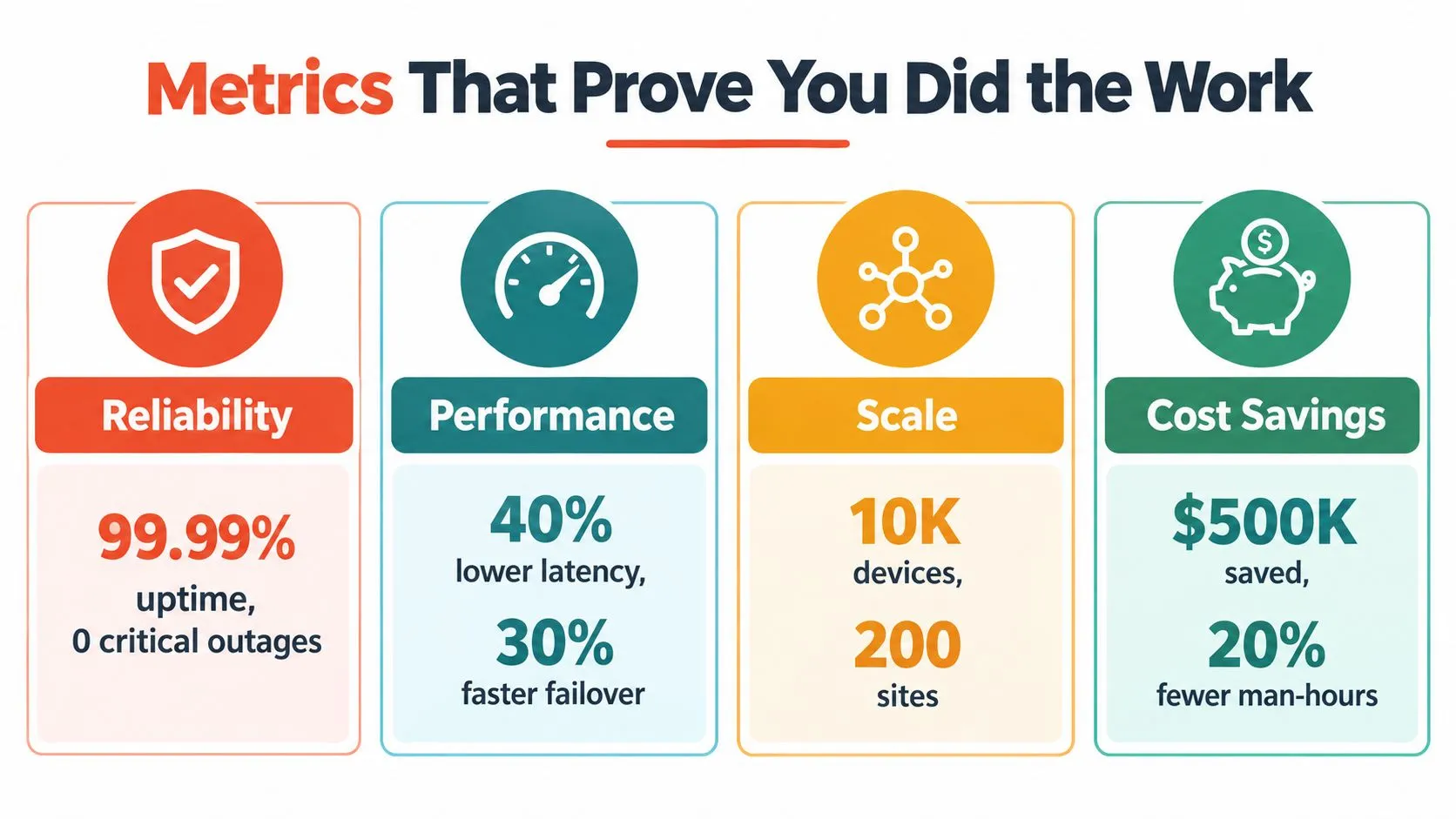
The useful metric families are reliability, recovery, performance, scale, capacity, and cost. Don't add numbers because numbers look impressive. Add them because they explain the size or consequence of the work.
Reliability and recovery
Availability belongs beside scope. “Maintained network uptime” is weak because it lacks an environment. A stronger version is:
- Before: Managed Cisco infrastructure across multiple sites.
- After: Operated a 600-device Cisco Catalyst estate across 14 sites with 99.99% uptime over 18 months.
Use only figures you can explain in an interview. If uptime was measured by a monitoring platform, know which systems and exclusions shaped the result.
For incident work, show the change in recovery:
- Before: Troubleshot network outages and escalated incidents.
- After: Reduced mean time to resolve from 47 minutes to 12 minutes over two quarters by improving triage runbooks and escalation paths.
Performance and scale
Latency, jitter, packet loss, devices, sites, prefixes, concurrent sessions, and bandwidth utilization all make invisible work legible.
- Before: Improved voice network performance.
-
After: Cut jitter from 18ms to 4ms on VoIP VLANs by revising QoS classification and path selection.
-
Before: Supported enterprise network infrastructure.
- After: Supported 14 sites, 600 devices, and distributed WAN connectivity through monitoring, change management, and outage response.
Cost and capacity
Cost savings need a clear connection to your action. “Saved money” is not a network achievement. “Redesigned WAN connectivity and reduced annual spend by $220K” tells the reader what changed, but only use that figure if it's documented and defensible.
Capacity can be physical or operational:
- Before: Optimized data center infrastructure.
- After: Freed 40% rack density through equipment consolidation and revised network placement standards.
Your number should answer one question: what became better, faster, smaller, safer, or cheaper because of your work? The metrics in a resume guide offers a broader framework, but your own records remain the authority.
Use the following video as another way to think about turning responsibilities into evidence.
ATS Rules and the Format That Beats Them
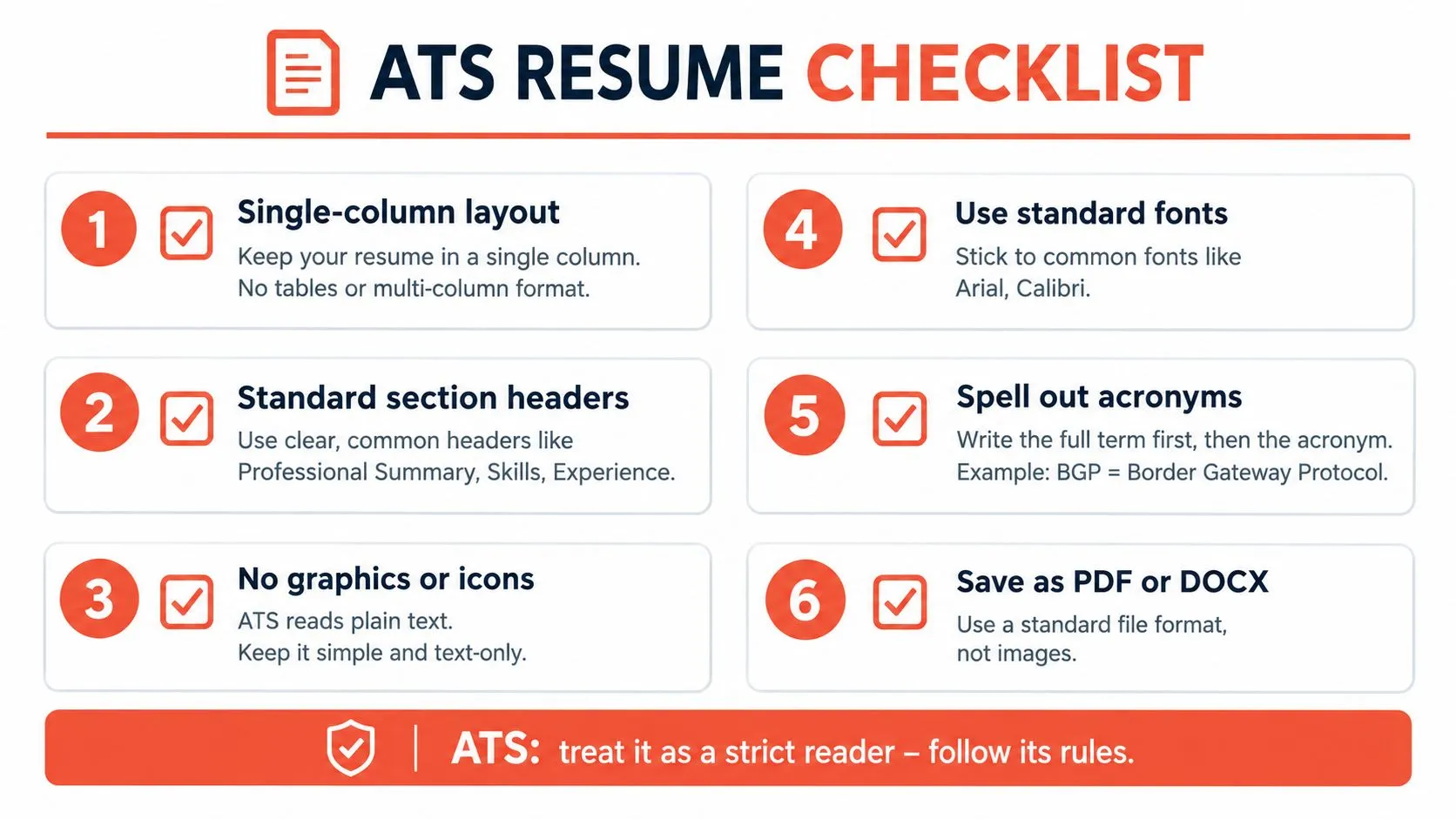
An ATS isn't your enemy. Treat it like a strict reader with limited patience and predictable habits.
One industry benchmark claims that 97.8% of Fortune 500 companies use ATS filtering before human review. The same source reports that unoptimized technical resumes passed ATS 38% of the time, compared with 74% for keyword-optimized versions, according to the QuietHire ATS pass-rate study. The lesson isn't to stuff your resume with acronyms. It's to use the exact language of the target role in a clean document.
The format decision
Use a single column, standard section headers, ordinary fonts, and a readable file format. Avoid tables, text boxes, headers, footers, icons, and images of certifications. Keep the document visually calm.
- Do: Use “Professional Summary,” “Skills,” “Experience,” “Certifications,” and “Education.”
-
Don't: Rename sections “What I Bring” or place skills inside a decorative sidebar.
-
Do: Write “Border Gateway Protocol (BGP)” once, then use BGP naturally.
-
Don't: Hide key terms in a graphic or assume the parser will interpret an image.
-
Do: Write bullets with a clear verb, technology, scope, and result.
- Don't: Use a paragraph that buries five protocols and no outcome.
A clean 11-point body, 13-point section headers, bold job titles, consistent dates, and generous white space works for both software and humans. Keep bullet lines under two lines where possible. If a date needs alignment, use a simple right-aligned text treatment, not a table.
For a more detailed reference, use this practical guide on how to format an ATS resume. You can also review resume optimization for ATS, but don't let formatting become a substitute for clear evidence.
Hybrid Careers and the Cloud Pivot
A hybrid resume should show direction without pretending the transition is complete.
Take a network engineer with eight years of Cisco routing and switching experience who has spent the last phase of their career automating with Python and Terraform, supporting an Azure landing zone, and building an Ansible-driven configuration baseline. That person shouldn't suddenly claim to be a cloud architect. The credible positioning is a network engineer with growing cloud and automation ownership.
A credible hybrid experience block
Senior Network Engineer
- Owned enterprise routing and switching across Cisco infrastructure, including BGP, OSPF, and VXLAN design, operational support, and incident response.
- Partnered with the platform team to support Azure vWAN connectivity, translating on-premises routing requirements into cloud network controls and documented operating procedures.
- Built an Ansible-driven configuration baseline for recurring network changes, using Python and Git to standardize validation and reduce manual variation.
- Developed Terraform modules with the platform team for repeatable network provisioning, reviewing changes through the existing engineering workflow.
- Documented connectivity patterns spanning Cisco routing, Azure vWAN, Terraform, Ansible, Python, and Git.
The phrase “partnered with the platform team” works only when the bullet names your contribution. “Helped with cloud” sounds like tourism. “Translated routing requirements into Azure vWAN connectivity controls and documented the operating procedure” shows useful adjacency without inflating ownership.
This approach also protects your technical identity. Name BGP, OSPF, VXLAN, Terraform, Ansible, Azure vWAN, Python, and Git where they belong. The network reader sees your foundation. The cloud reader sees a trajectory. Neither has to guess what you did.
A current skills summary from Vertical Talent Solutions highlights monitoring, firewalls, automation, BGP, network security, OSPF, VPN, Python, and DNS among demanded network engineering capabilities. Another discussion of network engineering skills companies want emphasizes the expanding overlap with Python, Ansible, Terraform, cloud networking, AI-assisted troubleshooting, and network analytics.
Don't flatten that overlap into a giant keyword block. Put cloud and automation in recent experience when you've used them, then keep the older network foundation visible. A hybrid resume should read like a network engineer learning cloud fluently, not a cloud engineer erasing the past decade.
The Final Pass and What to Cut
Run this review before you send the resume. Start with the cuts that remove noise, then tighten the evidence.
- Delete the objective statement: It consumes space without proving capability. Your target title and summary should do that work.
- Delete “references available on request”: Employers already know they can ask. The line adds nothing.
- Delete soft-skill clichés: “Team player” and “excellent communicator” waste keyword space unless demonstrated through a real project or result.
- Delete pronouns outside the summary: Bullets are sharper without “I,” “we,” or “my.”
- Trim skills over 20 items: A giant list looks like keyword stuffing and weakens the terms that match the role.
- Remove “responsible for”: Start with “designed,” “automated,” “resolved,” “standardized,” “implemented,” or “owned.”
- Remove duplicate protocols: If BGP appears in every role without a different achievement, it's repetition, not proof.
- Add missing scope: Devices, sites, environments, users, incidents, or change volume make infrastructure visible.
- Strengthen “managed”: Replace it when you can name the decision or action. “Managed” often hides ownership.
- Align dates consistently: Inconsistent formatting makes the document look unfinished and slows the skim.
- Check the length: Keep one page as the default and two pages as the senior ceiling unless the extra material is directly relevant.
For another useful cut list, review these resume items to avoid. The point isn't minimalism for its own sake. It's protecting the reader's attention and making your seniority visible before the strongest bullets disappear inside maintenance history.
A resume network engineer document works when it translates invisible infrastructure into scannable impact. Every line should prove scope, judgment, technical depth, or outcome. Everything else gets cut.
StoryCV is an online resume writer that interviews you about your work and turns the answers into clear, role-specific bullets, including for network engineering careers. Start with one fully written role for free by visiting StoryCV, then use the result to replace protocol lists with evidence recruiters can understand.