You shipped the migration. You stabilized the platform. You handled the incident nobody else wanted. Then why does your resume just say you were “responsible for maintaining infrastructure.”?
That's the whole problem.
If you're looking at resume writing services for IT professionals, you're probably asking two sane questions. First, will a non-technical writer flatten your work into generic sludge? Second, is paying for resume writing help worth it?
My view is simple. For technical resumes, the bottleneck usually isn't writing. It's translation. You already did the hard work. The actual hard part now is getting the actual achievement onto the page without losing the technical truth.
Why Your IT Resume Is So Hard to Write
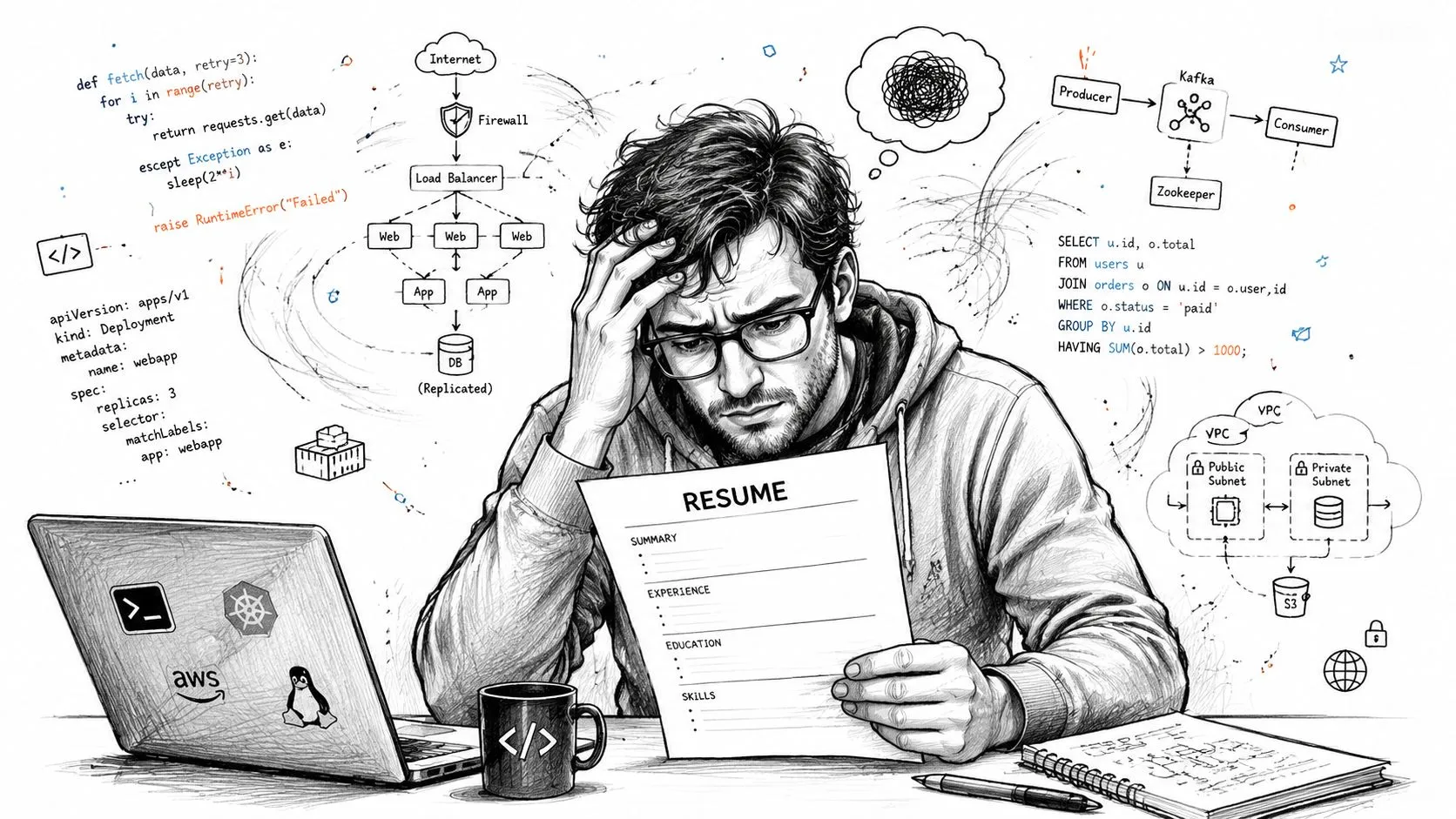
Technical people don't usually have a motivation problem. They have a compression problem.
You know exactly what happened in the migration, incident, re-architecture, or reliability push. You know why it was hard. You know which tradeoffs mattered. But a resume has to communicate that to two very different readers: an ATS and a human who often isn't a technical expert.
The real issue is translation
A lot of strong engineers write like this:
-
Too internal: They describe the implementation in terms only their team would care about.
-
Too flat: They list duties, tooling, and ownership, but not what changed because of their work.
-
Too compressed: They skip the stakes, so the difficulty disappears.
That's why technical resumes get flattened so easily. “Implemented Kafka event architecture” might be accurate, but it doesn't tell a recruiter why that mattered, what broke before, or what outcome leadership cared about.
Your work can be impressive and still read as ordinary if you don't translate the difficulty, stakes, and outcome.
Why generic advice breaks on technical roles
Most resume advice is built for broad audiences. It tells you to use action verbs, keep it concise, and tailor for keywords. Fine. That's not enough for a technical resume.
Software, DevOps, SRE, security, data, platform, and IT leadership roles all involve invisible complexity. The hard part is often architectural judgment, risk reduction, reliability work, performance tuning, or preventing failure. That doesn't show up well if you treat the resume like a grammar exercise.
If your tech CV isn't getting responses, the problem is often this translation gap, not a lack of experience. StoryCV has a useful breakdown of that in this piece on why your tech CV may not be getting responses.
How Traditional Resume Writing Services for IT Professionals Work
Let's be fair. Done-for-you resume services are a real category, and plenty of people use them. The global resume writing service market is projected at $2.69 billion in 2026 and growing at an 8.1% compound annual growth rate, according to The Business Research Company's market report.
That demand exists for a reason. People want help.
The standard model
A traditional service usually works like this:
-
You submit your current resume or work history
-
A writer reviews your target role and background
-
They interview you or send intake questions
-
They rewrite the resume
-
You request revisions
That workflow is common across the category. Some providers also describe a more structured process: intake, role analysis, strategy, draft, then revision, with writing done from scratch rather than from a template.
What they usually sell
Most services bundle some mix of:
-
A rewritten resume
-
A cover letter
-
A profile rewrite
-
Revision rounds
This model suits one kind of buyer well. You want the task off your plate. You don't want to think about wording. You're okay with someone else interpreting your experience.
That's a valid choice.
If you're weighing that route, here's an article on what to know before hiring a resume writer.
Three Common and Fixable IT Resume Mistakes
Most bad IT resumes aren't bad because the candidate lacks substance. They're bad because the substance never makes it onto the page clearly.
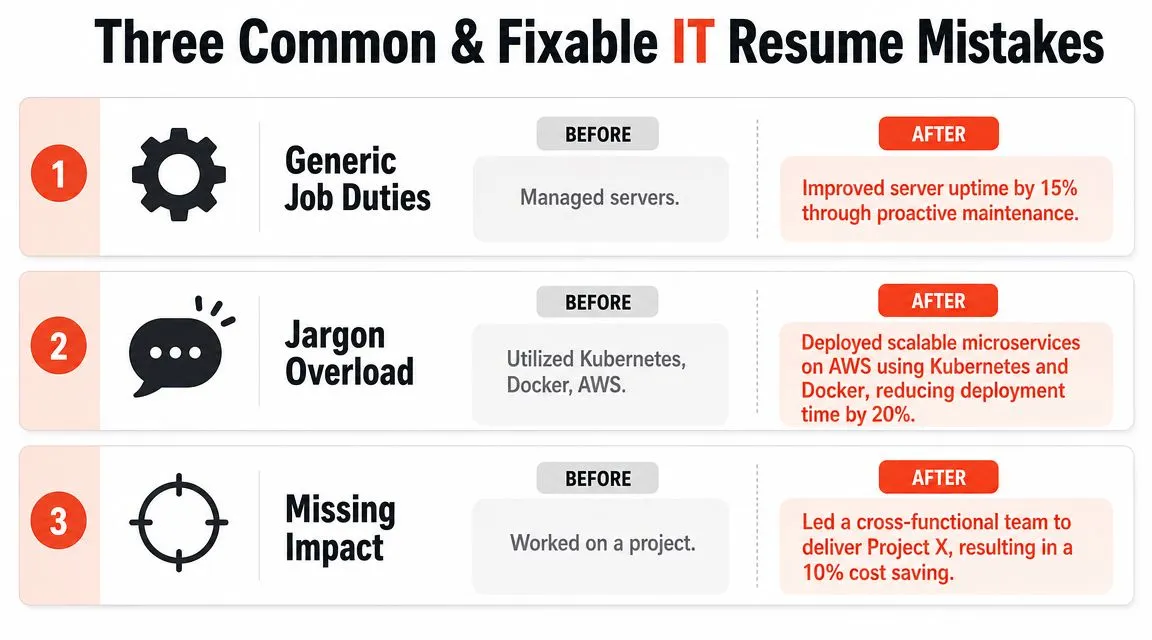
Mistake 1 listing responsibilities instead of impact
This is the classic engineer resume failure. You describe ownership, not change.
Before
- Managed CI/CD pipelines and Kubernetes clusters.
After
- Rebuilt the CI/CD pipeline, cutting deploy time from 40 minutes to 6 and ending the weekly release-night outages.
The second bullet works because it answers the only question that matters. What improved because you touched it?
Mistake 2 hiding impact behind jargon
Technical detail isn't the enemy. Untranslated detail is.
Before
- Implemented event-driven architecture using Kafka for the order service.
After
- Re-architected the order system to be event-driven (Kafka) so it survived 5x peak load on Black Friday, without the checkout failures from the year before.
The stronger version still names Kafka. It just explains why that choice mattered to the business and to customers.
Practical rule: Keep the technical term if it helps, then translate the consequence in plain English.
Mistake 3 leaving out scale
Seniority is hard to infer if you hide the size of the system, team, or risk.
Before
- Led migration to microservices.
After
- Led the migration of a monolith serving 12M users to microservices, coordinating four teams over nine months with zero customer-facing downtime.
That one line signals scope, coordination, and execution discipline. Without scale, a lead-level achievement can read like a routine task.
A Better Approach: Articulate Your Work, Not Outsource It
A generalist writer can absolutely format your resume, improve readability, and give you a cleaner draft. What they usually can't do is know which architecture decision mattered, why your incident response showed senior judgment, or which migration detail signals staff-level work.
That's not because they're bad. It's because they're outsiders.
The better model is guided excavation
A better approach is to pull the story out of you with the right questions, then turn that into strong work-experience bullets.
That's the part StoryCV focuses on. It's not a done-for-you human service and it doesn't write your full formatted resume, cover letter, or profile for you. It uses a guided interview to help you articulate one role at a time and turn your answers into strong, copiable experience bullets. That's the hardest part anyway.
This model solves the actual problem. It doesn't ask a stranger to guess what mattered. It helps you say it clearly yourself.

What good achievement excavation sounds like
If the process is any good, it shouldn't start with “write three bullet points about your last role.” That's just a blank page with better branding.
It should ask questions like these:
-
Pick a real project: “Walk me through a project from this role you'd want to talk about in an interview.”
-
Surface the before-state: “What was broken, slow, risky, or impossible before you touched it?”
-
Expose the difficulty: “Why was this hard? What would a solid engineer have struggled with here?”
-
Separate your contribution: “What did you do specifically, versus the team?”
-
Clarify the outcome: “What was different afterward that someone above you noticed or cared about?”
-
Add magnitude where it exists: “Can we put a number on any of it, time, cost, scale, users, latency, uptime, error rate, team size?”
-
Check durability: “What did you build or decide that's still running or still used today?”
-
Reveal the stakes: “If this had gone wrong, what would have broken, and for whom?”
-
Filter buzzwords from depth: “Which technologies did you make decisions about, versus just use?”
That's how technical truth survives the editing process.
If you care about long-term career advantage, this matters beyond the resume too. Once you can articulate your work cleanly, you can reuse it in interviews, performance reviews, and even public-facing career assets. Different medium, same skill. This SupaBird article on building a personal brand on X as a freelancer is about a different audience, but the core point is relevant: clarity compounds.
Here's a quick look at the guided format in action:
If you outsource the articulation step completely, you may get a better document. You probably won't get better at telling your own story.
What to Include on a Technical Resume Besides Code
A lot of mid-to-senior candidates undersell themselves by treating the resume like a code inventory. Real seniority shows up in judgment, scope, and context, not just tools.
Certifications that should connect to real work
Certs matter when they reinforce applied experience.
Common ones people bury or isolate in a dead list include:
-
Cloud and platform certs: AWS, GCP, Azure, CKA, CKAD, Terraform Associate
-
Security certs: Security+ or CISSP for people moving toward security-heavy roles
Don't just dump them at the bottom and hope ATS picks them up. Mention the relevant certification where it connects to actual work, then keep the rest in a tight skills or certifications line.
Senior signals that don't look flashy
Some of the most important technical resume content doesn't look “technical enough” to engineers, so they omit it.
That's a mistake. Include things like:
-
Incident command and on-call leadership
-
Mentoring and onboarding engineers
-
Reliability and SRE practices
-
Cost and FinOps optimization
-
Stakeholder translation
-
Code review culture
-
Interviewing and hiring
These aren't filler. They're often the difference between mid-level execution and senior ownership.
Domain depth counts
If you've worked in payments, fraud, fintech compliance, HIPAA-heavy healthcare, or another domain with real constraints, keep that in. Domain knowledge is often the differentiator.
Open-source contributions, internal tools, talks, and writing also help when they support your story.
For a practical list of role-relevant skill examples, see StoryCV's guide to technical skills to include on a resume.
One small but related note. If you're wondering whether a photo belongs on a resume, the answer depends on region and role norms, not aesthetics. Secta Labs has a useful breakdown on whether a headshot can help or hurt job chances.
Pay for Writing or Articulate It Yourself A Clear Framework
This doesn't need drama. It needs a clean decision.
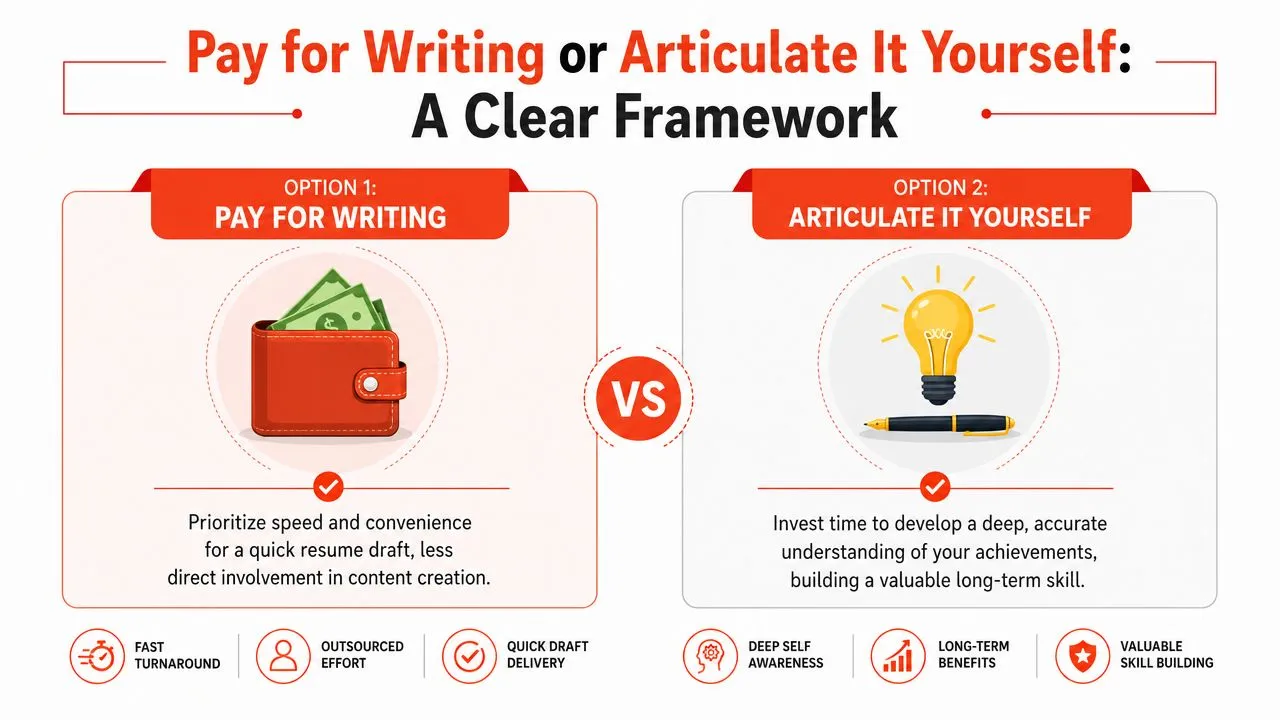
Choose based on what you actually want
Pay a traditional service if:
-
You want full offload
-
You're fine with a generalist interpretation
-
You mainly need a polished document fast
Use a guided-interview approach if:
-
You don't trust a non-technical stranger to interpret your work
-
You want the technical details translated accurately
-
You want language you can reuse in interviews and beyond
-
You'd rather feel the value before paying
One of the larger established providers in this space reportedly operates with 1,000+ professional writers across 65 industries, as noted in IGotAnOffer's overview of resume writing services. That scale shows the market is mature. It doesn't solve the core issue for engineers, though. Breadth across industries isn't the same as understanding your specific technical achievement.
Quick comparison
| Criteria | Generalist writing service | Guided-interview approach |
|---|---|---|
| Who writes it | A hired writer | You articulate it through structured prompts |
| Understands your tech | Sometimes. Depends heavily on the writer | Better for technical accuracy because the source is you |
| What you walk away with | A finished draft | Strong, reusable work-experience bullets and clearer self-understanding |
| Useful for interviews and profile updates | Less, unless you internalize the wording | More, because you practiced saying what you did |
| Resume writing service cost | Usually a paid commitment upfront | Can be lower risk if there's a free first step |
| Try before you pay | Usually limited | Often easier |
Frequently Asked Questions
Are resume writing services worth it for IT professionals
Yes, sometimes. If your main goal is to hand off the task completely, a service can help. But for technical roles, the risk is interpretation. If the writer doesn't understand your work, you get a cleaner resume that still misses the point.
How much do resume writing services cost
It varies a lot by provider and package. Most services charge upfront for a rewritten resume and often bundle extras like a cover letter or profile help. A key question isn't just cost. It's whether the service can translate technical work accurately.
Can a resume writer handle a technical engineering resume
Some can. Many can't do it with sufficient acumen. The issue isn't grammar or formatting. It's whether they can tell which achievement signals seniority, what technical decision mattered, and how to explain it without flattening it into buzzwords.
Do resume writing services actually work
They work best when the problem is presentation. They work less well when the problem is articulation. If your resume already has the right substance and just needs cleanup, a service can help. If the substance is buried, the method matters more than the polish.
Can I just use ChatGPT to write my IT resume
You can, but it has the same weakness as a blank document. It waits for you to already know what to say. That's the exact part most technical people struggle with. Its core value is being asked sharp questions that pull out the work accurately.
Try StoryCV free on your most recent role and see your work in your own words before paying anything.