
Most social media marketing CV advice is bad. It tells you to cram in keywords, pick a clean template, and list what you were responsible for. That creates a polite-looking document full of empty calories.
Recruiters don't hire responsibility. They hire proof. If your CV reads like "managed Instagram," "created content calendars," and "ran paid campaigns," you've flattened real work into admin.
A strong social media marketing CV isn't a record of tasks. It's an argument. It should show where you changed audience behavior, improved performance, protected brand reputation, or drove commercial results.
Your Social Media CV Is Broken, Not Your Experience
A weak CV can make strong work look ordinary.
That is a common problem for a lot of social media marketers with solid experience. They write bullets that describe motion, not value. "Managed social media accounts" could mean anything from basic scheduling to leading paid strategy, handling creator partnerships, and steering brand response during a backlash. Recruiters will not fill in those blanks for you.
Vague writing costs interviews. It hides judgment, commercial awareness, and range. If your CV reads like an admin checklist, you look easier to replace than you are.
Stop listing tasks
A task is "posted content three times a week."
An achievement is "shifted the content mix toward platform-native video and creator collaborations, improving engagement quality and giving the sales team stronger inbound signals."
That difference matters. The first line says you were busy. The second says you understood what the channel was for and improved performance.
Your CV should read like a case for hiring you, not a recycled job description.
Templates often make this worse. They push you to fill boxes before you decide what story the evidence supports. Generic builders produce generic phrasing for the same reason. If you want help tightening your positioning, study tools closer to a top AI resume writer than a fill-in-the-blank resume form.
What recruiters need to see
Recruiters scan fast and judge hard. They are looking for proof that you can do the job at a level worth paying for.
-
Results: Show that your work changed something measurable, such as engagement quality, reach, conversions, response time, or brand sentiment.
-
Platform judgment: Show that you understand the difference between running Instagram, LinkedIn, TikTok, X, or paid social, and that you adjusted execution accordingly.
-
Commercial thinking: Show the link between your work and business goals like awareness, lead generation, retention, customer trust, or launch performance.
-
Evidence: Back up claims with numbers, examples, or a clear before-and-after story.
A social media marketing CV does not win because it looks polished. It wins because it turns duties into impact stories with enough specificity to earn curiosity. That is how you get interviews. Passing an ATS is the floor. Convincing a hiring manager is the job.
Structure Your Story Not Just Your CV
Good structure doesn't mean fancy design. It means every section has a job.
Think in four layers. Pitch. Proof. Toolkit. Evidence. That's the spine.
Write the pitch first
Your summary isn't a biography. It's your opening argument.
Bad summary:
"Experienced social media marketer with a passion for content creation and brand growth."
Better summary:
"Social media marketer with experience leading multi-platform content, paid, and creator campaigns for consumer brands. Strong track record translating audience insight into campaigns that improve engagement, strengthen brand presence, and support commercial goals."
The first version sounds like everyone. The second sounds hireable.
Make experience do the heavy lifting
Your work history should carry the weight. Keep it reverse chronological. Lead with outcomes, not software lists. Recruiters care less that you used Later, Hootsuite, GA4, or Meta Business Suite than they do about what changed because you used them well.
Expert guidance on social media resumes is blunt. A dedicated Social Media Metrics section with figures like engagement growth and follower acquisition helps candidates show tangible impact and get past generic screening, as noted in Teal's social media manager resume examples.
That section belongs near your summary or near the top of your experience, not buried at the bottom.
Build the narrative flow
A clean structure looks like this:
| Section | Job |
|---|---|
| Summary | Makes a sharp promise about your value |
| Experience | Proves that promise with results |
| Social Media Metrics | Pulls your strongest performance signals into one place |
| Skills | Shows your operational toolkit |
| Portfolio | Verifies that your claims are real |
Practical rule: If a section doesn't strengthen your hiring case, trim it or delete it.
For examples of this narrative approach in action, study a few narrative resume examples. They do a better job showing flow than most "best CV template" articles ever will.
Treat skills like support, not substance
Don't let your skills section become a landfill. Group it tightly.
-
Platforms: Instagram, TikTok, YouTube, Facebook, Pinterest, X
-
Paid and analytics: Meta Ads Manager, GA4, Looker Studio
-
Execution: content strategy, community management, influencer outreach, social reporting
-
Commercial strengths: campaign planning, conversion-focused creative, stakeholder management
Skills should support your story. They should never replace it.
Turn Vague Duties into High-Impact Achievements
Recruiters do not care that you "managed social media." They care what changed because you did.
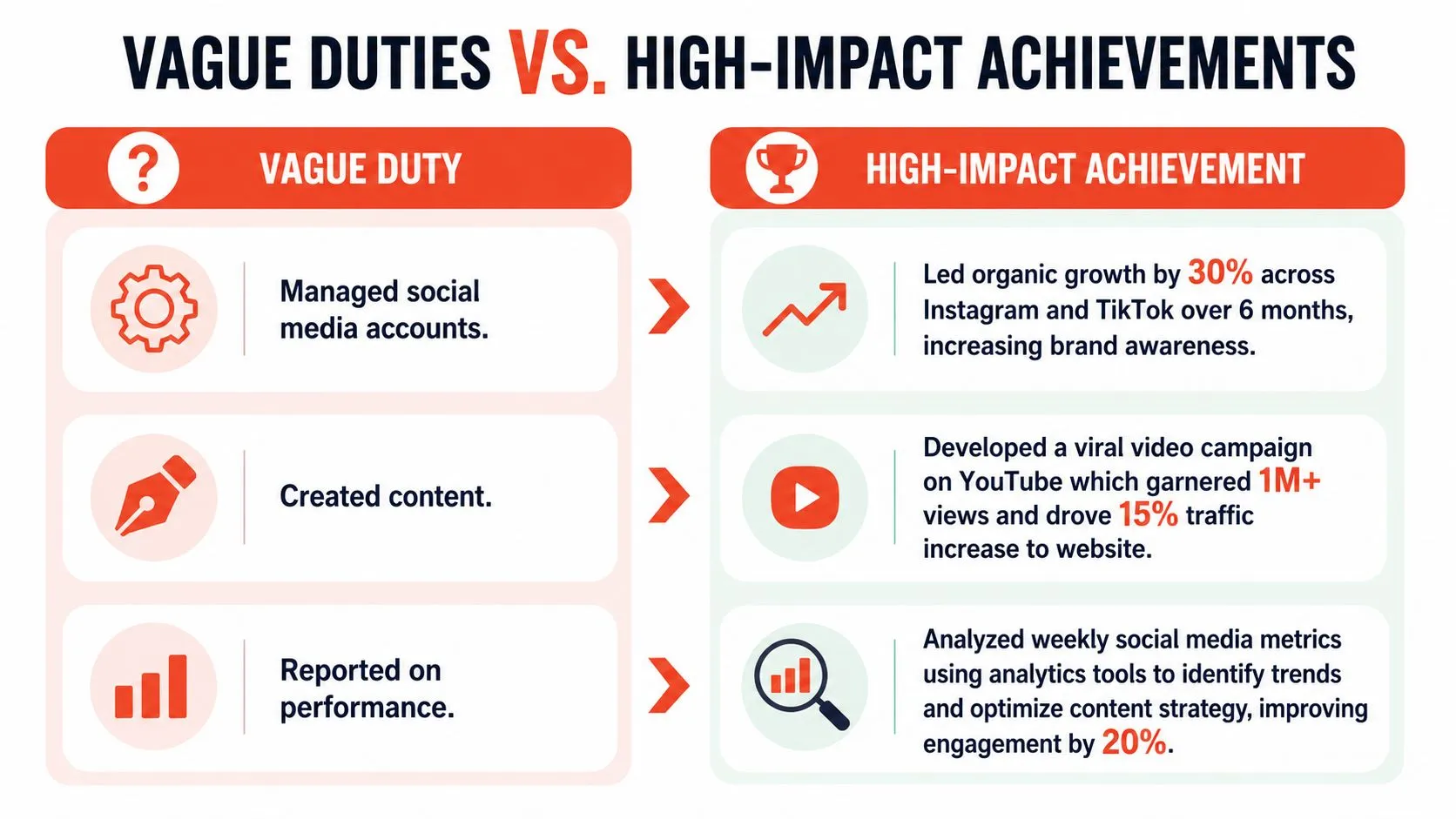
A duty describes activity. An achievement proves value. If your bullets read like a task list, your CV undersells you, even if your work was strong.
Use a simple formula: action, context, result. Drop the generic duty. Show what you owned, where you applied judgment, and what improved.
Before and after examples
These rewrites make the same experience sound like someone worth interviewing.
Weak
-
Managed social media accounts for multiple brands
-
Created content for Instagram and TikTok
-
Worked with influencers on campaigns
-
Reported on campaign performance
Stronger
-
Ran organic social strategy across Instagram, TikTok, and Facebook for three consumer brands, aligning content plans with launch dates and brand priorities
-
Produced platform-specific content for Instagram and TikTok that improved audience response quality and gave the wider team clearer insight into what themes converted attention into interest
-
Coordinated influencer campaigns from outreach to briefing to post-campaign review, connecting creator work to traffic and conversion goals
-
Reviewed weekly performance in GA4 and native platform analytics, then adjusted creative direction, posting cadence, and paid support to improve efficiency
The difference is judgment. The stronger bullets show scope, intent, and consequence. That is what makes a recruiter take you seriously.
Use metrics where they prove the point
Numbers are evidence, not decoration.
If you have clean metrics, put them inside the bullet where they carry weight. Do not bury them in a portfolio screenshot or leave them trapped in a reporting deck. Social teams that follow current social media marketing strategies for 2026 are judged on growth, engagement quality, conversion, and speed of learning. Your CV should reflect that.
Example rewrites:
-
Increased TikTok followers by 40% in one quarter by building a creator-led content series and tightening response time to trends
-
Improved engagement rate by 40% over three months by replacing product-heavy posts with short-form educational content
-
Grew audience size significantly through paid campaigns tied to seasonal launches and coordinated organic support
-
Reduced reporting delays by rebuilding the weekly dashboard workflow in GA4 and native analytics, giving stakeholders faster visibility into campaign performance
Those bullets work because they answer three questions fast. What did you do? In what context? What changed?
Here's a useful walkthrough before you rewrite your own bullets:
A quick rewrite method that works
Use this sequence for every bullet:
-
Start with the action
Led, launched, rebuilt, scaled, analyzed, optimized, produced, negotiated. -
Add the business context
For a product launch, during a brand refresh, across paid and organic channels, for a multi-market audience, during a high-risk reputation period. -
Finish with the result
Higher engagement, stronger creator output, cleaner reporting, faster response times, clearer brand consistency, measurable growth.
If a bullet could sit on any social media CV, cut it and rewrite it.
Do not force a number into every line. Some bullets should show complexity, ownership, or cross-functional judgment. But your best bullets must prove impact with outcomes, not duties. If you want sharper examples, read this guide on writing impact statements for a resume.
Speak the Recruiter's Language With Keywords
ATS panic has rotted a lot of resumes. People stuff them with phrases they barely understand, then wonder why they get ignored.

This move is simpler. Pull keywords from the job description, then place them inside credible achievement statements.
That matters because business priorities have shifted. Short-form video delivers 41% ROI, and influencer marketing generates 2x to 3x returns over traditional ads, according to Sprout Social's social media statistics. If a role cares about growth, discovery, and revenue, terms like short-form video, influencer marketing, creator partnerships, paid social, ROI, and conversion aren't buzzwords. They're hiring signals.
What to pull from the job post
Scan for three kinds of language:
-
Channel priorities: TikTok, Instagram Reels, YouTube Shorts, Meta
-
Commercial priorities: acquisition, retention, conversion, ROI, product discovery
-
Operating priorities: analytics, campaign reporting, stakeholder management, creative testing
Then write bullets that sound human.
Bad:
"Experienced in short-form video, influencer marketing, analytics, ROI, paid social, and content strategy."
Better:
"Led short-form video planning and creator partnerships for product launches, using campaign reporting and creative testing to improve conversion-focused social performance."
That's how you satisfy both the machine and the recruiter.
Write for the human first. The machine only needs enough clarity to pass the file through.
If you want stronger context for the kinds of skills and channel priorities brands are chasing, this roundup of social media marketing strategies for 2026 is a useful reference point.
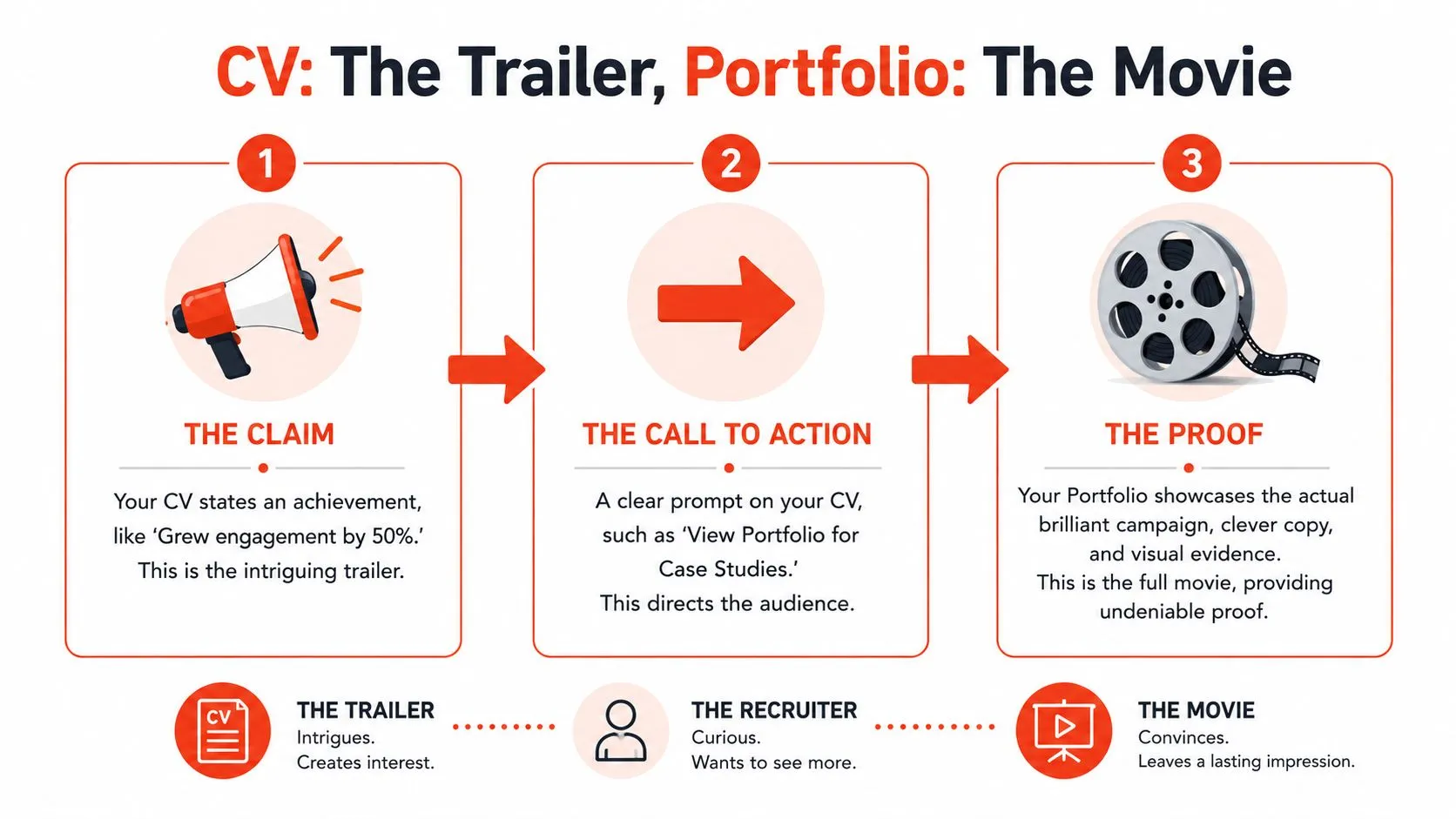
Your CV Is the Trailer Your Portfolio Is the Movie
Your CV makes claims. Your portfolio proves them.
If you say you built a strong creator campaign, I want to see the brief, the content, the rollout logic, and the result. Not fifty samples. Two or three sharp case studies are enough.
What your portfolio should include
Keep each case study lean:
-
The challenge: product launch, poor engagement, unclear brand voice, weak creator fit
-
Your role: strategy, copy, reporting, paid support, influencer management
-
The work: screenshots, creative, captions, calendars, test variations, reporting snapshots
-
The outcome: what improved, what changed, what the business learned
This is especially important in visible digital roles. Resume experts note that omitting a live portfolio link can reduce shortlisting probability by 30 to 40%, because recruiters can't verify content creation or community engagement ability, according to Enhancv's social media marketing CV guide.
Where to place the link
Put it somewhere impossible to miss:
-
In the header beside your contact details
-
In a dedicated Portfolio section near the top
-
In bullets where a case study directly supports a claim
Example:
"View portfolio for creator campaign case study and reporting sample"
That's cleaner than dumping a long URL into the footer and hoping someone notices.
If you're also tightening your broader professional presence, a good guide to LinkedIn profile optimization can help you keep your positioning consistent across platforms.
A good portfolio doesn't repeat your CV. It gives your CV credibility.
The Final Sanity Check Before You Hit Send
Before you apply, stop editing for polish and start checking for force.
Ask these questions:
-
Does the summary make a clear promise: Can someone tell what kind of marketer you are in seconds?
-
Does each role include proof: Not every bullet needs a number, but every role needs visible consequence.
-
Is commercial value obvious: Can a recruiter see how your work supported growth, reputation, or customer action?
-
Are the right keywords present naturally: Not stuffed. Not pasted. Woven into real achievements.
-
Is the portfolio link prominent: Easy to click, easy to trust, easy to understand.
-
Does it sound like you: Not a robot, not a template, not a vague "results-driven professional."
One more thing. Check that every claim you make can survive scrutiny. If a recruiter clicks through, asks for detail, or wants to discuss execution, you should be able to walk them through the decision-making behind the result.
For marketers, that same discipline matters beyond the CV. This piece on how creators build online presence is useful because it reinforces the same basic truth. Presence isn't built by saying you're good. It's built by showing consistent evidence in public.
Ship the version that makes your value obvious.
If your experience is real but the writing still feels flat, StoryCV helps turn messy duties into clear, credible career stories. It's a Digital Resume Writer built for people who've done strong work and need sharper language, better framing, and a CV that sounds like a professional, not a template.