Most sports reporter resumes are tournament rosters in disguise. They list every beat, league, and software package, then leave the hiring editor to guess whether the candidate can find a source, meet a deadline, and publish a clean story.
That approach is backwards. A sports reporter resume should read like a reporting product. It should show who you cover, what you ship, how you work, and what changed because you reported it. The format below turns your experience into evidence instead of decoration.
The Resume Hiring Editors Actually Want
A hiring editor isn't hiring someone because they have “a passion for sports.” Every applicant can write that sentence. Editors hire reporters who can deliver accurate work when the score changes, the interview runs late, and another outlet is chasing the same quote.
Sports reporting has never been only about describing a match. The specialization has roots traceable to the 15th century, expanded sharply in the 19th century, and moved from newspapers into radio, live coverage, analysis, and multimedia publishing. At the modern Olympic Games in Athens in 1896, 11 journalists attended. At Paris in 1924, the number was 724. The Oxford Research Encyclopedia account of sports journalism documents that expansion.
Your resume needs to reflect that range without becoming a list of tournaments.
Editorial rule: Don't describe your interest in sport. Show your reporting system.
A strong sports reporter resume answers four questions quickly:
- Who do you cover? Name the beat, competition level, geography, and audience.
- What do you produce? Identify game reports, interviews, breaking news, analysis, newsletters, podcasts, live blogs, video, or social coverage.
- How do you work? Show source verification, deadline speed, data research, editing, and collaboration.
- What evidence can I inspect? Put a clear clips or portfolio link where an editor can find it.
The most useful resume bullets connect action, reporting method, scale, and result. “Covered football” says almost nothing. “Reported, verified, and published four postgame stories weekly across football and basketball beats, coordinating interviews with coaches and athletes under same-day deadlines” gives the reader a workflow.
The job-posting benchmark supports that priority. In a dataset of 13,905 sports-reporter-related postings, employers most often requested journalism expertise, writing, communication, editing, and research. Social media, news stories, storytelling, and AP Stylebook knowledge also appeared regularly. The Franklin University guide to sports reporter work provides those benchmarks.
Don't copy the keywords blindly. Use them only where your clips and experience prove them.
Build the Frame from Headline to Clips
Editors read from the top down. Make every block answer a different question.
Start with a two-line headline. The first line gives your role. The second gives your beat, platform, or level.
Sports Reporter | NFL and College Football | Digital and Print
That headline is stronger than “Experienced Journalist” because it tells the editor where to place you. If you want broadcast work, use a headline such as Sports Reporter and Digital Correspondent | Football | Live, Video, and Audio. If you're moving from commentary into reporting, don't call yourself a reporter until the experience and clips support that distinction.
Follow the headline with a three-sentence summary. Name the beat, the work you produce, and one defensible proof point. A proof point can be story volume, same-day turnaround, a recurring broadcast contribution, a documented exclusive, or a clearly defined newsroom responsibility.
Then organize experience around beats owned, not just jobs held. Your employer and title still matter, but the bullets should show the work an editor would assign.
| Section | Editor's Question | What Goes Here | ATS Label |
|---|---|---|---|
| Headline | Who are you? | Role, beat, platform, level | Professional Summary |
| Summary | Why this role? | Reporting focus, output, proof | Summary |
| Experience | What did you produce? | Beats, stories, sources, deadlines, formats | Work Experience |
| Clips | Can I inspect the work? | Curated links by beat and format | Portfolio |
| Education | What supports your foundation? | Degree, journalism training, relevant coursework | Education |
| Skills | Which capabilities are real? | AP style, CMS, audio, video, research, social | Skills |
Education can sit below experience for mid-career candidates. A sports journalist CV should not lead with a degree if the candidate already has a substantial reporting record. Keep relevant training, student media, internships, and freelance work when they provide published evidence.
The clips block belongs near the bottom, but it must remain visible. Use a descriptive portfolio URL or a labeled link. Don't bury it among social icons. The editor's question is simple: Can I see the work without hunting for it?
Bullets That Prove You Can Cover a Beat
A resume bullet is a decision, not a description. It should tell the reader what happened, what you did, and why the work required judgment.
The transformations below use only defensible reporting details. Replace the bracketed elements with your own verified facts. Never fill them with guesses.
| Level | Weak Bullet | Strong Bullet | What Changed |
|---|---|---|---|
| Entry | Wrote game stories for the Daily | Reported, verified, and published four postgame stories weekly across football and basketball beats, coordinating interviews with coaches and athletes under same-day deadlines | The rewrite names the beats, volume, reporting method, sources, and deadline |
| Mid | Covered high school sports | Covered high school football and basketball, building source relationships with coaches and athletes, checking game details against official records, and filing same-day reports for a local audience | The rewrite shows beat ownership, verification, sourcing, and turnaround |
| Senior | Managed beat of eight reporters | Directed coverage across multiple sports, assigned breaking news and enterprise angles, edited copy for accuracy and voice, and coordinated print, digital, live, and broadcast output | The rewrite replaces management language with editorial judgment and deliverables |
The senior example intentionally doesn't claim an award, traffic lift, or subscription result. Add one only if you can document your individual contribution. If the newsroom improved traffic as a team, don't write “increased traffic” unless you know what you personally changed.
Make the reporting method visible
“Wrote articles” hides the hard part. Did you interview two sides? Verify an injury update? Work from a box score? Use public records? Coordinate a photographer? Build a live blog? Edit a video package?
A credible bullet might read:
Secured and verified postgame interviews, checked statistical details against official records, and adapted the report for web, newsletter, and social distribution.
That sentence demonstrates editorial judgment without inventing an audience figure.
When analytics are unavailable, use other proof:
- Scope: Name the beat, competition level, and audience.
- Cadence: State whether you filed after every game, weekly, or during live events.
- Access: Identify original interviews, exclusive sourcing, or direct reporting.
- Accuracy: Mention fact-checking, corrections avoided, or verification procedures only when true.
- Output: Name stories, live updates, podcasts, newsletters, video, and broadcast work.
- Follow-through: Note whether a story led to an interview, response, correction, or follow-up coverage.
Use verbs that carry responsibility: broke, secured, filed, anchored, rebuilt, restructured, verified, investigated, edited. Retire helped, responsible for, worked on, assisted with, unless the weaker verb is precise and the context does the heavy lifting.
For a useful framework on turning duties into evidence, see how to write stronger resume bullet points. The same logic applies to a sports commentator resume, but commentary must not be presented as original reporting. Label analysis, play-by-play, hosting, and reporting accurately.
ATS Mechanics for a Sports Reporter Resume
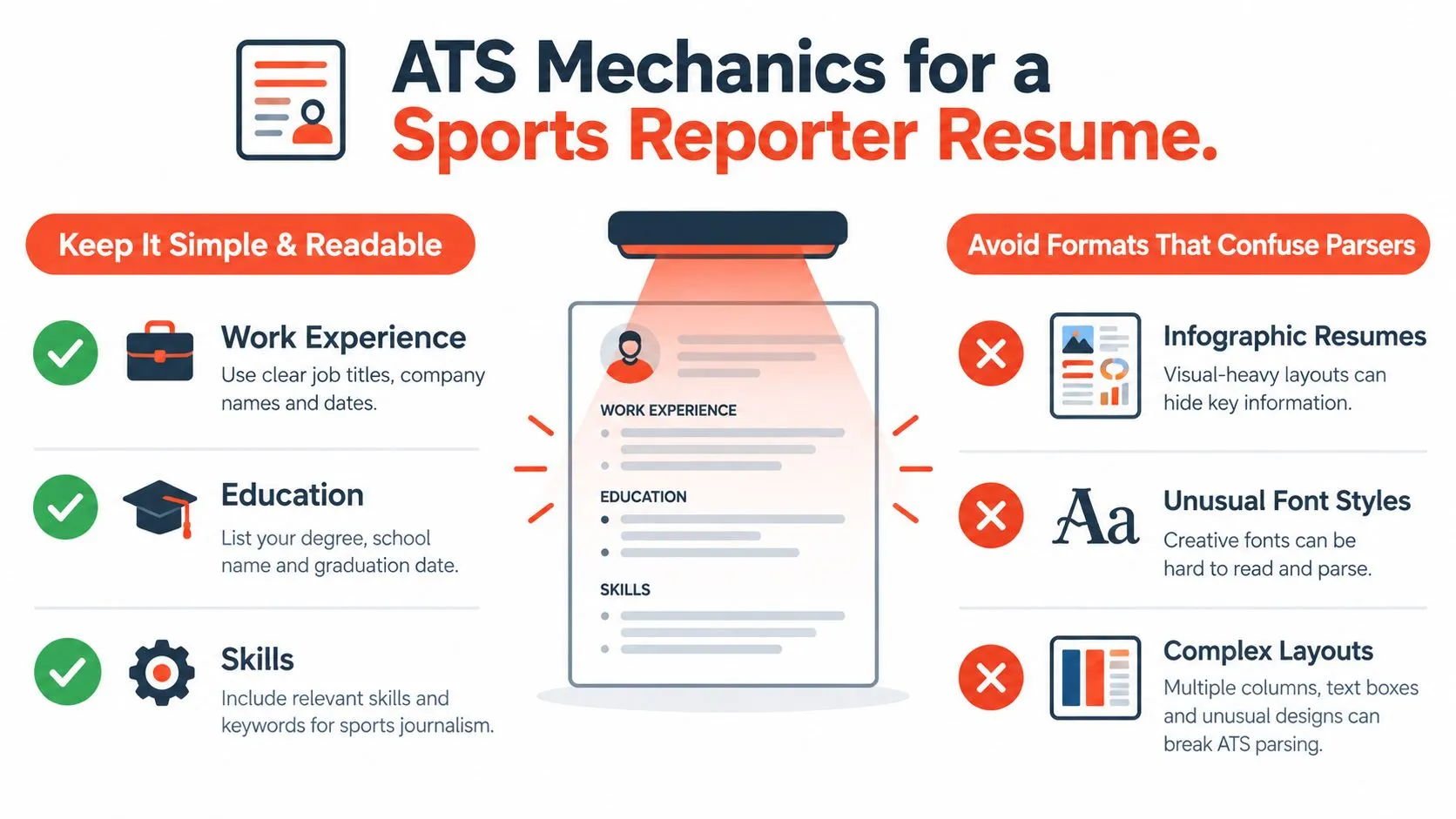
An applicant tracking system doesn't understand your clever section names. It looks for readable text, recognizable labels, dates, and relevant terms.
Use Work Experience, Education, Skills, Summary, and Portfolio. Avoid labels such as “The Tape,” “My Beat,” or “The Locker Room.” They may look distinctive to a person, but they give the parser less certainty.
Keep the document simple:
- Use one column: Columns can scramble chronology and separate titles from employers.
- Choose ordinary fonts: Use a standard system font at a readable size.
- Keep dates consistent: Use MM/YYYY formatting throughout, as recommended by the cited formatting guidance.
- Avoid text boxes and icons: Put beat names, platforms, and tools in normal text.
- Submit readable files: Use a text-selectable PDF or a clean document file. Don't submit a resume that is only an image.
- Remove visual widgets: Skill bars, logos, embedded video thumbnails, and decorative graphics add noise and can hide relevant text.
A formatting checklist based on 25 recruiters, more than 10 applicant-tracking systems, and systems including Workday, iCIMS, and Greenhouse linked 23% of parsing failures to formatting problems. The ATS formatting rules from Resume Adapter explain the practical fixes.
Build a keyword map, not a keyword pile
Pull exact phrases from the posting, then place them where they make sense.
- Entry level: reporting, writing, AP style, research, interviews, game coverage, CMS publishing.
- Mid-career: beat reporting, breaking news, enterprise reporting, live coverage, editing, audience distribution.
- Senior: assignment editing, newsroom leadership, investigative reporting, multimedia strategy, standards, coaching.
Use a phrase in the headline when it describes your target role. Use it in a bullet when a real assignment supports it. Read the finished resume aloud. If it sounds like equipment packaging, remove the excess.
Candidates also need to think about screening transparency and automated review. This resource on opting out of AI resume screening offers useful context for that broader issue. For practical resume mechanics, use this guide to optimize a resume for ATS.
Clips, Portfolio and Proof of Range
Your clips aren't a highlight reel. They're the evidence behind the resume.
Choose work that shows different reporting muscles. A clean portfolio usually needs a mix of formats, but each clip should earn its place. A strong game story proves deadline reporting. A feature proves structure and depth. An audio segment proves performance and preparation. A video explainer proves visual judgment. A social post can show how you moved verified information forward without flattening the context.
| Clip Format | What It Proves | Pick When |
|---|---|---|
| Game story | Speed, accuracy, scene, and reporting discipline | The target role includes deadline coverage |
| Feature or investigation | Enterprise judgment, sourcing, and narrative control | The employer values deeper reporting |
| Broadcast package or podcast | Preparation, delivery, interviewing, and editing | The role includes audio or on-air work |
| Video explainer | Visual storytelling and concise explanation | The newsroom publishes video |
| Live blog or social update | Real-time verification and distribution judgment | The beat includes breaking or live coverage |
Select one clip per beat you want next. Favor recent work, unless an older piece is clearly your strongest example of reporting judgment. Lead with the strongest lede, not the most prestigious publication name. Editors hire the work they can understand quickly.
Build one portfolio link. It should load on mobile, open without a login, and group clips by beat and format. Use clear labels such as “College football, game report” or “Basketball, audio interview.” A hiring editor shouldn't need to decode file names.
You can find sports coverage online to study how different outlets frame headlines, ledes, analysis, and live updates. Use that exercise to sharpen your editorial choices, not to imitate another writer's voice.
Replace missing analytics with defensible proof
Many reporters don't control pageviews, ratings, reach, or newsletter data. Student outlets, community papers, freelance clients, and shared newsroom dashboards often leave contributors without clean metrics.
That doesn't make the work unmeasurable. Use readership estimates supplied by a publication, circulation data, syndication lists, awards, peer references, editor endorsements, assignment volume, turnaround time, or follow-up coverage. Label the source of the evidence. Say “published across the paper's community sports section” rather than pretending you know the article's unique visitors.
For campus, unpaid, freelance, or fan-site work, identify the editorial conditions. Name the competition level, publication schedule, approval process, and reporting duties. Don't inflate a fan site into a professional newsroom. Do show that you sourced interviews, checked facts, met deadlines, and published consistently.
Before sending, ask:
- Does every clip support the target beat?
- Can the editor open every link without signing in?
- Is the strongest work first?
- Does each format have a clear purpose?
- Have you separated reporting from commentary?
- Can you explain every result on the resume?
Tailor It, Pair It, Send It
Tailoring doesn't mean rewriting your entire career for every posting. It means changing the evidence that appears first.
Read the posting for three signals: beat, platform, and audience. Then make three edits.
First, change the headline to lead with the target beat. A role seeking college football coverage should not receive a headline led by general sports writing. Second, mirror two or three exact phrases from the posting in the summary and skills line, but only when your work supports them. Third, replace one or two generic bullets with stories that match the assignment.
A focused summary might shift from “Digital sports reporter covering local athletics” to “Sports reporter covering college football and basketball through same-day game stories, interviews, live updates, and newsletter-ready analysis.” The wording is specific because the target is specific.
Use a short cover letter as a reporting note, not a biography. Open with the story or beat you want to cover. Name a recent piece from the publication and explain what made its reporting effective. Close with one relevant clip link and a direct statement of fit.
Refresh LinkedIn to match the same headline, summary, and beat focus. The Featured section should point to the same portfolio as the resume. A recruiter who sees three different professional identities has to resolve the contradiction. Don't make them do that work.
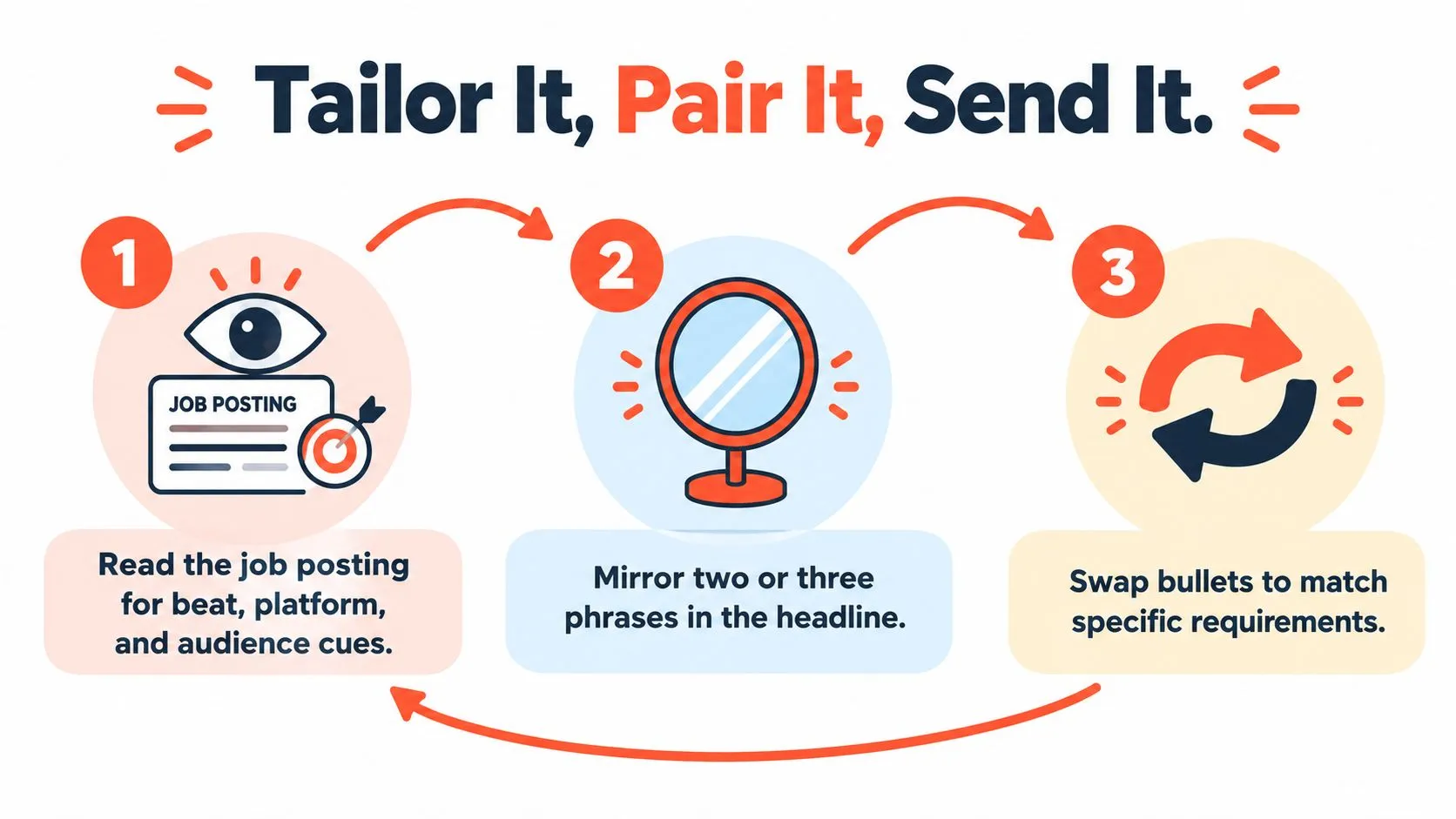
The tailoring loop is straightforward:
- Read: Mark the beat, platform, audience, and required reporting skills.
- Mirror: Add two or three accurate phrases to the headline, summary, and skills.
- Swap: Bring forward the bullets and clips that match the assignment.
Repeat the loop for the next serious application. Don't mass-apply with one unchanged file. Don't send a PDF named “Resume Final Final 2.” Use a real file name with your name and target role. Check that the links work, the dates match, and the document opens as selectable text.
For a practical guide to this process, use this approach to tailoring a resume to a job description.
Resume length should follow the reporting record, not an arbitrary rule. In an experiment involving nearly 20,000 one- and two-page resumes, reviewers approved 5,375 two-page resumes compared with 2,337 one-page resumes. They spent an average of 4 minutes and 5 seconds on two-page resumes, versus 2 minutes and 24 seconds on one-page resumes. The Business Insider summary of that experiment supports using a second page when it carries meaningful evidence.
A separate survey of more than 200 HR professionals found that 68.3% considered two pages ideal, while 21.8% preferred one page. NovoResume's analysis points to the practical answer: use one page when it captures the relevant record, and two when cutting material would hide meaningful work. Don't shrink the type to preserve weak bullets.
StoryCV helps turn the reporting you remember into resume-ready writing by asking about the beat, context, actions, and outcomes behind your work. Start your sports reporter resume with StoryCV, then edit the draft against your clips so every bullet reflects what you reported.