Most advice about professional development tells you to take a course, attend a webinar, earn a badge, update your profile, and feel productive. That's not development. That's activity.
Sometimes it's useful. Often it's just corporate theater with a completion certificate attached.
If you're asking what is professional development, start with this rule: if it doesn't change how you work, what you can do, or how you can explain your value, it probably doesn't matter.
Professional Development Isn't What You Think
Hearing “professional development” often brings to mind training days, mandatory workshops, and forgettable slide decks. Fair reaction. A lot of it deserves the skepticism.
Workshop-heavy development gets criticized for being too generic and lacking follow-through. The stronger approach is context-specific, collaborative, and supported after the training. One analysis also notes that around 49 hours of well-designed professional development across a school year was associated with higher impact on performance, according to BetterLesson's summary of the research.
That matters because it kills the lazy assumption that all learning is good learning. It isn't.
What bad professional development looks like
Bad PD usually has three traits:
-
It's disconnected from your job. You sit through training you can't apply this week.
-
It's passive. You watch, nod, complete the quiz, and forget it.
-
It's hard to prove. Six months later, you can't point to a better result, sharper skill, or stronger decision you made because of it.
Professional development that never touches real work is just organized optimism.
What good professional development actually does
Good PD creates evidence. It helps you do one or more of these:
-
Solve a harder problem than you could solve before
-
Take on broader responsibility without faking it
-
Tell a sharper career story because you can explain what changed
That last part gets ignored. It shouldn't.
A certificate is weak career currency by itself. A story is stronger. “I learned SQL” is thin. “I learned SQL so I could stop waiting on analysts and answer recurring ops questions myself” is better. Better again if you can explain what changed in your workflow, your judgment, or your team's output.
So no, professional development is not a stack of credentials. It's not compliance. It's not “lifelong learning” as a slogan.
It's a career advantage.
A Better Definition for Professional Development
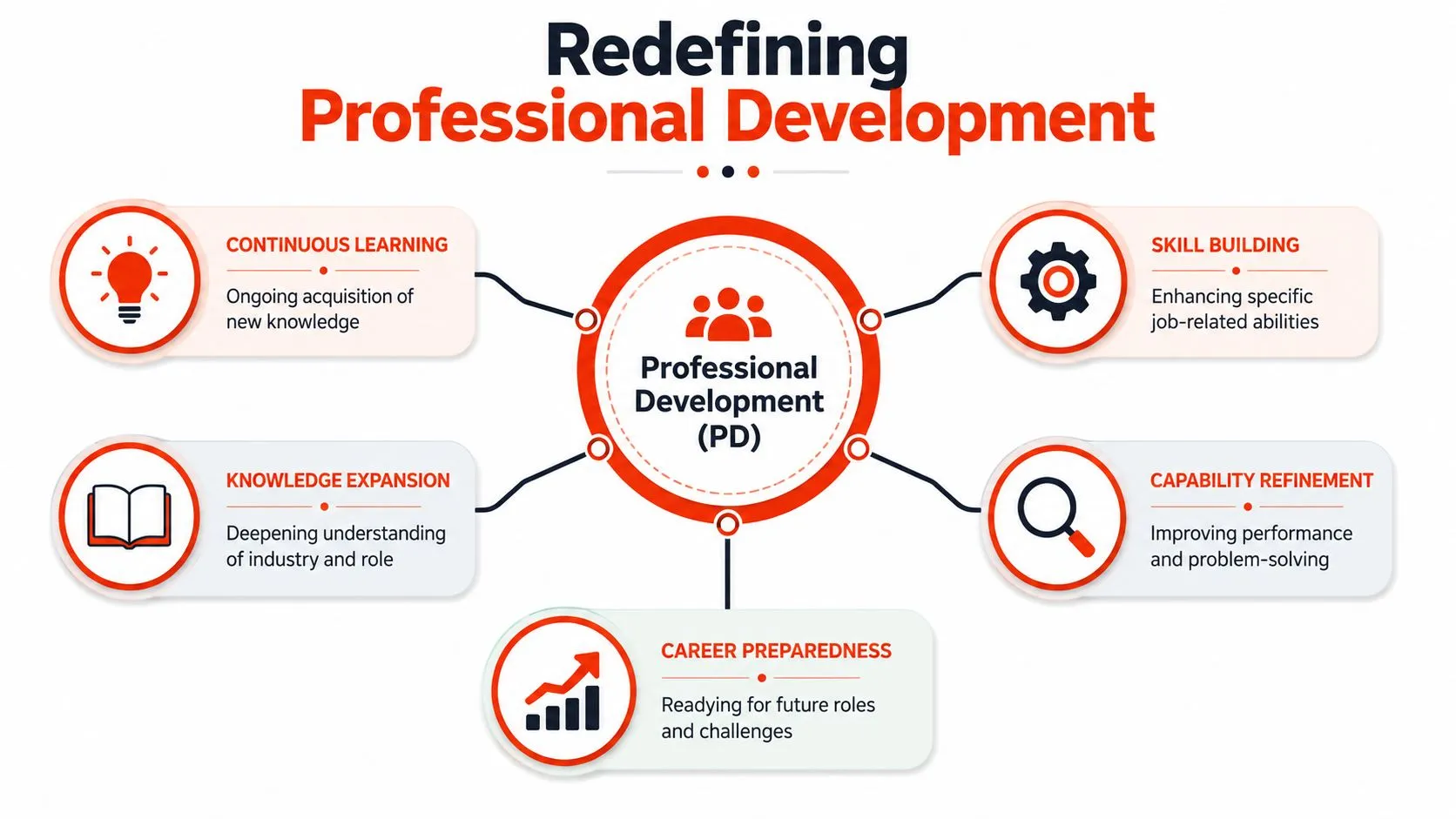
Professional development is the ongoing process of building skills, knowledge, and judgment that improve your performance now and prepare you for what's next.
Not an event. A system.
The National Center for Education Statistics describes professional development as an ongoing process, not something solved by one-time training. It also notes that effective development connects to performance goals, uses hands-on practice, and adapts as roles and technology change, as described in NCES guidance on professional development.
Here's the simple way to think about it: your career needs its own R&D function. Companies that stop investing in R&D get stale. Professionals do too.
What counts as professional development
It includes formal learning, but that's only one slice.
| Type | Real example |
|---|---|
| On-the-job learning | Running a postmortem better than you did last quarter |
| Skill practice | Rebuilding a dashboard in Excel, Power BI, or Tableau until it actually answers business questions |
| Feedback-based development | Asking your manager why your project updates don't land, then fixing the structure |
| Mentorship | Learning how a director frames decisions for executives |
| Self-directed work | Taking on a stretch project that forces you to use a new tool or workflow |
Why this isn't corporate fluff
Professional development is now a real labor-market function, not a side hobby. The U.S. Bureau of Labor Statistics projects employment of training and development specialists to grow 11% from 2024 to 2034, with about 43,900 openings per year and a median annual wage of $65,850 in May 2024, according to the BLS occupational profile.
That doesn't mean every training program is good. It means organizations now treat workforce capability as serious infrastructure.
Practical rule: If your development plan lives only in a learning portal, it's probably not a plan.
The useful version of PD is active. You choose it, use it, and tie it to better work.
Choosing the Right Development for Your Career Stage
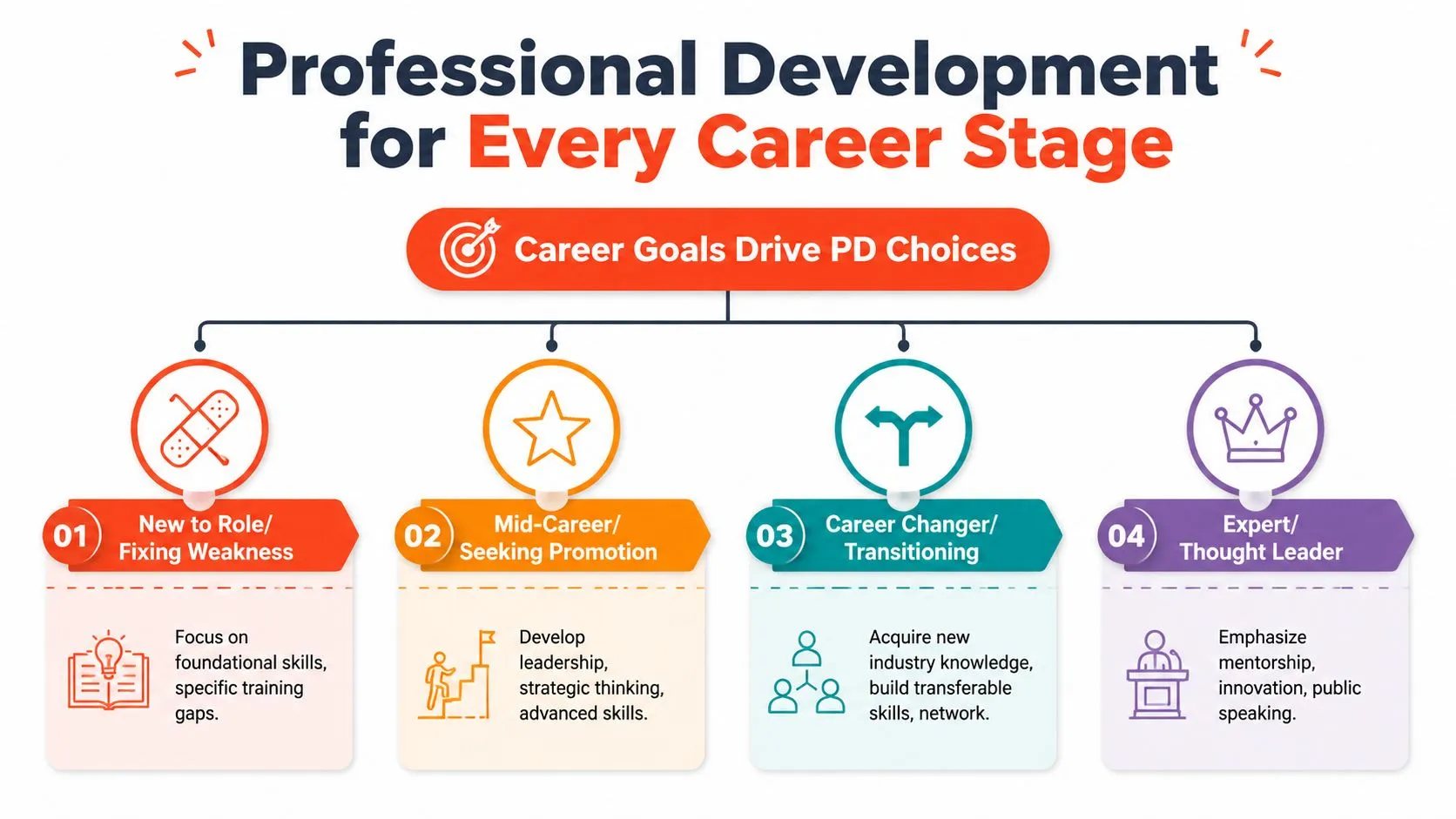
One-size-fits-all professional development is nonsense. The right move depends on the problem you're trying to solve.
A practical framework breaks PD into maintaining professionalism, fixing current weaknesses, and planning for the future, as explained in the HERC career framework. That's much more useful than the usual random list of courses, workshops, and certifications.
If you're fixing a weakness
Be brutal about the weakness. Name the exact skill gap.
Not “communication.” That's too vague. Try “I ramble in stakeholder updates and leave meetings without clear next steps.”
Good development here is narrow and repetitive:
-
Target one failure point. Public speaking, executive summaries, project scoping, stakeholder management.
-
Use feedback fast. Record yourself presenting. Ask for markup on your writing. Shadow someone who's already good at it.
-
Practice in live work. That's where it sticks.
If you're sorting out capability gaps, this breakdown of soft skills vs hard skills helps you choose whether the problem is technical, behavioral, or both.
If you're trying to advance
Promotion-stage development is different. You don't just need to do your current job better. You need proof that you can handle a wider one.
That usually means:
-
Leadership exposure through mentoring, coaching, or leading a messy cross-functional task
-
Strategic skill building in planning, prioritization, delegation, or influencing without authority
-
High-impact knowledge like budgeting, roadmap thinking, risk management, or customer insight
A mid-career product manager, for example, doesn't need another generic productivity course. They may need to learn how finance thinks, how to defend tradeoffs, or how to lead through ambiguity.
If you're changing direction
Career pivots need a different playbook. Generic learning won't save you.
Use development that builds credibility in the new direction:
-
Learn the language of the field
-
Build visible proof, such as a small portfolio, side project, audit, memo, or case walkthrough
-
Talk to people doing the work through informational conversations and targeted networking
Don't ask, “What's the best credential?” Ask, “What proof would make this pivot believable?”
That's the filter. Not prestige. Not trendiness. Believability.
The Real Payoff of Your Growth Efforts
The payoff of professional development isn't “more knowledge.” Knowledge alone doesn't move careers. Applied capability does.
During the COVID-19 era, learning stopped being treated as optional. A survey summarized by WorkRamp found that 64% of L&D professionals said employee development shifted from a “nice to have” to a “need to have,” and global workplace training spending was estimated at nearly $401 billion in 2024, according to WorkRamp's roundup of learning and development statistics.
That shift matters for one reason. Employers now read development as a signal. Not because they love learning for its own sake, but because they need adaptable people.
Three payoffs that actually matter
-
More impact at work
You stop needing step-by-step instruction. You make stronger decisions, fix more expensive problems, and contribute outside your narrow lane. -
More resilience in a messy market
Roles change. Tools change. Teams reorganize. The people who keep moving are the ones who can learn without drama. -
A stronger professional narrative
This is the underrated one. Good development gives you material. It gives you examples for interviews, performance reviews, promotion cases, and resume bullets.
Agency is the real win
People think professional development helps them “grow.” Fine. But the more useful word is agency.
You have more influence when you can say:
-
I took on this challenge because I saw a gap.
-
I learned this skill because the team needed it.
-
I changed how I worked and got better outcomes.
That's a stronger story than “I attended training.”
If your growth effort doesn't give you a sharper answer in an interview, you left value on the table.
How to Plan and Measure Your Development
A good intention is useless without a system.
The strongest professional development plans start with evidence, identify specific needs, prioritize based on real constraints, and define activities, outcomes, resources, and evaluation measures, according to the Center for Applied Linguistics guide to data-driven planning.
That sounds formal. Your version doesn't need to be.
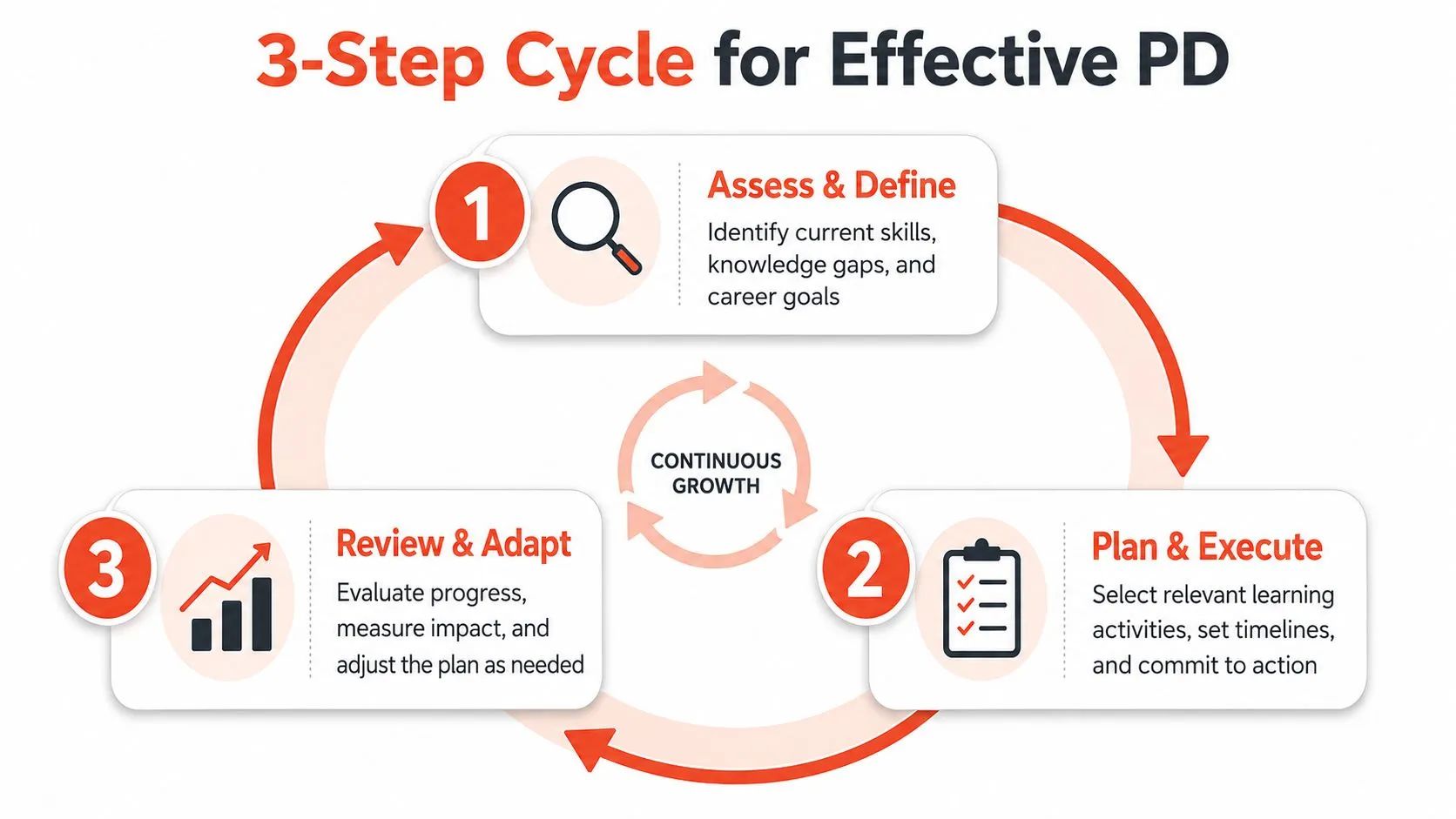
Use a three-step loop
1. Assess and define
Pick one gap that matters now.
Bad goal: “Get better at leadership.”
Better goal: “Run weekly project meetings that end with clear owners, deadlines, and decisions.”
Use baseline evidence. Missed deadlines. Confused stakeholders. Rework. Weak feedback. Slow turnaround. That's your starting point.
2. Plan and execute
Choose one development method that fits the problem.
If the gap is communication, a manager's feedback and weekly practice may beat a generic course. If the gap is technical, a tool-specific course plus a live project might work better. If you learn best through structure, discover Gaeilgeoir AI's language blueprint for a clean example of how to break a skill into repeatable study loops. The same logic works outside language learning.
You can also use a written reflection process to track what changed. This guide on how to write a self-assessment for performance review is useful because it forces you to connect actions to outcomes instead of vague effort.
3. Review and adapt
Decide in advance how you'll know it worked.
Measure with real-world signals:
-
Behavior change such as cleaner meeting facilitation or better written updates
-
Work quality like fewer errors, less rework, or stronger stakeholder feedback
-
Career effect such as being trusted with bigger scope
Keep the loop tight
Don't run six development goals at once. That's how people stay busy and improve nothing.
Pick one. Apply it fast. Review it objectively. Then either deepen it or move on.
Turning Development into a Career Story
A common point of failure occurs here.
They do the work. They learn the skill. They improve. Then they describe it like a filing cabinet.
“Completed certification.”
“Attended leadership workshop.”
“Participated in training.”
That's dead language. It tells a recruiter or hiring manager almost nothing.
Professional development only becomes career value when you translate it into context, action, and impact. That lines up with the earlier point that disconnected, generic development is weak. The better version is tied to real work and followed by implementation support.

Stop listing. Start translating.
Here are better before-and-after examples.
| Before | After |
|---|---|
| Completed a project management course | Used project planning methods from formal training to tighten timelines, assign clearer owners, and reduce confusion across a cross-functional launch |
| Attended leadership training | Applied coaching techniques in weekly 1:1s to improve delegation, unblock a junior teammate, and raise team reliability |
| Earned a data analytics certification | Built recurring reports that replaced ad hoc spreadsheet work and helped leadership make faster decisions |
| Took a public speaking workshop | Reworked executive updates into shorter, decision-focused presentations that got quicker alignment |
None of those “after” versions need invented numbers to be stronger. They work because they explain application.
Use this simple translation formula
When you describe professional development on a resume or in an interview, answer these three questions:
-
What did you learn or improve?
-
Where did you apply it?
-
What changed because you applied it?
That third question is the whole game.
Reflection is where the story comes from
If you struggle to answer those questions, the issue usually isn't lack of achievement. It's lack of reflection.
Use a short review after any serious development effort:
-
What problem pushed me to learn this?
-
What did I do differently afterward?
-
What outcome, reaction, or improvement followed?
This article on career reflection before resume writing is useful for pulling those details out before they disappear into memory.
The certificate is the receipt. The story is the asset.
If you want help turning that raw material into resume language, StoryCV works as a digital resume writer. It guides you through role-specific questions, pulls out context and outcomes, and turns that into draft resume content. That's useful when you've done meaningful work but keep underselling it with flat bullets.
The point isn't to sound impressive. It's to be legible.
A hiring manager doesn't need your entire learning journey. They need proof that you grew, applied that growth, and created value with it. That's what professional development is really for.
Most professionals don't have a development problem. They have an articulation problem. They've learned, adapted, solved harder problems, and grown into bigger work, but their resume still reads like a task list. If that's you, StoryCV helps turn that experience into a clear career story without forcing you into a template.