You know this moment.
The interviewer asks, “Why are you interested in employment with us?” You had a decent conversation going, then your brain grabs the nearest corporate-sounding sentence and betrays you.
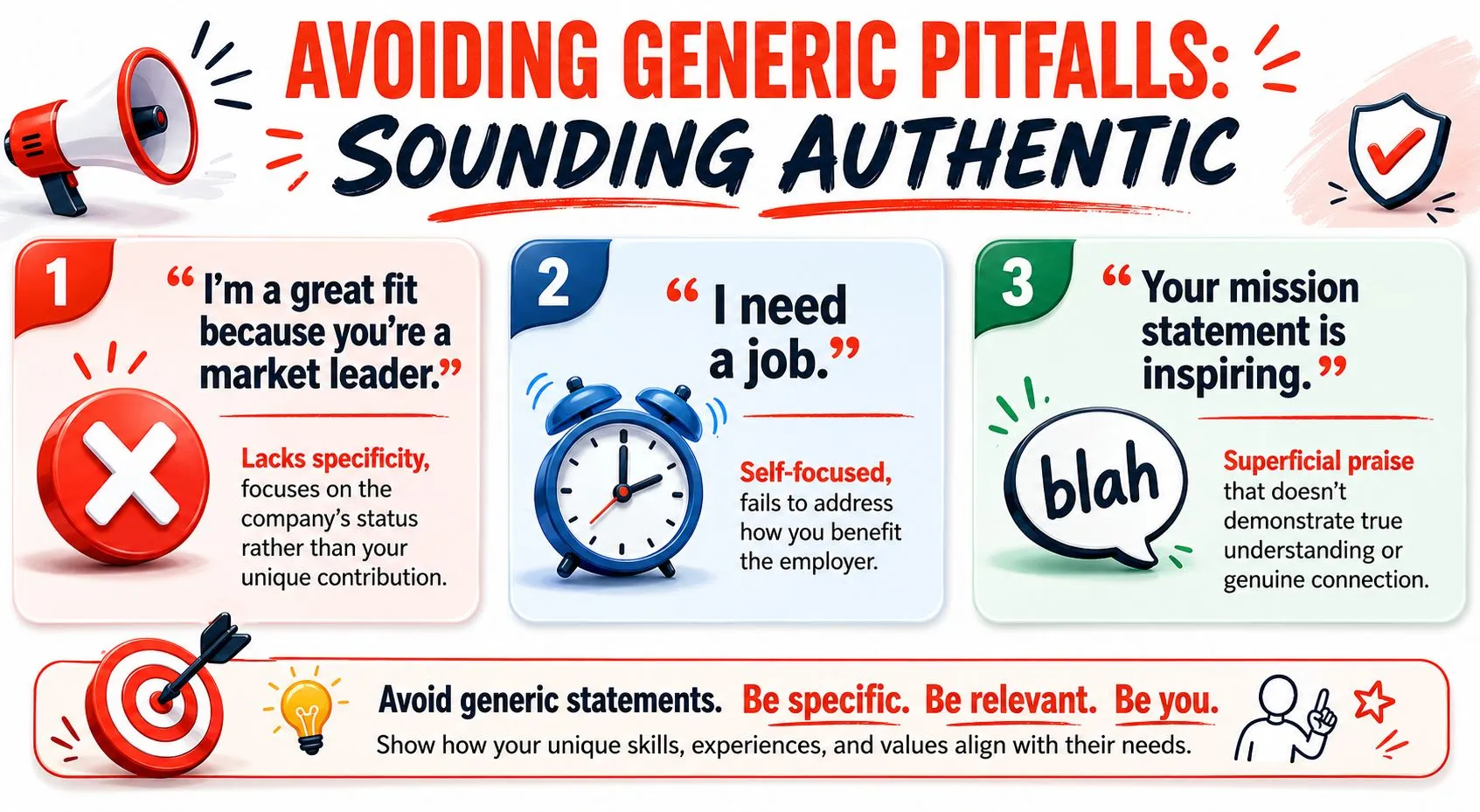
“I really admire your mission.”
“Your company is a leader in the space.”
“This feels like a great next step for me.”
None of that is wrong. It's just useless.
If you're a mid-career professional, you can't afford a filler answer. You need a sharp one. Not memorized. Not fake. Just clear. The kind of answer that shows you understand the company, understand the role, and understand where your work fits.
Why Most Answers to This Question Fail
Most answers fail because they confuse interest with praise.
Hiring managers don't ask this question because they want compliments. They ask it because they want evidence. In a 2022 Harvard Business Review article on answering why you want to work here, career experts note that interviewers want to hear whether you're interested in the company's product, service, mission, or brand, and not just looking for any job.
That's the bar.
The bad answer everyone gives
Here's the version that sounds polished and lands flat:
“I'm passionate about your mission, and I'd love to join such an innovative company.”
What does that tell them?
Almost nothing. It doesn't show you know what they're building. It doesn't show you've thought about the role. It definitely doesn't show how you'd help.
The interviewer hears: “I found a sentence that could apply to 50 companies.”
What they're actually trying to learn
They want to know three things:
- Did you do the work to understand what this company cares about?
- Do you understand the role, not just the brand?
- Can you connect your background to something useful here?
That's why generic enthusiasm backfires. It sounds lazy, even when you're trying to sound eager.
Practical rule: If your answer could be copied into an application for a different employer with only the company name swapped out, it's a weak answer.
A lot of smart people fail here because they treat this question like a personality prompt. It isn't. It's a relevance prompt.
Your answer should feel more like an argument than a slogan.
If you struggle to turn your experience into something sharper, start by fixing the broader way you present yourself. This guide on how to stand out in job applications gets at the same problem from the application side.
A Framework for Authentic Answers
You don't need a script. You need a structure.
Use C.A.I.:
- Context
- Alignment
- Impact
That's it. Clean. Repeatable. Human.
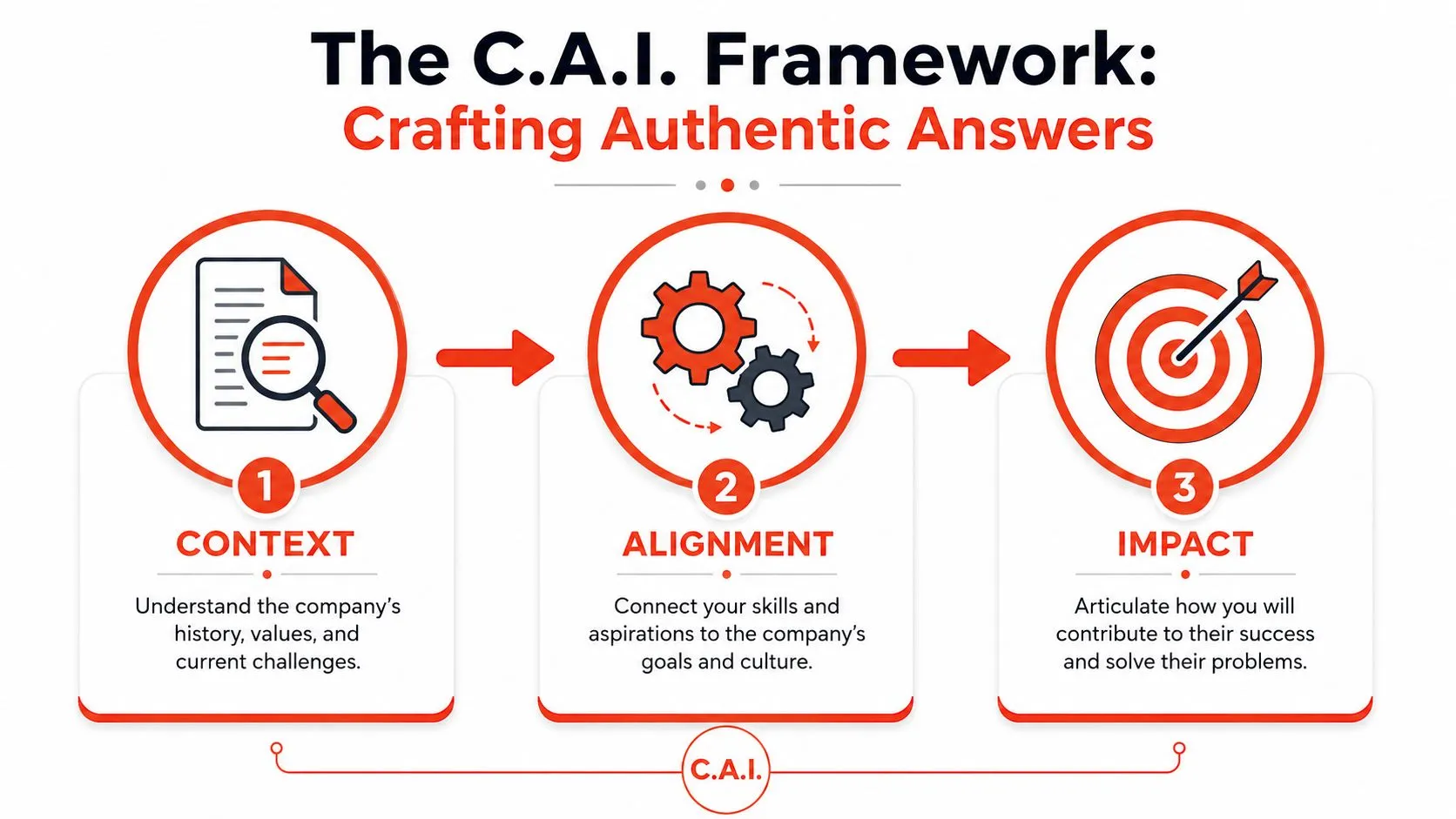
A strong answer follows the same logic highlighted in Field Engineer's interview guidance: identify a concrete company priority, connect it to a specific skill or achievement, then show the impact you expect to make.
Context
Start with something real about the company.
Not “you have a great culture.” Not “you're growing fast.” Those are empty calories.
Pick one concrete thing:
- a product shift
- a market move
- a customer problem
- a hiring pattern
- a strategic message from leadership
- a recurring theme in the job description
Good context sounds like this:
- “I noticed your team is expanding self-serve capabilities for mid-market customers.”
- “Your product messaging keeps stressing implementation speed and cross-functional adoption.”
- “The role seems to sit right at the point where operations discipline meets customer experience.”
That tells them you looked past the logo.
Alignment
Now connect that context to your actual work.
Specificity is crucial at this juncture. Don't. Name the kind of problem you've handled. Name the environment. Name the capability.
If you've never thought thoroughly about values and career fit, resources on core values and career direction from Life Purpose App can help you sort out what truly matters to you before you try to say it out loud in an interview.
Use lines like:
- “In my current role, I've worked on the same kind of handoff problem between product, support, and operations.”
- “I've spent the last few years translating messy stakeholder input into launch decisions.”
- “A big part of my background has been building process where speed matters, but so does accuracy.”
This is also where broader employer value proposition strategies become useful. Not because you need marketing jargon, but because they reveal what companies think makes them worth joining. That gives you language to respond to what they care about, instead of making up your own story in a vacuum.
Impact
Then finish forward.
Don't stop at “that's why I'm excited.” Tell them what your presence would change.
A strong answer doesn't end with admiration. It ends with contribution.
Examples:
- “That's why the role stands out to me. I can see a clear path to helping the team tighten delivery and reduce friction across functions.”
- “I'd be excited to bring that experience here because the work seems to require someone who can bring structure without slowing people down.”
- “I'm interested because I don't just understand the space. I know how to help teams make progress in it.”
Short formula:
| Part | What to say | What to avoid |
|---|---|---|
| Context | One specific company priority | Generic praise |
| Alignment | Your relevant experience | Broad claims about being a fit |
| Impact | What you can help them do | Ending on enthusiasm alone |
How to Research Like You Mean It
Most candidates “research” by reading the About page and memorizing two adjectives.
That's not research. That's skimming.
The baseline advice is sound. Indeed's interview guidance recommends reviewing the company's About page, mission statement, press releases, and social media, then tying your skills to what the company is trying to achieve. Fine. Start there. Then keep going.

Where the useful signal actually is
Look in places where the company reveals priorities, tension, or friction.
- Press releases tell you what the company wants the market to notice.
- Product pages show how they frame customer pain.
- Job descriptions across teams reveal what they're trying to build repeatedly.
- Reviews on G2 or Capterra expose customer complaints and praise in plain language.
- Executive interviews or podcast appearances show how leadership thinks.
- Posts from future teammates often reveal process, tooling, or current headaches.
What to pull from your research
Don't collect trivia. Pull material you can use in a sentence.
Build notes under three buckets:
- What they care about
- What seems hard right now
- Where your experience overlaps
For example:
| What you found | What it might mean | How to use it |
|---|---|---|
| Recent press release about expansion | New complexity, new coordination demands | “Expansion usually creates execution strain. That part interests me.” |
| Repeated mention of customer adoption | Product value depends on behavior change | “A lot of my work has been helping teams improve adoption after launch.” |
| Reviews mention onboarding confusion | Customer experience gap | “I'm interested in roles where operational clarity affects customer retention.” |
Don't research to sound informed. Research to form a point of view.
A smart follow-up habit is to prepare your own interview questions from what you found. This list of questions to ask from an interviewer helps you turn research into an actual conversation instead of a rehearsed monologue.
Real Examples for Different Roles
Theory is cheap. Here's what this looks like in practice.
A quick video can also help you hear the difference between canned and convincing answers.
For technical roles, the bar is even higher. Indeed's guidance for technical interview answers says strong responses should show technical knowledge, problem solving, and hands-on experience, ideally structured with concrete examples.
Software engineer
Weak answer
I'm interested because your company is doing exciting work in tech, and I'd love to be part of a cutting-edge engineering team.
This says nothing.
Stronger answer
“I'm interested in this role because your team is clearly working through platform scale and reliability challenges, and that's work I enjoy. In my current role, I've spent a lot of time improving backend workflows, debugging production issues, and working with product partners to make technical tradeoffs visible early. What stands out here is that the job isn't just about writing code. It's about helping the team ship dependable systems, and that's where I do my best work.”
Why it works:
- Context: platform scale and reliability
- Alignment: backend workflows, debugging, product collaboration
- Impact: shipping dependable systems
Product manager
Weak answer
“I'm interested in working with you because I'm passionate about product and your company has a strong reputation.”
That's wallpaper.
Stronger answer
“I'm interested because this role seems close to real user behavior, not just roadmap administration. From the way the team talks about adoption and cross-functional execution, it looks like you need someone who can take messy feedback, identify what matters, and help engineering and go-to-market teams move in the same direction. That's been a big part of my work. I've enjoyed being the person who turns scattered input into clear priorities and launches that make sense for the business.”
Why it works:
- It names the work, not the brand
- It shows understanding of the role's pressure points
- It frames the candidate as useful immediately
Career changer
Weak answer
“I'm looking to pivot into this industry because I'm ready for a new challenge.”
No one hires “ready for a new challenge.”
Stronger answer
“I'm interested in this role because the core work is familiar, even though the industry is new to me. My background has been in operations, where I've had to manage competing priorities, improve process clarity, and keep stakeholders aligned when the details are changing fast. What attracts me here is the chance to apply that discipline in a new context where the business is still solving practical execution problems. I'm not trying to sell a dramatic reinvention story. I'm bringing transferable judgment to a team that needs it.”
That answer is grounded. No fake romance. No overexplaining.
The best answer usually sounds like a capable adult describing work they understand, not a fan auditioning for access.
Common Pitfalls That Make You Sound Generic
You can have good intentions and still sound like every other candidate in the stack.
That's the danger. Generic answers don't usually sound bad. They sound acceptable. Acceptable gets ignored.
A lot of employers now care more about skill transfer than pedigree. In a 2024 LinkedIn report cited by Harvard Kennedy School, 75% of recruiters said they're more likely to hire candidates with non-traditional backgrounds when those candidates clearly explain transferable skills and motivation. That means vague praise is even less useful than it used to be.
Four phrases to stop using
-
“I'm looking for a new challenge.”
The interviewer hears: “I'm bored, and this answer is about me.”
Better: tie your interest to a specific kind of problem you want to solve. -
“Your company has a great culture.”
The interviewer hears: “I read your careers page.”
Better: mention what kind of team environment helps you do strong work and why this role appears to match it. -
“This is the perfect next step in my career.”
The interviewer hears: “I want upward movement.”
Better: explain why this role's scope matches the work you're ready to own. -
“I've always admired your mission.”
The interviewer hears: “I have no proof.”
Better: point to one visible company priority and connect it to your background.
A simple self-edit test
Run your answer through this filter.
| If your answer says... | Replace it with... |
|---|---|
| admiration | evidence |
| excitement | relevance |
| ambition | contribution |
| fit | proof |
If you need help turning fuzzy career stories into usable proof points, this piece on how to talk about your work is worth reading.
Make the Answer Your Own
The point isn't to memorize a paragraph and perform it on cue.
The point is to think clearly enough that you can answer like yourself. Calmly. Specifically. Without hiding behind corporate filler.
That's why your resume matters here too. A good answer to “Why are you interested in employment with us?” usually comes from the same raw material as a good resume: real projects, real constraints, real outcomes. If you need help extracting that material, StoryCV is one option. It uses a guided interview approach to turn your work into clearer narratives, which can make both resume writing and interview prep less painful.
Presentation still matters, of course. If you're cleaning up your application package, a polished photo from an AI headshot generator can help with consistency across your professional profiles. Just don't confuse polish with substance. A better headshot won't save a generic answer.
What works is simpler than people think. Know what they care about. Know what you've done. Connect the two without fluff.
If your experience is strong but your wording keeps coming out flat, StoryCV helps you turn messy career history into a clear, specific narrative you can use in resumes, applications, and interviews.